
The dust had hardly settled from South Sudan’s Independence Day celebrations before the National Bureau of Statistics (NBS) of South Sudan formerly known as the Southern Sudan Center for Census, Statistics and Evaluation, released the new country’s first estimate of GDP. The long-awaited figures were revealed at a well-attended press conference at the NBS on 16 August 2011. Unfortunately, I wasn’t able to attend the event, but I had the pleasure of spending a couple of days in late July in the company of NBS’ Director of Economic Statistics, David Chan Thiang, and his small team of dedicated economists and statisticians.
It was a very positive experience. Despite obvious adversities in terms of staff and infrastructure, NBS has managed to publish a variety of high-quality statistical products since 2005 - primarily within demographic and social domains.
NBS seems particularly adept at dissemination and communication with a knack for writing clear and concise reports and making use of their well-structured website as the main dissemination tool: http://ssnbs.org/.
However, estimating GDP is very different from counting people, bed nets and toilets or recording health and education characteristics. It’s a difficult task to accurately estimate the production, consumption and investments of the myriad households, corporations and government institutions – especially given the scarce data available. In a poor-data environment, assumptions and guesstimates are needed to fill in the blanks, and national accountants have to be inventive and creative. It requires a lot of experience to do that well, and that’s when statistics become less of a science and more of an art.
The fact that NBS managed to pull off this feat is truly remarkable.The anticipation and attention to the release of the estimate added to the pressure on NBS.
Gross National Income (GNI)1 is used to determine the official income status of countries, and this determines potential access to concessional borrowing from international lenders such as the World Bank and IMF. The World Bank International Development Assistance (IDA) ceiling is currently a GNI of US$1,165 per capita.
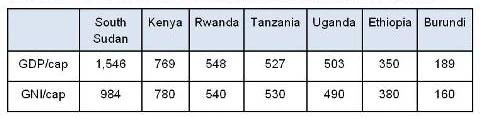
So what was the verdict? It turns out that in terms of overall income generation; South Sudan does quite well compared to its neighbors in East Africa.GDP per capita in 2010 was estimated at US$1,546 compared to US$769 in Kenya and just US$189 in Burundi. As a result of the oil revenue sharing deal with the North, gross national income (GNI) is much lower GNI at US$984 per capita. But this is still significantly higher than any country in East Africa:
Table: GDP and GNI of East African Countries in 2010, million USD, current
source: GDP Press Release, South Sudan NBS, 11 August 2011
People visiting South Sudan may find these numbers surprising. As your airplane descends towards Juba Airport, you see grassland stretching endlessly, deserted in every direction. Compared to the bustling, congested streets of Nairobi, Kampala and Dar es Salaam, Juba seems quiet and provincial. The city has few paved roads and is almost devoid of multi-storey buildings. Poverty is rife, and the vast majority of the population still lives in rural areas in the traditional, thatched-roof houses with scant access to safe drinking water and sanitation. Mortality rates and illiteracy is high and basic services are largely inaccessible. It seems odd that this should be the richest country in East Africa in per capita terms.
However, to those familiar with South Sudan, the GDP numbers will be confirmation that the country is rich in oil and natural resources, but has yet to transform the abundant natural endowments into infrastructure and improved livelihoods.
Export of oil amounts to 71 percent of GDP, and oil revenue accounts for almost 98 percent of total Government revenue. Income inequality is high (Gini coeffient is 46)2, which may explain some of the mismatch, but more importantly, coming out of civil war and strife, the Government of South Sudan still spends around one third of the budget on “security and rule of law”3.
In terms of statistics, despite the initial success stories, a lot of challenges remain. South Sudan authorities are still disputing the population numbers from the 2008 Population and Housing Census, claiming that some areas in the south were not adequately covered. Some experts estimate that the official population of South Sudan of 8.3 million is probably closer to 9 million people. The Government has expressed plans to conduct a new Population and Housing Census within the next 5 years.
The first GDP estimate has been released, but economic statistics is still in its infancy in South Sudan. The new GDP figures were compiled using expenditure information, i.e. survey data on household consumption, government expenditure records, capital investment information, in addition to data on exports and imports. A stronger estimate could be constructed by estimating GDP from the production side, i.e. by collecting and aggregating the actual production volumes, values and costs of producers within agriculture, manufacturing, mining and quarrying and other important industries in the economy. The more information, the more robust the estimate, especially if the production and expenditure sides could be reconciled in a comprehensive and coherent supply-use table framework.
While the construction of a supply-use table is a medium to long-term objective for the NBS, the collection of industry data has already started. NBS has established a business register and the results of the first business survey are due shortly. The NBS is also in the planning phase of the first agricultural survey. Statistics Norway is supporting the initiative through financial and technical assistance, and the IMF has established a trust fund to support economic statistics.
The World Bank will soon be joining ranks with other donors supporting statistics in South Sudan. So far a US$424,000 grant from the Trust Fund for Statistical Capacity Building has been approved to support priority activities in the coming years. This includes training and study visits on economic statistics and technical assistance on designing the National Strategy for Development of Statistics (NSDS).
-------------------
1. GNI is defined as GDP less net payments to the rest of the world
2. National Baseline Household Survey 2010, SSCCSE
3. Key Indicators for Southern Sudan, SSCCSE, 8 February 2011

Join the Conversation