
Why do Kenyans want to live in cities?
Every day, Kenya’s capital Nairobi is facing endless traffic jams. Our colleagues spend hours every day to commute to and from work. One Kenyan colleague escapes traffic by leaving home at 4.30am, others by leaving the office as late as 9pm. Given this congestion, escalating costs of living and high crime, why are Kenyans moving into cities more rapidly than ever – more 250,000 every year?
Our fourth Kenya Economic Update titled ”Turning the Tide in Turbulent Times” argues that East Africa’s largest economy can benefit from demographic change and rapid urbanization, despite the pains it entails.
First, like the rest of Africa, Kenya is still predominantly rural but urbanizing rapidly. Today, 30 percent of Kenyans live in cities. From now on, most of Kenya’s population growth will be urban. While total population will double by 2045, the urban population will more than quadruple (see figure 1). By 2033 the country will reach a “spatial tipping point”, when half of Kenya will be residing in the urban areas.
Figure 1 – From now on, most of Kenya’s population growth will be urban
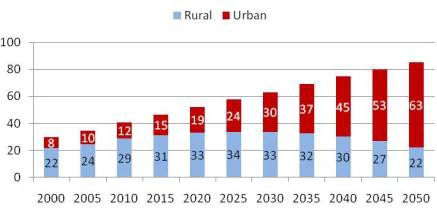
Second, population growth and urbanization go together. Today, Kenya has 40 million people, and adding more than one million each year. By 2030, there will be 63 million Kenyans and the country will also have the opportunity to reap a “demographic dividend”. With more people in the same space, there will be more cities and bigger cities: Kenyan cities of 100,000 people and above will grow from 21 today to 37 in 2020.
Third, urbanization and growth go together. As the World Development Report 2009 demonstrates convincingly, no country has ever reached high income with low urbanization. Kenya’s cities are already powering the country’s economy. Nairobi and Mombasa are home to 10 percent of the population but represent 40 percent of the country’s wage earnings. If cities thrive, the overall economy will benefit. But cities will only become true growth poles if Kenya continues to upgrade infrastructure within and between urban centers.
Fourth, Kenya needs a coastal hub. Given the high transport costs within East Africa, only a coastal hub, i.e. Mombasa, would be in a position to become a manufacturing center for global products. Rising wages in Asia will provide incentives for manufacturing companies to locate to Africa. Mombasa could be an attractive destination, but it will only live up to its potential if it manages to tackle inefficiencies in the port, a dilapidated urban infrastructure, and the opaque system of land titling.
Fifth, cities need to grow and thrive. Kenya’s new constitution prepared the ground for substantial devolution of power to 47 counties, which provides opportunities for better accountability and local service delivery. However, despite rapid urbanization, 42 out of the 47 Kenya’s new counties will be predominantly rural. At the same time, there is a risk that Kenya’s medium-sized cities with 100,000 to 400,000 people, will not receive the autonomy and resources they need. Kenya needs a separate urban tier to help manage rapid urbanization successfully.
So why are people moving to cities in Kenya and elsewhere in the world? As former U.S. President Bill Clinton’s campaign said, “It’s the economy, stupid!“



Comments
Why do Kenyans want to live in cities
The simple answer is:
Because there are no services in the villages. All these so called development organizations don't seem to get it. Most projects they do, do not have supportive infrastructure and services for sustainability. Take for example the focus on basic education almost all the development agencies and mainly driven by world bank policies. They support teacher education, classroom materials, literacy, numeracy, etc but there is no library withing a 50 mile radius of the schools? How do teach literacy when the students can't get supplementary reading materials to reinforce what they do in class? If they had libraries, they would stay in the villages and transform them, William Kamkwamba style.
http://www.ted.com/talks/lang/eng/william_kamkwamba_how_i_harnessed_the_wind.html
Libraries or jobs?
Dear Tungisa,
Thank you for your thoughts. I am also inspired by William Kamkwamba's story and would also argue that rural areas need better services (incl. education) to advance a country. However, I would still be surprised if rural-urban migration would be stopped because most jobs will still be in urban areas. If you look at the rich countries, including my home country Germany, most urbanization rates are 80% or higher, even thought services in rural areas are very good.
Wolfgang
Finally !!
At long last, a Bank economist who has seen the light and isn't afraid to say it out loud!! welcome.
With Urbanization and Population Growth Come New Challenges
The trends highlighted here are true not just for Kenya but for many other developing countries. Urbanization can deliver high incomes and potential demographic dividends. But we must not downplay the price that Kenya and other developing countries will inevitably pay along the way. And, hopefully, this report gives a balanced view of both sides of the coin.Increasing urbanization also carries social-political pressures, with a much increased short and medium-term potential for greater instability. Urban societies don't have the informal social nets that their rural counterparts enjoy. The youth who are migrating to the city will need jobs, food, shelter etc... I am afraid Kenya and many countries are simply not geared yet to respond with the speed, coherence and foresight to keep up. The pain is coming. It will be worth it in the long term if the government appreciates both the opportunities and the challenges of increasing urbanization, and then takes the right steps. We as development partners and, moreso, our client countries have huge challenges to confront.
Challenge and opportunity
Dear colleague,
I agree with your analysis and would highlight three points:
1. Rapid population growth and urbanization will happen. It is good to prepare for this certainty and adjust public services and economic policies accordingly.
2. These changes will provide ample opportunities and a number of challenges for development. I am not convinced about the "lack of jobs" argument yet because it argues from a static perspective. Globally, countries with more people (and higher density) actually don’t necessarily have higher unemployment. Otherwise Germany or Japan would be doomed but these two countries seem to face the opposite problem: a rapidly shrinking working population.
3. Indeed, a more urban and better educated population will put more pressure on the (government) system. Poorly functioning governments will be in greater trouble: see what is happening in the Middle East.
Wolfgang
what at the incentives at the individual level?
Thank you for the piece. Having grown up in Nairobi, I have witnessed the growing congestion, escalating costs of living and high crime. It use to take 10 mins to drive from Sarit Centre to home during lunch time. Now 30 mins. My favorite resturants are charging much more for the same meal and some cases with lower quality food. And the number of carjacking stories go up each time I return for vacation.
While the above five reasons explain what is happening at the Macro level. I don't get the incentives at the micro-level.
Are rural Kenyans really finding better jobs/higher pay in the city?
And is their lifestyle really better given congested matatu rides, high crime and escalating costs?
And who are these new comers? (families, male, females?)
thanks,
Raj
Re: Incentives at the individual level
Dear Raj,
Many thanks for your thoughtful comments. In our report we have two case studies of individuals who came to Nairobi mainly because their lives in rural Kenya were miserable. If though these individuals (and their families) are still struggling, they at least have some degree of steady income. Nairobi and Mombasa have only 10% of Kenya's population but provide 40% of the country's wage income.
Here is an excerpt of the lady we portrayed in the report: Josephine does not think that she’ll ever go back upcountry. “I’ve no home there, nor can I afford to buy one”, she says. She’s also not sure that she would survive even if she got there. “It would be very difficult to find the supplies I need for my business there”, she explains, “and since people do not work there, where would I find customers with the money to buy my wares?”
We argue that one of the main challenges for Kenya is manage the cities better. Thisn entails better urban services and connect the cities better to other cities and the rural areas, i.e. to address the challenges you are highlighting (but not turning the clock backwards and trying to stop urbanization because it will happen in any case).
Wolfgang
re:
Dear Wolfgang,
Thank you for your reply. It helps me understand the issue better. A question in regards to your last comment about "not turning the clock backwards and trying to stop urbanization because it will happen in any case."
Are there any studies done that show where exactly rural Kenyans are migrating out of and if there is a correlation between level of government (IOs, NGOs, private etc) investments in that area and migration out of that area?
For instance is the migration out of Sauri MVs less than the migration out of say a neighboring village with fewer essential services and business opportunities?
RR
Good question. But, as a
Good question. But, as a Kenyan who moved from rural Kenya to Nairobi, I suspect that the more interesting development question is "why do Kenyans not want to live in rural Kenya"? I can attest that, particularly for the unemployed youth, urban poverty and life is much more depraving than the lives they lived in their "villages". And yet they keep coming to the cities!
Extreme urban poverty vs. the very "cushy" lives of the urban elite has provided the fodder of an "army" for the low scale warfare (called car-jackings, robberies, police shooting of criminals, etc)that's ongoing. So, it's way beyond numbers and graphs.. It's a real ticking time bomb.
So, what kinds of programs have others, (e.g., in much of Latin America) put in place that may have mitigated the worst implications of this problem? Can we learn from them?
WHY KENYANS WANT TO LIVE IN CITIES
This is the simplest question yet the most difficult one when it comes to solving. I think this is true about most developing economies and not peculiar to Kenya. Having said this, I have noted that the development system that has been put in place be these countries is a major source of this migration system. e.g When a student leaves the village to go to school in an urban center, s/he once is done with school has nothing to motivate him/her to go back and serve in the rural area.That is to say, there is no or very limited opportunity for such students back in the rural areas.
If we could ensure the rural areas are empowered with entrepreneurial skills so as to enable them establish meaningful businesses in the rural areas, we will not only be fighting the issue of rural urban migration but we will also be improving the overall economic contribution of these rural areas to the nations GDP.
Urbanisation in Kenya
Interestingly, the Kenya Goverment has also seen the light and has initiated a National Urban Policy, which hopefully will be approved by parliament this year. No predominantly rural country has managed to escape poverty, and economies of scale do not permit large infrastructure projects in rural areas. This is a fact that has eluded our rural-focused project implementors.
rural-urban demographic paradigm
Perhaps now with ICT4D information, money goods might move around more but people less? could this overturn economic density advantage of urbanization?
I think it well could. if only 20 % of what is spent on physical highways is spent on information ones (including ICT literacy), the rural-urban demographic paradigm would certainly change.
Post new comment