
 Photo: Wesley Poon/Shutterstock
Industrialization drives the sustained growth in jobs and productivity that marks the developmental take-off of most developed economies and industrialization remains central to structural transformation in Africa, yet Africa’s experience has been uneven and incomplete. Our Industrialization in Sub-Saharan Africa: Seizing Opportunities in Global Value Chains, published in 2021 as part of the WBG-AFD Africa Development Forum series, challenged the prevailing pessimism about Africa’s manufacturing prospects. We found no strong evidence of premature deindustrialization, a decline in manufacturing at unusually low levels of income. Instead, Africa has experienced false starts and partial peaks - episodes of manufacturing expansion that failed to evolve into sustained growth. Industrialization has not reversed, but neither has it taken firm root as a driver of long-term growth. Too few firms have progressed beyond low-complexity assembly into higher-value production that raises incomes and exports.
When we look at the numbers, they underscore progress and constraint. In Sub-Saharan Africa (SSA), employment in manufacturing has roughly tripled since 2000 from 6 million in 2000 to 20 million in 2018, raising the employment share in manufacturing from 7.2% to 8.4%. Yet the sector’s contribution to GDP has stagnated with slight decline from 12.1% to 11.5%. The challenge is not premature decline but incomplete transformation, industrialization that begins but fails to mature into cumulative and sustained employment and productivity growth.
Figure 1: Relative sectoral labor productivity and employment shares in select African countries, 2018.
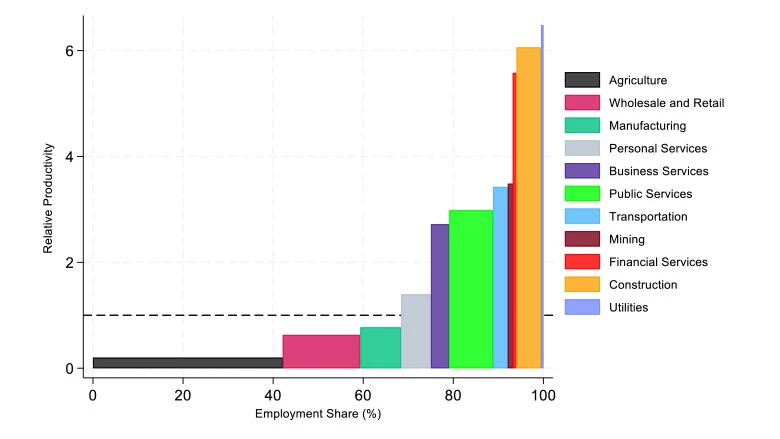
Note: Figure 1 displays the relative labor productivity of sectors on the vertical axis and employment share on the horizontal axis of 21 African countries. Adapted from McMillan et al. 2024
Behind this paradox lies a dual structure. Job creation is concentrated in small, low- productivity firms, while a few large, capital-intensive producers account for most value-added but employ few workers. Most new jobs emerge in young domestic firms, vital for employment but constrained by low capital intensity, weak technology absorption, and limited finance. Large, often foreign-owned exporters dominate production and productivity yet remain weakly linked to local supply chains.
Jobs are created when value is added
Through our research we find that countries that integrate more deeply into global and regional value chains record faster growth in productivity and employment. Moving from the lower to upper quartile of participation raises manufacturing productivity by about 2–3 percentage points, especially through backward linkages that improve input quality and diffuse know-how. Each step up the chain from cotton to fabric, cocoa to chocolate, lithium to batteries multiplies employment by shifting labor into more complex, skill-intensive activities.
Firm-level evidence confirms this pattern. Small and medium enterprises linked to lead firms through supplier networks, joint ventures, or industrial parks achieve higher productivity, pay better wages, and survive longer. In Ethiopia’s industrial zones, exporters’ productivity is several times higher than that of non-exporters; similar results appear in Côte d’Ivoire’s agro-processing and Kenya’s apparel clusters.
Despite these gains, we see that competitiveness in wages has not translated into competitiveness in value. Policy priority is not cheaper labor but more productive labor. Industrial policy must evolve from attracting investment toward cultivating ecosystems of skills, infrastructure, finance, and technology that enable firms to move up the value ladder. Policy must emphasize technology adoption, managerial capability, and continuous firm learning. Value-added manufacturing scales with learning, links agriculture, services, and extractives into productive ecosystems, and strengthens resilience.
Governments can act on three fronts.
- First, support small firms through technology extension, certification, and finance to enhance productivity and product quality.
- Second, help large firms add jobs by deepening local supplier linkages and creating skills ecosystems around industrial clusters and parks.
- Third, promote learning by exporting through trade facilitation, standards harmonization, and performance-based incentives that reward innovation and upgrading.
Policy priorities: Compete, connect, and create value (C3)
Global production is being reorganized around resilience, regionalization, sustainability, and technology. These shifts widen Africa’s opportunity but demand a new industrial strategy, and we think it should be one that competes on productivity and learning, and connects national industries into regional and global value networks and creates value.
Compete. Competitiveness must rest on firm-level productivity. Reforms should reduce logistics and energy costs, stabilize macroeconomic policy, and eliminate distortions such as overvalued exchange rates, monopolized infrastructure, and opaque regulations that weaken competitiveness. Fiscal resources should move from broad incentives toward targeted investments in industrial utilities, energy reliability, and quality infrastructure that directly lowers production costs.
Connect. Regional integration is the foundation of industrial scale. Implementing the regional agreements including the African Continental Free Trade Area (AfCFTA) and harmonizing customs, transit, and standards can transform fragmented markets into regional production systems. Industrial policy must therefore operate simultaneously at national and regional levels, synchronizing transport, energy, and digital corridors to reduce effective distance between firms. Regional value chains in copper and cobalt linking the Zambia–DRC battery corridor or textiles and agro-processing in West Africa’s food-processing networks illustrate how integration internalizes scale economies and diversifies exports.
Create Value. Industrial policy should target learning and upgrading, not protection. Support must be conditional, performance-based, and time-bound tied to export success, technology transfer, supplier development and value addition. Success of industrial policy depends on institutions that reward technological upgrading and export-oriented competition. The new competition is for value. Countries that combine low-carbon energy, regional scale, and credible institutions will capture the next wave of global industrial investment. The next phase of policy must emphasize converting factories into learning systems, connecting suppliers to lead firms, and capturing more value at home.
The window for low-wage, labor-intensive exports is narrowing as automation advances, but new opportunities in green, digital and technology-intensive manufacturing are widening. In Ethiopia, TOYO Japan is expanding its solar-cell manufacturing plant to supply its U.S. operations, evidence that Africa can host segments of global green value chains. In South Africa, Volkswagen and BMW are expanding production lines for electric vehicles to serve both regional and European markets, demonstrating that value creation, not just assembly can occur within Africa’s borders. With competitive markets, connected infrastructure, and capable institutions, Africa can become a hub for value-added, job-rich, climate-smart manufacturing.
Industrialization still matters but only when it adds value. Africa’s story is not one of failure but of unfinished transformation. The next chapter must build the productive foundations for jobs that are formal, skilled, and resilient. The future of Africa’s employment lies in value-added manufacturing, from cocoa to chocolate, lithium to batteries, cotton to fabric, and data to digital services.
This blog is part of a commemorative series marking 15 years of the Africa Development Forum book series co-published by the World Bank and the Agence Francaise de Developpement


Join the Conversation