
 Evidence from four countries shows that economic inclusion programs help people overcome barriers to earning, investing, and growing. | © Shutterstock.com
Protecting people from poverty has long been one of the fundamental goals of social protection. Cash transfers help people eat, keep children in school, weather shocks, and avoid selling the few assets they own. This matters enormously. But can social protection also help people get ahead — not just get by?
The development community has been working on this question for years. Microfinance, training, cash-for-work, community grants— the list of interventions tried is long, but results have not always been long-lasting. Over time, this led to growing interest in economic inclusion programs, which combine multiple interventions to address the constraints that can keep people trapped in poverty. When programs got the combination right, the impacts grew and, in many cases, were sustained for many years.
Figure 1. Impacts of Economic Inclusion Programs on Household Income
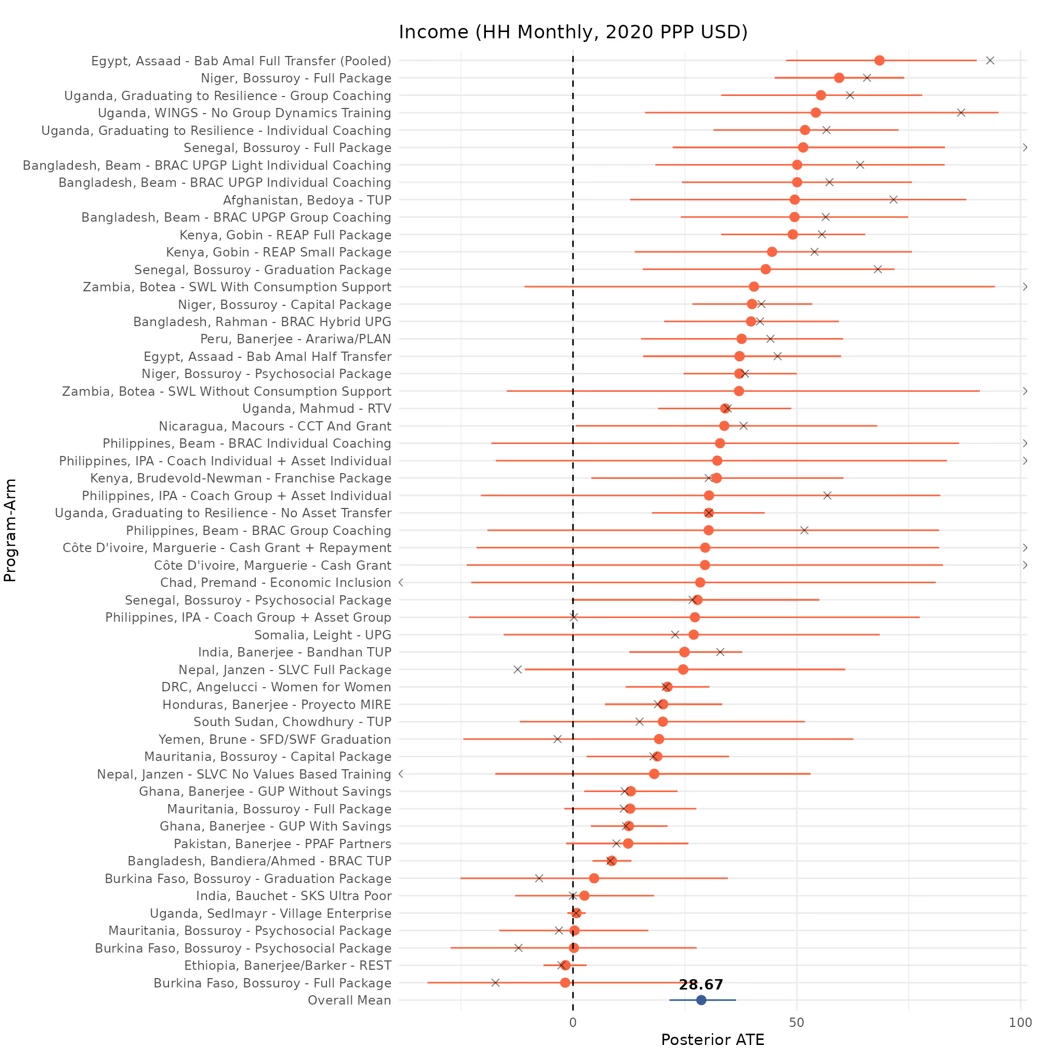 An ongoing meta-analysis, jointly undertaken by the World Bank (DEC Development Impact and PEI) and technical partners (Northwestern University and the Livelihood Impact Fund) show positive income gains across programs and contexts.
The question now is how to make these programs work better, cost less, reach more people, and connect participants to markets and private capital to grow their businesses. New evidence from Tanzania, Ethiopia, Malawi, and Cameroon is beginning to provide answers, showing how social protection can move from protecting livelihoods to enabling them. What do we learn from these four countries?
Tanzania: what components make for an effective program?
Tanzania’s Productive Social Safety Net program started with cash and public works, then added training, mentoring, and business capital grants to make households more productive. The results were impressive: relative to cash transfers only, household incomes and assets increased by a third. The gains were driven by business activities and higher productivity, with a $3 dollar return for each dollar invested in the program.
Figure 2. Cost-effectiveness of economic inclusion relative to other interventions
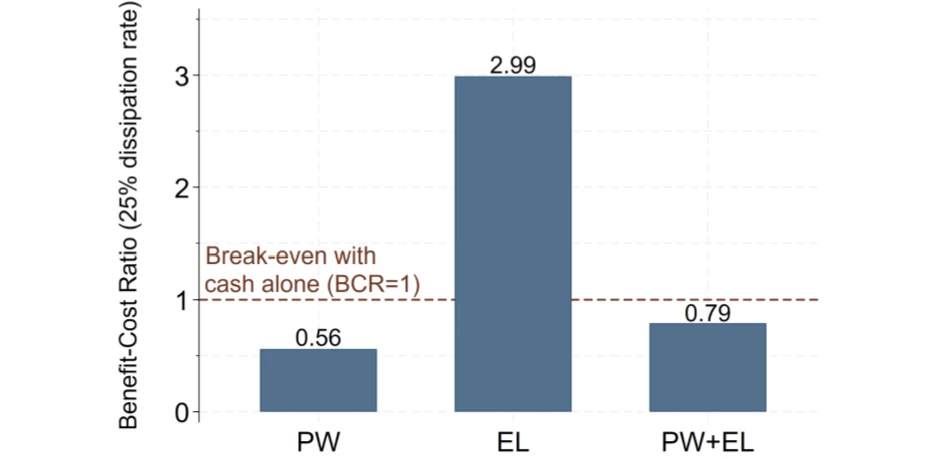 An impact evaluation study of Tanzania’s large-scale Productive Social Safety Net (PSSN-II) found that $1 invested in economic inclusion package (EL=Enhanced Livelihoods; PW=Public Works) layered on cash transfer generated $2.99 in economic return.
One of the most useful findings came from comparing different combinations of support. Households receiving livelihoods interventions did substantially better than those receiving cash alone. But adding public works on top of the livelihoods package did not lead to additional gains in productive outcomes. That distinction matters. Public works can provide temporary employment and consumption support, but that’s different from building a business or a durable source of income. The Tanzania results suggest that governments should start separating these objectives more deliberately: what helps households cope is not necessarily sufficient to help them grow.
Malawi: does delivery modality matter?
Once we know that economic inclusion programs work, another question emerges: how much intensity and individual attention are really necessary? Group-oriented delivery is appealing. It is easier and cheaper to organize households together for training, coaching, savings, or productive activities, allowing programs to reach more people.
Malawi put this to the test. Its Social Support for Resilient Livelihoods Project compared a less intensive, group-based livelihoods model with a more intensive, individual-based approach. Skills training was always delivered in groups, while financial support was provided either to the group - through grants and loans - or to individuals through grants. The difference was large. The more intensive, individualized approach outperformed the less intensive, group-oriented model across food security, consumption, productive assets, business ownership, revenues, and livestock holdings. Households worked more, became more productive, and hired labor to expand their activities.
Groups may be easier to administer. But when the goal is to change a household’s economic trajectory, how much support people receive and how tailored it is matter as much as the delivery channel. The next question is whether the additional gains justify the additional cost. Malawi shows that how programs deliver support can shape the results.
Ethiopia: can credit help economic inclusion programs reach more people?
Economic inclusion programs work because they relax a basic constraint: people cannot invest in productive activities without capital. Historically, programs have solved that problem with grants. But grants are expensive, limiting how many people governments can reach. Ethiopia points toward another possibility. Its Productive Safety Net Program combined income support with training, coaching, and productive capital. It generated gains not only for participating households but also for their neighbors, suggesting that new knowledge and behaviors can spill over into local economies.
Researchers then asked a transformative question: do all households need a grant? For relatively better-positioned participants, credit often generated impacts comparable to, and sometimes larger than grants. It is too early to conclude that credit can broadly replace grants: repayment and longer-term outcomes still matter, and households facing the deepest constraints may continue to require subsidies. But the possibility changes the scale equation.
If programs can identify who needs a grant, who can productively use credit, and who might graduate toward commercial finance, scarce public grants can be directed to those who need them most. That could move economic inclusion beyond a government program and open the door to a broader role for markets and private finance.
Cameroon: a rural anti-poverty model works for urban youth
Perhaps the biggest surprise comes from Cameroon. Economic inclusion programs were largely developed for very poor rural households, often women, with few assets and limited market access. Cameroon asked whether the same approach could work for a different population: youth in urban areas building businesses. It did. Urban youth receiving business capital alongside training and coaching saw large gains in business activity, revenues, profits, assets, and savings. Food security also improved. This widens the potential of economic inclusion programs considerably. A model developed for rural households may also help address a defining challenge facing developing countries: creating productive opportunities for rapidly growing urban youth populations.
Cameroon also produced a second practically useful lesson. The program tested whether business grants should be divided into several payments or transferred upfront. The outcomes were essentially the same - meaning the simpler option worked. Fewer transactions, fewer delays for participants, and lower administrative costs for implementors.
What does this mean for policymakers?
Taken separately, these four experiments answer specific design questions. Together, they tell a bigger story. Social protection was initially about protecting people from hunger and helping families through shocks. The next generation of programs showed that, with the right combination of support, social protection could also help people become more productive.
Now the question is no longer whether economic inclusion programs work, but how to take what we know to scale - which matters increasingly as the World Bank Group works toward its goal of reaching 500 million people with social protection and employment programs by 2030. The evidence from these four countries offers practical guidance: understand who needs what, simplify where possible, and find ways for public support to unlock private capital and markets. The ambition is simple: help people overcome the barriers holding them back so they can earn, invest, grow, and eventually move beyond the need for program support.


Join the Conversation