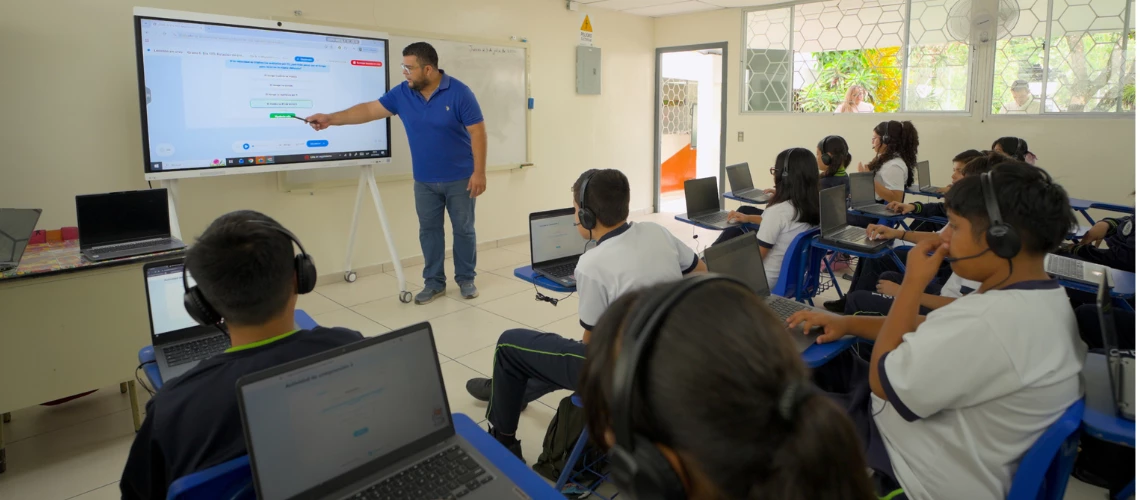
 In the schools participating in El Salvador’s education modernization program, technology is being used to support teaching, learning, and evidence-based decision-making. Photo: Gerson Elizondo / The World Bank.
There is an assumption that runs through education policy: “change in education takes time,” people often say. That assumption comes at a cost: students lose days and years of their lives while the system improves, days and years that can never be recovered. But rapid change is not impossible. El Salvador is an example.
El Salvador faces deep learning gaps. Before the pandemic, around 69% of children were unable to read and understand a simple text by age 10, and UNESCO's primary-school assessment (ERCE) and the OECD's secondary-school assessment (PISA) have confirmed these structural limitations. Behind these results lie challenges accumulated over decades: persistent inequalities, long-standing resource constraints, difficulty attracting and supporting teachers, and a context of violence that affected the functioning of many schools.
But the government of El Salvador is convinced that a better-educated population and a more skilled workforce are essential to drive growth, improve productivity, and raise quality of life. In 2024, the government decided to treat this as a systemwide problem. It launched an ambitious education modernization effort to transform how the sector works and, above all, to improve learning in mathematics and reading in public schools. Rather than pursuing isolated and fragmented interventions, the reform starts from a diagnosis of the main barriers facing the system and of what is needed for every student to learn. The strategy harnesses artificial intelligence and technology as tools to accelerate this transformation and align the different components of the system around a common goal. Recent results from a group of participating schools are striking and encouraging, suggesting that substantial improvements are possible when the entire system is organized around a single purpose: ensuring that every student learns.
El Salvador's education modernization was designed as a gradual process, beginning with a carefully defined pilot in 10 schools. That first stage was a chance to test the approach and refine it against evidence, with improving learning as the constant reference point. In mid-2025 the program expanded to around 200 schools; a year later it operates in nearly 1,000, moving step by step toward almost 5,000 public schools nationwide.
What the data show
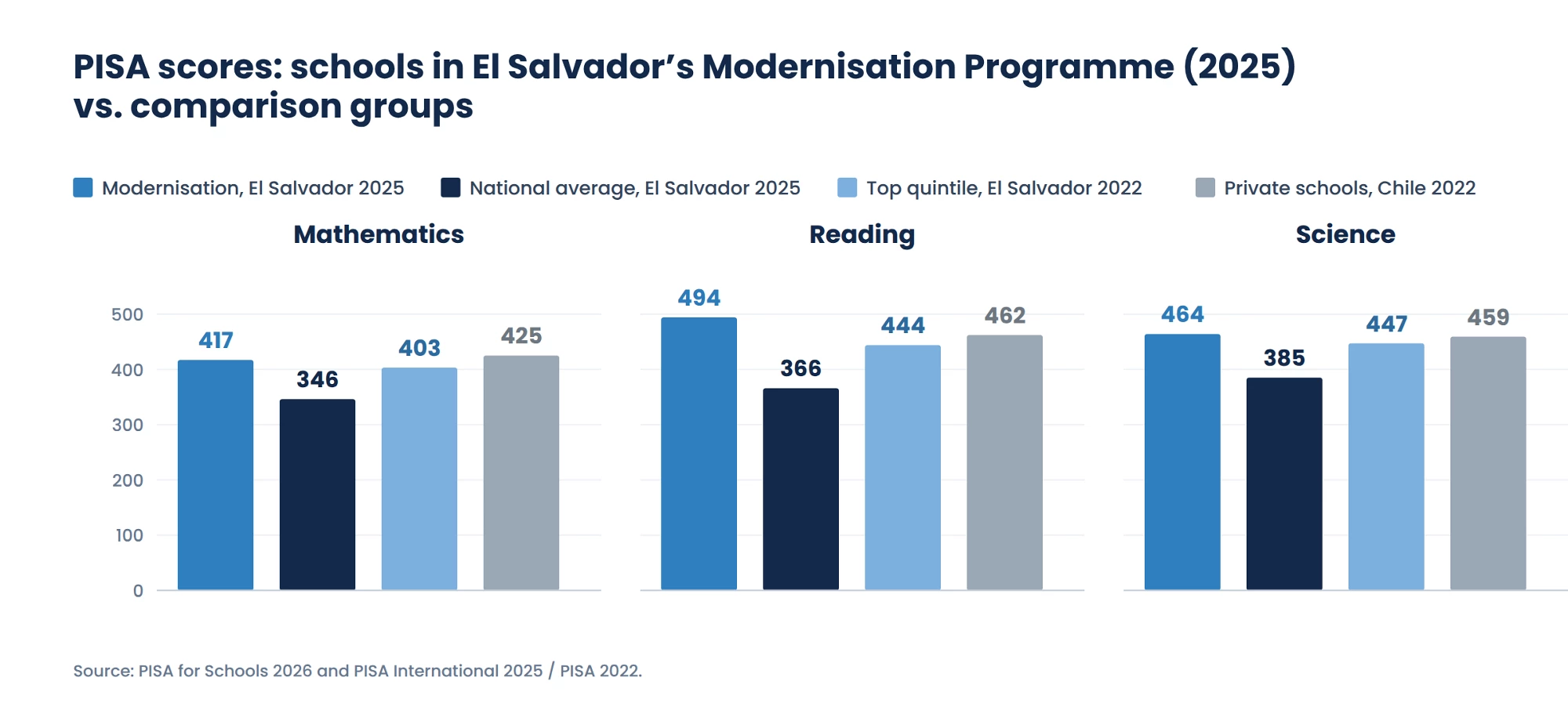
In July 2026, 1,198 volunteer students took PISA for Schools, the assessment the OECD administers to groups of schools in a network or special program. They came from 171 of the 200 schools in the first phase of the rollout, which had been in the program for nearly a year. The results far exceeded the national average: 417 points versus 346 in mathematics, 462 versus 385 in science, and 492 versus 366 in reading. Although the results are not representative of the program as a whole or of the country, the difference is too large to ignore.
What do these scores mean? At 366 points, the national average, a student can understand a relatively short text and interpret ideas literally. At 492 points, the result achieved by schools in the modernization program, a student can independently locate information in more complex texts, interpret it, draw inferences, and connect information from different parts of the text.
The OECD notes that these results are similar to the averages for Sweden and Germany. Even considering that these students took the test voluntarily, and that they are likely among the higher performers in their schools, this is a notable result for public schools in vulnerable settings. In all three subjects, they outperformed El Salvador's highest socioeconomic quintile in PISA 2022 and achieved scores similar to those of private schools in Chile, which along with Uruguay is the region's top performer.
What is El Salvador's education modernization doing that explains these results?
Reforms work when they operate as a system
Many education reforms fail because their components advance in a fragmented way. Technology is handed out, but teachers get no pedagogical support. Students are assessed, but the results never reach the classroom. What is happening in El Salvador is different. In the program's schools, curriculum, materials, teacher support, school leadership, technology, and assessment advance together, with each component reinforcing the others. This coherence is what distinguishes El Salvador's approach and its results. The evidence is encouraging: there is a path forward.
The reform seeks to strengthen foundational skills by implementing a curriculum that prioritizes mathematics and reading. It sets out the essential knowledge and skills each student should acquire in each grade. Teachers have lesson plans and classroom guides that incorporate the latest evidence from the science of learning, and they receive coaching and both in-person and virtual support. This is complemented by a continuous assessment system, with formative and summative tests that feed monitoring dashboards in real time and trigger support for students who fall behind. These components are integrated into digital platforms, creating coherence among the curriculum, materials for teachers and students, teacher training, and the learning outcomes being measured.
These are the elements generally found in successful systems. The common feature, as in El Salvador, is that they are implemented in an integrated way, with learning as the main criterion organizing the system's day-to-day operations rather than a general aspiration. But there are two additional elements here. First, management and implementation capabilities were developed to deliver with fidelity across hundreds of schools, a delivery that must continue to expand. And second, technology made it possible to incorporate these elements in an integrated way and at greater speed.
Technology and artificial intelligence at the service of learning
Almost all the actions described could be carried out without technology. The difference is that, when technology and artificial intelligence are used well, those actions can be carried out more quickly, systematically, and effectively, enabling the system to learn and respond faster. The approach here is to place technology at the service of the reform and of a very specific goal: accelerating and expanding the system's capacity to improve learning.
A distinctive feature of the education modernization program is that artificial intelligence and technology are conceived as cross-cutting enablers rather than as a standalone intervention. This poses a complex challenge, because we do not know the best combination of human capabilities and technology for each task in the education process. Moreover, that combination is neither static nor universal; it depends on the context and changes with the stage of development of the education system and the human, financial, and managerial capabilities and resources available, both systemwide and at each school. What is clear is that none of these combinations seeks to replace teachers. Technology expands what a teacher can do, strengthens their capabilities, and allows them to devote more time and attention to the work that requires their judgment and experience.
Precisely because this challenge is dynamic, El Salvador has not limited itself to introducing technological tools; it is developing the capabilities needed to design, test, and continuously adapt different instruments and processes in line with the system's capabilities, learning from implementation as it goes. This process guides the iteration and evolution of technology: tools are refined according to how teachers and schools use them, and they will continue to evolve as those capabilities grow stronger. It also involves finding the optimal balance between small language models (SLMs) and large language models (LLMs), depending on the specific task at hand (assessment, coaching, and classroom observation). The result is a continuous cycle among system capabilities, technology, and learning outcomes, which progressively accelerates the reform's impact.
In a system that faced attendance challenges among students and teachers, where teachers had little support and there was no systematic, continuous monitoring of learning, technology offers a way to introduce new practices at a pace that would otherwise have taken much longer. Digital learning platforms can tailor experiences to each student's level, monitor attendance, track progress, and identify early on the students who need additional support. They also provide new tools to support teachers, from content generation to stronger learning assessments. At the same time, they generate real-time information that shows where gaps are opening and where the system should concentrate greater effort.
From pilot to system transformation
There is still a long way to go. These results do not yet represent El Salvador's education system as a whole, and enormous challenges remain. El Salvador participates in the PISA assessment every three years. Despite ranking near the bottom, the country has chosen to obtain as much information as possible about its performance, based on the conviction that only data can show how much improvement is needed.
The latest results, collected in November 2025 and released in September 2026, when the Salvadoran education system was at the very start of the modernization, already show a moderate improvement. El Salvador is one of only 12 countries in the world with gains in mathematics, reading and science between 2022 and 2025, and — together with Costa Rica — the only one in Latin America, at a time when scores fell across OECD and middle-income countries alike. Enrollment in El Salvador has also begun to rise as the country has become safer. That alone could have been expected to pull national scores down, since the students who entered the system came from more disadvantaged backgrounds. Even so, national scores did not fall.
The government is expanding the modernization program with the goal of reaching all public schools in the country. This expansion is being supported by World Bank technical assistance and financing. The financial instrument being used is a Program-for-Results, meaning that the country does not receive disbursements to finance inputs such as technology, materials, or training, but rather as results are achieved. This is consistent with a policy focused on the ultimate outcome: learning. In August 2026, the government also announced that it would increase education spending to more than 8% of GDP beginning in 2027, a budget commitment that is almost unprecedented in the region.
These results show that a system, even when starting from very low levels, can improve rapidly if it is conceived as an integrated whole that expands coherently. In the twenty-first century, this means using technology to strengthen existing capabilities and, as those capabilities grow, improving the technology being used through an iterative process focused exclusively on better learning. These are central elements in undertaking the most difficult task: taking this experience to scale so that every child in the country has the same opportunities to learn.
The political commitment to this goal and the sense of urgency surrounding it are evident and constitute an indispensable condition. When learning becomes the priority and reforms reach the classroom, change in education need not take as long as we assume.
Related articles
Join the Conversation