
 High school student from Lima, Peru. Photo: Dante Luza / MAIA Films / World Bank Group
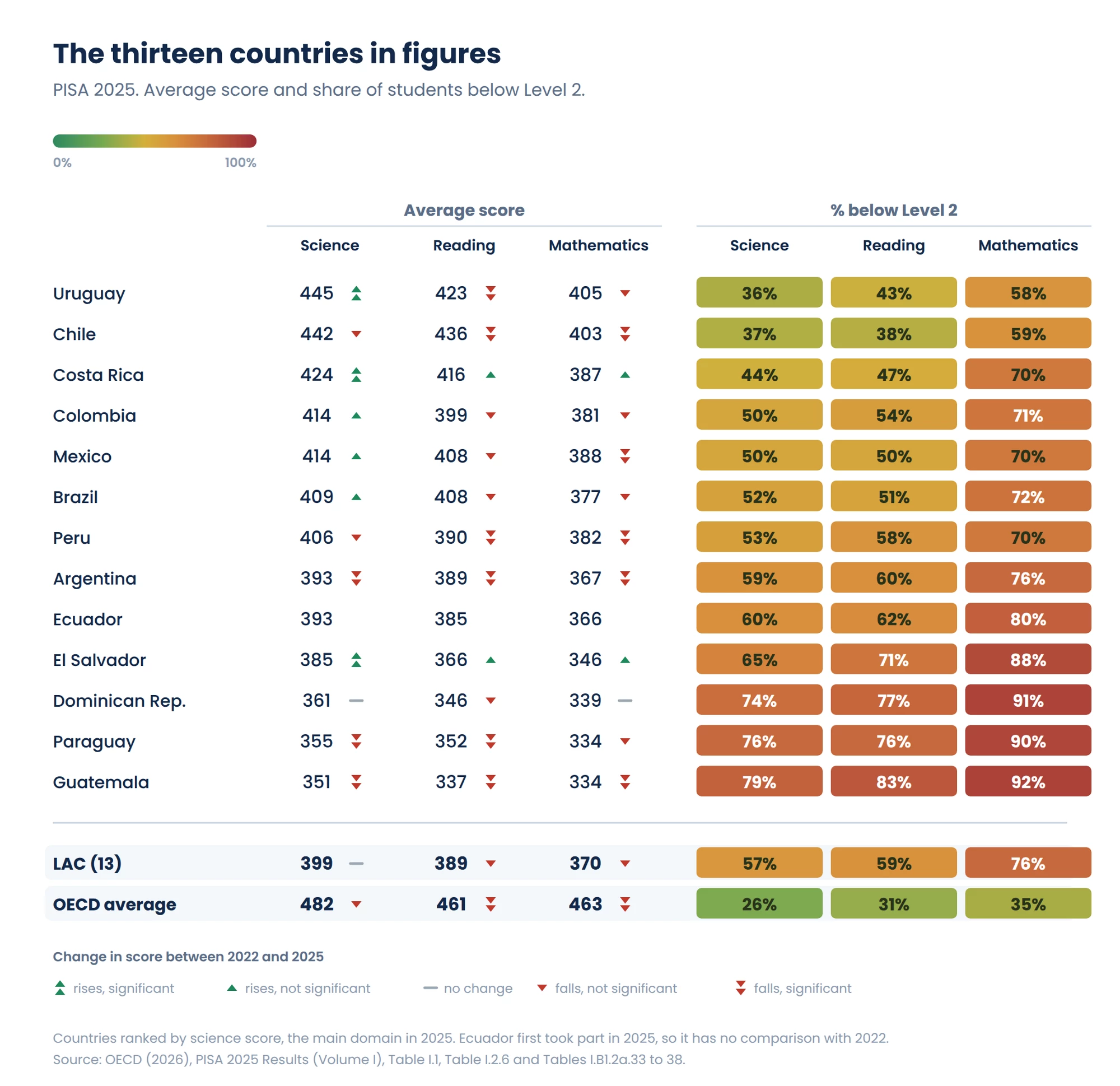
Learning outcomes among secondary school students fell in most of the countries that take part in PISA. Between 2022 and 2025, the average score of Latin American students dropped 11 points in reading and 4 in mathematics, and held steady in science, continuing a downward trend that goes back to 2018. More serious than this latest decline is that the region is not escaping a low-quality trap, and is slowly sinking deeper into it: our 15-year-olds in Latin America are far from where they should be, more than half do not reach the minimum reading level expected for their age, and 3 out of 4 do not reach the minimum expected level of mathematical reasoning. That long-term stagnation in foundational learning undermines the prospects for sustained growth in the region's productivity, competitiveness and well-being.
What the data show for Latin America
On average, the thirteen countries in the region that took part in PISA 2025 are 93 points below the OECD average in mathematics, 83 in science and 72 in reading. The OECD itself estimates that, at age 15, a student gains about 20 points for each year of schooling. By that measure, our young people are between four and five years of learning behind their OECD peers.
This hides something more serious. PISA defines a minimum that a student needs in order to participate meaningfully in society. It is not a standard of excellence, but of basic capacities to understand and reason: identifying the main idea of a text, representing a simple situation mathematically, distinguishing a scientific explanation from one that is not. That is the floor.
And in the region, most students are below that floor: more than half in reading (59%) and in science (57%), and three out of four (76%) in mathematics. In the OECD, by contrast, the share is one in three in reading (31%), one in four in science (26%) and one in three in mathematics (35%). One in two students in the region is below the minimum in all three subjects at once; in the OECD, one in five.
And that group of students below the floor is growing. Between 2022 and 2025, the share of students below the minimum in reading rose significantly in five countries; in mathematics, in three. More and more young people are being left without foundational learning.
No country in the region improved significantly in reading or mathematics. Only El Salvador and Costa Rica had positive changes, though small. At the other end, mathematics fell by more than 8 points in Argentina, Guatemala, Chile and Peru, and reading in Guatemala, Paraguay, Peru, Argentina, Chile and Colombia. The good news is in science: of the 16 systems in the world that improved, three are Latin American: Costa Rica, El Salvador and Uruguay.
In the rest of the world, eight education systems improved significantly in all three subjects: Cambodia, the United Arab Emirates, the Philippines, Georgia, Jordan, Montenegro, Thailand and Türkiye. None is Latin American, and several started from levels similar to those of Guatemala or the Dominican Republic. But there are promising signs in the region. Costa Rica achieved its first significant improvement since it began taking part in PISA, and did so with more young people inside the system than before. Uruguay improved in science after a recent curriculum transformation, built on the long-standing work of Plan Ceibal (although it still has a major dropout problem). And in El Salvador, the improvement coincides with the start of a comprehensive reform that aligned curriculum, materials, teacher coaching and assessment, with intensive use of technology. There are systems that manage to align their interventions around learning.
A digression on participation. Thirteen Latin American countries took part in PISA 2025, out of 91 countries and economies worldwide. They chose to have information in order to make decisions. When you measure, you always run the risk of bad news, as when the doctor takes your temperature. But if we do not measure, we do not know how much we need to improve. In the region, Bolivia has never taken part and Honduras only once; most Caribbean countries do not participate, and Jamaica and Panama, which took part in 2022, did not do so in this round. That is the worst scenario: not knowing.
Why learning is falling
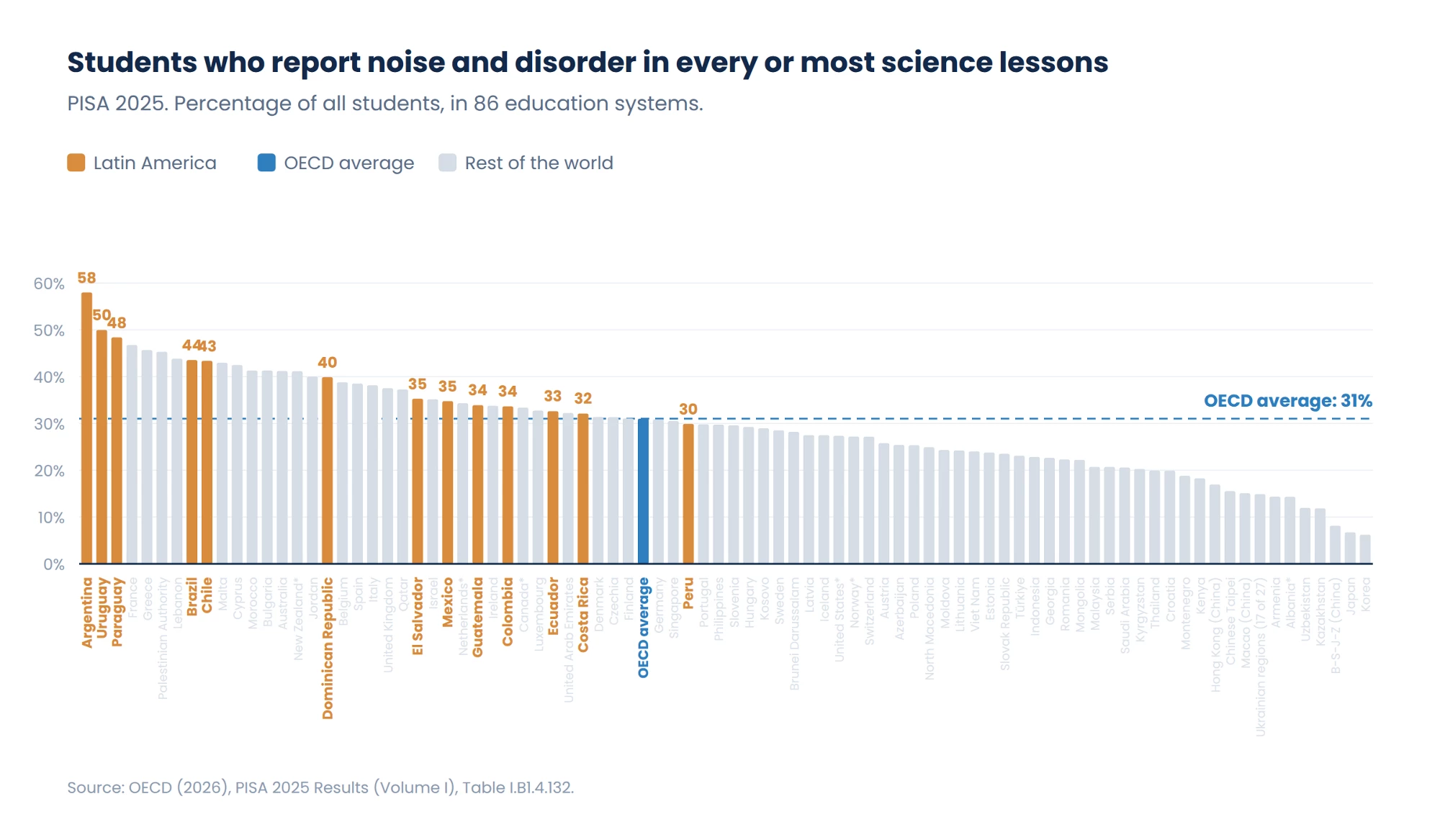
The OECD attributes the global decline in reading to four interrelated factors. Students lost attention; "hasty readers"—fast and wrong—nearly doubled since 2018. Classrooms have more disruptions, less teaching time and more bullying. In school systems, a single class has students at very different levels, and there is no capacity to teach all of them. And at the societal level, there is less reading for pleasure and more time on social media and video games. In Latin America, neither bullying nor classrooms with students at different levels are anything new. What sets us apart is classroom climate: in noise and disorder in class, twelve of our thirteen countries are above the OECD average, and Argentina, Uruguay and Paraguay top the world ranking.
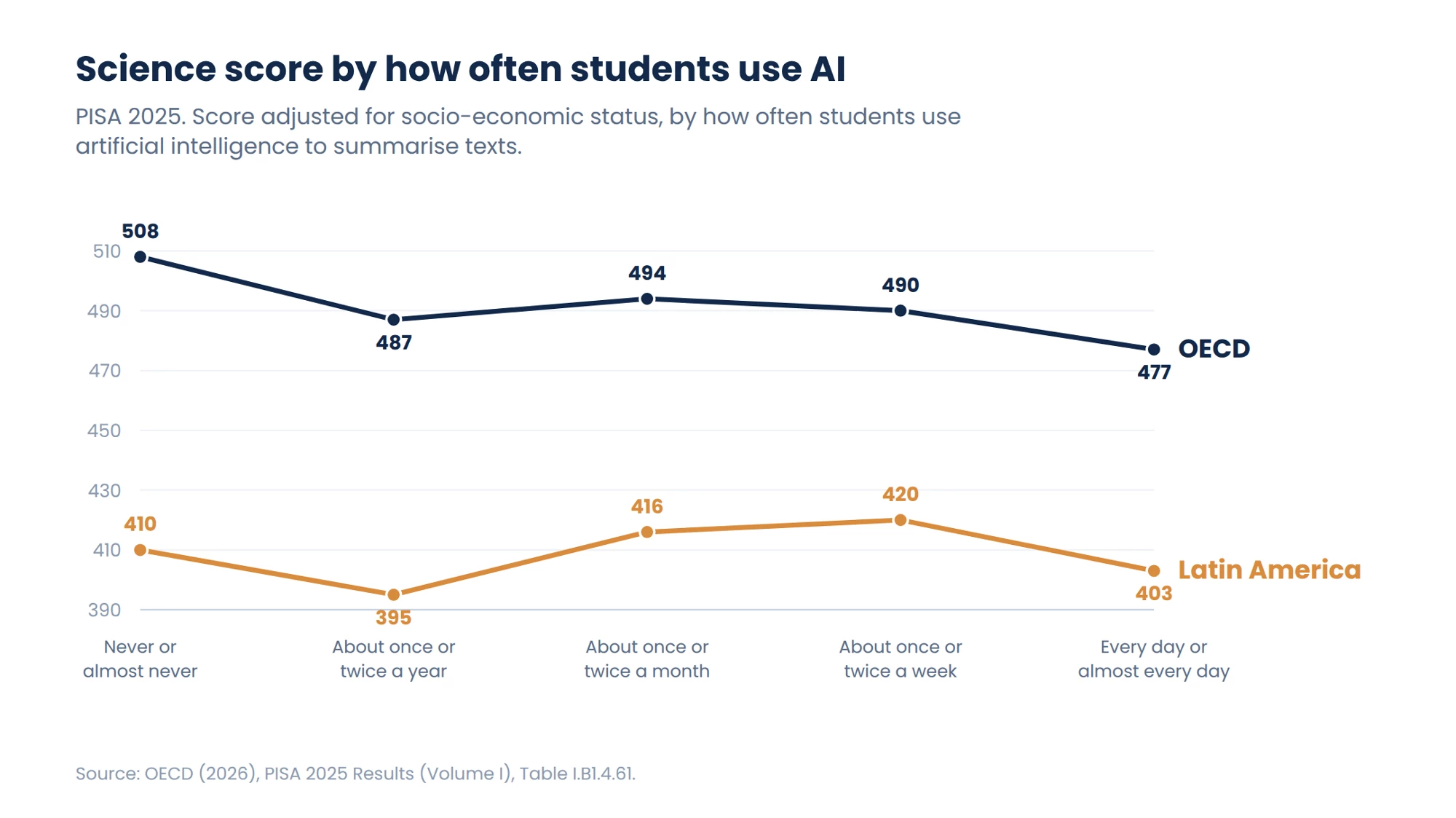
On top of these four factors come two questions everyone asks: was it the pandemic? Is it artificial intelligence? The young people who took PISA 2025 were 10 or 11 years old when schools closed: the age at which children stop learning to read and start reading to learn. The correlation is not clear-cut: countries with school closures of similar length had very different results. But it may be an underlying factor in the widespread decline. On the other hand, PISA 2025 measures the use of artificial intelligence for the first time. In OECD countries, students who never use it to summarize texts score higher than those who do; in Latin America, moderate use is associated with better results and daily use with worse ones. This is not causation, and more research is essential, but AI appears to help when it adds to a student's effort and to get in the way when it replaces it.
What to do: secondary school has to guarantee learning
A few days ago we launched Where the Paths Divide, the World Bank's latest report on secondary education in the region. Read alongside the PISA results, it helps explain what is happening in schools and what can be done. And what happens there has a lifelong impact: two out of three working adults in Latin America have no more than a secondary education. What they learned in those years is the foundation they took into the labor market, and the one they still work with. If that foundation is weak, productivity and well-being will not improve.
The report proposes actions so that young people stay in school, learn, and finish secondary school prepared for life. The lessons of PISA 2025 point in the same direction:
- Start from where students are in their learning, not from where the curriculum says they should be. By the end of sixth grade, 62% of students do not reach the minimum level in reading and 74% do not reach it in mathematics. What students know must be measured continuously, and those results used to give them support tailored to their needs. Tutoring and structured remediation must be part of the daily work of the school. Adaptive platforms and AI tutors can help reach more students efficiently, as long as there is effective teacher support.
- Act before students drop out. Dropping out does not happen overnight: absences, falling grades and behavioral problems are early signs of disengagement. Many countries already collect attendance and performance data that can flag these warnings in time. The key is that they trigger a concrete response: tutoring, psychosocial or financial support, and other forms of accompaniment. Preventing dropout is far more cost-effective than bringing a young person back to school after they have left.
- Teach the essentials well, and make finishing secondary school worthwhile. Curricula are overloaded; what matters is not covering content but students learning. Countries need to define what students must master in each grade and give teachers the time to teach it well. A longer school day helps if it is used well: in some countries that means moving from two- or three-shift schools to a full day; in others, simply getting students to attend class every day. Secondary school also has to connect with what comes next. Many young people will go straight to work and need technical training that has value in the labor market, and that is neither easy nor cheap: it requires workshops and equipment, teachers who know the job, real links with companies, certifications that employers recognize, and guidance on careers and jobs. For finishing school to be worth it, young people need to see how secondary school prepares them to keep studying and to access better jobs.
- Strengthen the teaching profession and give schools the conditions to teach well. Demanding better results must go hand in hand with adequate support. Teachers need quality training, materials and continuous coaching to carry out the immense and complex responsibility they hold. That support must be part of a career that attracts talent, with entry and promotion based on merit and with recognition of good performance. And schools need well-prepared principals, with support, authority and less administrative burden, to lead teaching and support their teachers.
To have an impact on learning, these actions have to be delivered together, as an integrated package. The challenge is to take them to every school and every student, and that requires political commitment sustained over time. It demands measuring progress, correcting what does not work, and making results visible, so that families know whether their children are learning, can demand improvements, and help sustain them.
Transforming secondary education is difficult. These are young people who today are also exposed to stimuli that do not favor learning, and to economic and social pressures. The challenge for teachers and schools is immense. But the importance of secondary school for the future of students, and for the future of nations, makes it essential to hold on to the ambition of giving every young person a quality education.
There is still time for more young people to finish secondary school prepared to keep studying, to work, and to build their future.

Join the Conversation