
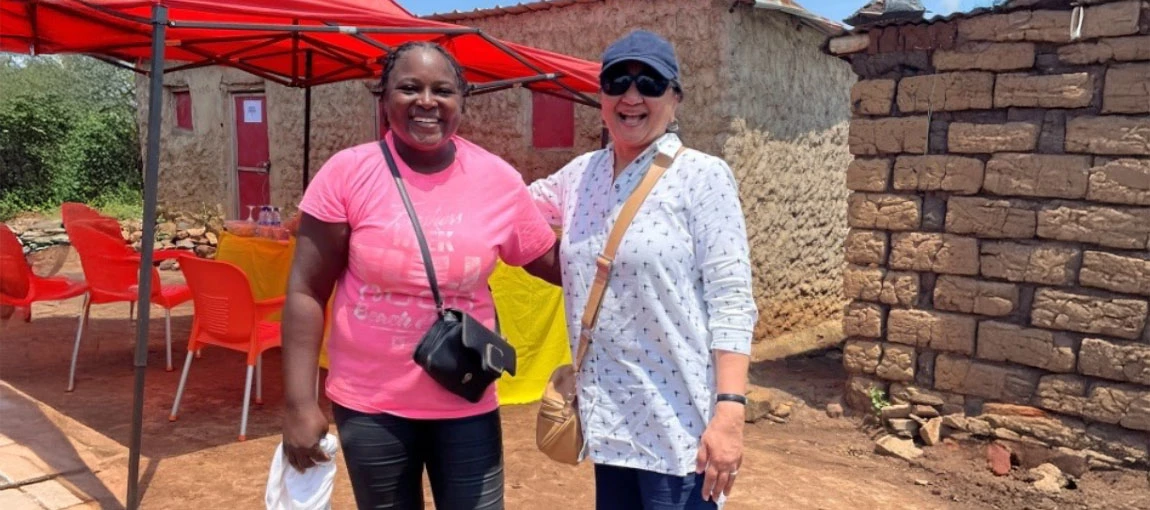
 Rebeca Rocha and Vara Vemuru in the Province of Cuanza Norte. Photo: World Bank
Communities experience significant benefits when women are fully included and empowered, especially when they can improve their skills and access financial markets. This became evident during our recent visit to beneficiaries of the Angola Commercial Agriculture Development Project (PDAC). We witnessed firsthand how women beneficiaries of the project were also involved in local development efforts that led to enhanced economic opportunities, improved education for their children, and benefits for their communities. Our vibrant discussions and experiences shared by the women highlighted the transformative impact of gender inclusivity on the overall well-being of the community.
We specifically want to share the story of Rebeca Rocha, a 39-year-old agri-preneur from the Lucala Municipality in the Province of Cuanza Norte. Rebeca told us of her journey from being a subsistence farmer, struggling to make ends meet with dwindling savings, to becoming a small business owner who now cultivates 28 hectares of land. She exemplifies how jobs can be created in the agriculture sector while also addressing food and nutrition security in Angola. With financial and technical support from the PDAC, Rebeca’s life has transformed significantly.
“For me, the most satisfying aspect of establishing my agribusiness is that, in the process of cultivating 28 ha of land with crop diversification and food processing, I have created 2 permanent and 4 seasonal jobs and have also been supplying soya porridge and nutritious soups to malnourished children and pregnant women in Lucala’s pediatric hospital. That gives me immense satisfaction,” she said.
In 2013, Rebeca began her journey as a subsistence farmer, cultivating a two-hectare plot with cassava and beans and raising various livestock. By 2022, her savings was dwindling and she considered leaving farming. Her situation changed when she discovered the offer of financial support to emerging agro-producers through PDAC. After expressing her interest and completing an interview, she joined the PDAC Jovem Program and received a $4,000 grant. With this financing, Rebeca improved her equipment and infrastructure and upgraded her livestock shelters. She also secured a bank loan to purchase a motor pump and a mechanized cultivator, along with setting up a water tank for irrigation.
At the heart of PDAC’s strategy to revitalize Angola’s agriculture sector is the promotion and support for agribusiness development. With $230 million, co-financed by the World Bank (IBRD) and the French Development Agency (AFD), the project has developed a matching-grants program to strengthen agribusiness investment capacity and to de-risk lending by financial institutions. The PDAC Jovem Program was added in 2023-2024 to assist young agripreneurs, like Rebeca, who were subsistence farmers and did not meet the eligibility criteria of commercial and financial viability of PDAC’s main financing windows. The program came in to address this eligibility issue by focusing on Angolan youth between the ages of 18 and 40 in the productive sector and supporting them with the formalization of businesses in the agricultural sector and by creating a class of young producers to boost agribusiness. This program seeks to create conditions for the introduction of innovation, technology, and agricultural mechanization linked to the value chains of corn, beans, soybeans, coffee, cassava, sweet potato, Irish potato, wheat, rice, peanuts, eggs, poultry, goats, and sheep. As of today, 308 business plans have been approved, 75 that were submitted by women, totaling about $2.12 million of direct investment.
We firmly believe that the comprehensive, reliable technical assistance that PDAC has offered plays a crucial role in empowering women's initiatives within local communities. This systematic support enhances the capacity of women to lead and implement projects but also fosters an environment where their voices and contributions are recognized and valued. By providing targeted resources, training, and mentorship, PDAC helps women entrepreneurs and leaders develop the skills and confidence needed to drive positive change in their communities, ultimately leading to more sustainable and inclusive development.
Rebeca is proud that with PDAC’s technical assistance she prepared a business plan, procured land documents, and got a commercial license to sell her produce and value-added products in the market. With the knowledge received from the mentorship provided by the PDAC team, she has improved her agriculture practices, incorporating beneficial actions like rotating crops between corn, beans, and cassava, which has enhanced soil quality and crop productivity. Of the cassava produced in 28 hectares, Rebeca recently sold cassava from 20 hectares and harvested another 5 hectares for sale; and harvested 3 tons of black beans and 2 tons of corn. With recipes researched from the internet using her laptop, Rebeca has been successful with producing various types of flour, cakes, pastries, and juices for sale in the local market with a growing clientele. With advice from her father, who worked on health programs, Rebeca is proud she is able to share her success with her social initiative of delivering soya porridge and nutritious soups to the province's main pediatric hospital to support malnourished children and pregnant women. She is also expanding her presence in local agribusiness fairs and hopes to create a digital presence to promote and grow her business.
With such examples, Angola is showing how leveraging agricultural financing to create jobs for rural youth and women can succeed and benefit not only the entrepreneurs but also their communities. Adequate infrastructure is the major challenge that Rebeca faces now. The lack of roads that increases the costs of transportation in reaching regional versus local markets, as well as the current lack of digital connectivity which makes digital access limited and expensive are holding her and others back from further growth.
Our critical imperative is for the strong foundations-- investments in electricity, infrastructure, and the right enabling policies--that will galvanize communities, jobs, and growth for the benefit of all Angola.

Join the Conversation