
The update at a glance
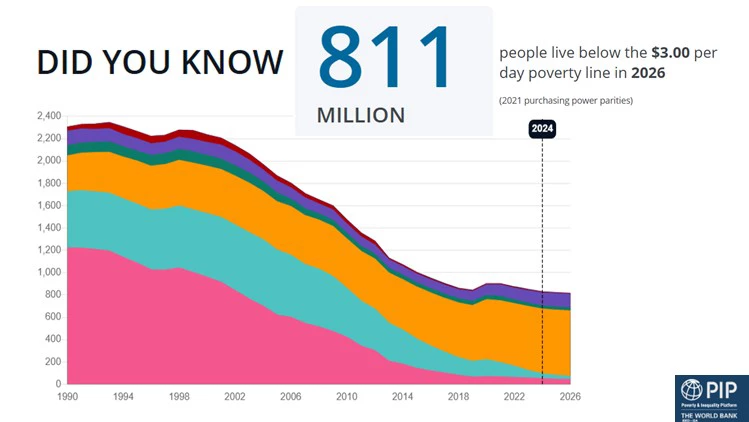
More than 824 million people, about one in ten worldwide, were living in extreme poverty in 2024. The World Bank updated these global and regional poverty estimates in September 2026, on the Poverty and Inequality Platform (PIP). The release provides estimates through 2024 and nowcasts for 2025 and 2026 (more details here). Extreme poverty is defined as living on less than $3.00 per person per day in 2021 purchasing power parity terms.
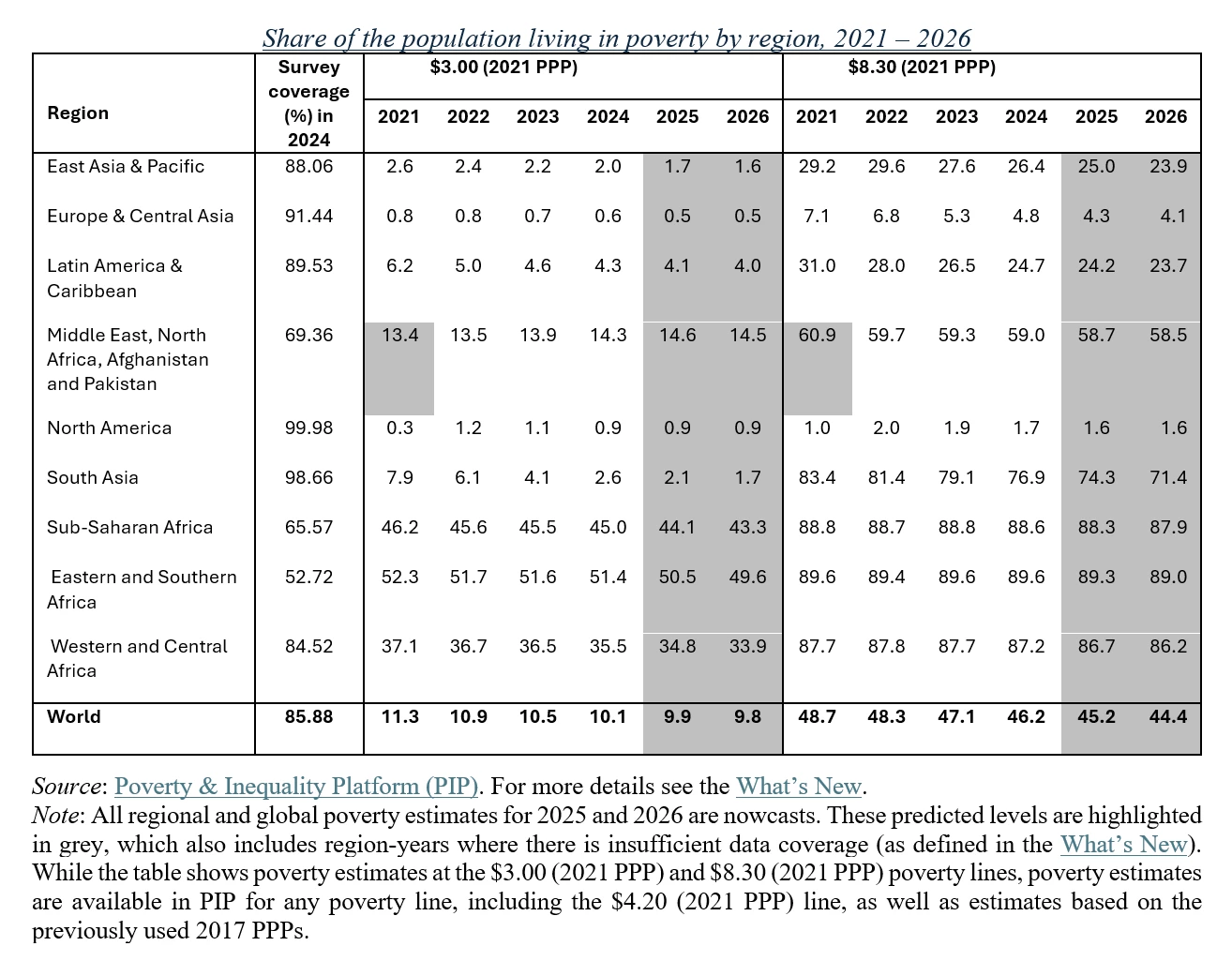
Global extreme poverty is projected to decline marginally from 10.1 percent in 2024 to 9.8 percent in 2026. The 2024 estimate is for the latest year with sufficient data coverage. The 2025 and 2026 nowcasts are based on national accounts projections from the June 2026 Global Economic Prospects, the latest currently available.
Survey coverage is sufficient across all regions in 2022–2024. Coverage was insufficient in the Middle East, North Africa, Afghanistan and Pakistan in 2021. In Eastern and Southern Africa, the addition of Uganda’s 2024 survey data brings 2024 population coverage above the required threshold.
What do the latest trends show?
Progress on extreme poverty remains sharply uneven: rates are below 5 percent in all regions except the Middle East, North Africa, Afghanistan and Pakistan, and Sub-Saharan Africa. Extreme poverty is rising in the Middle East, North Africa, Afghanistan and Pakistan region, and remains high in Sub-Saharan Africa. Both regions remain far from eradicating extreme poverty (Figure 1).
Figure 1: Global and regional poverty trends, 1990 – 2026
What changed in this release?
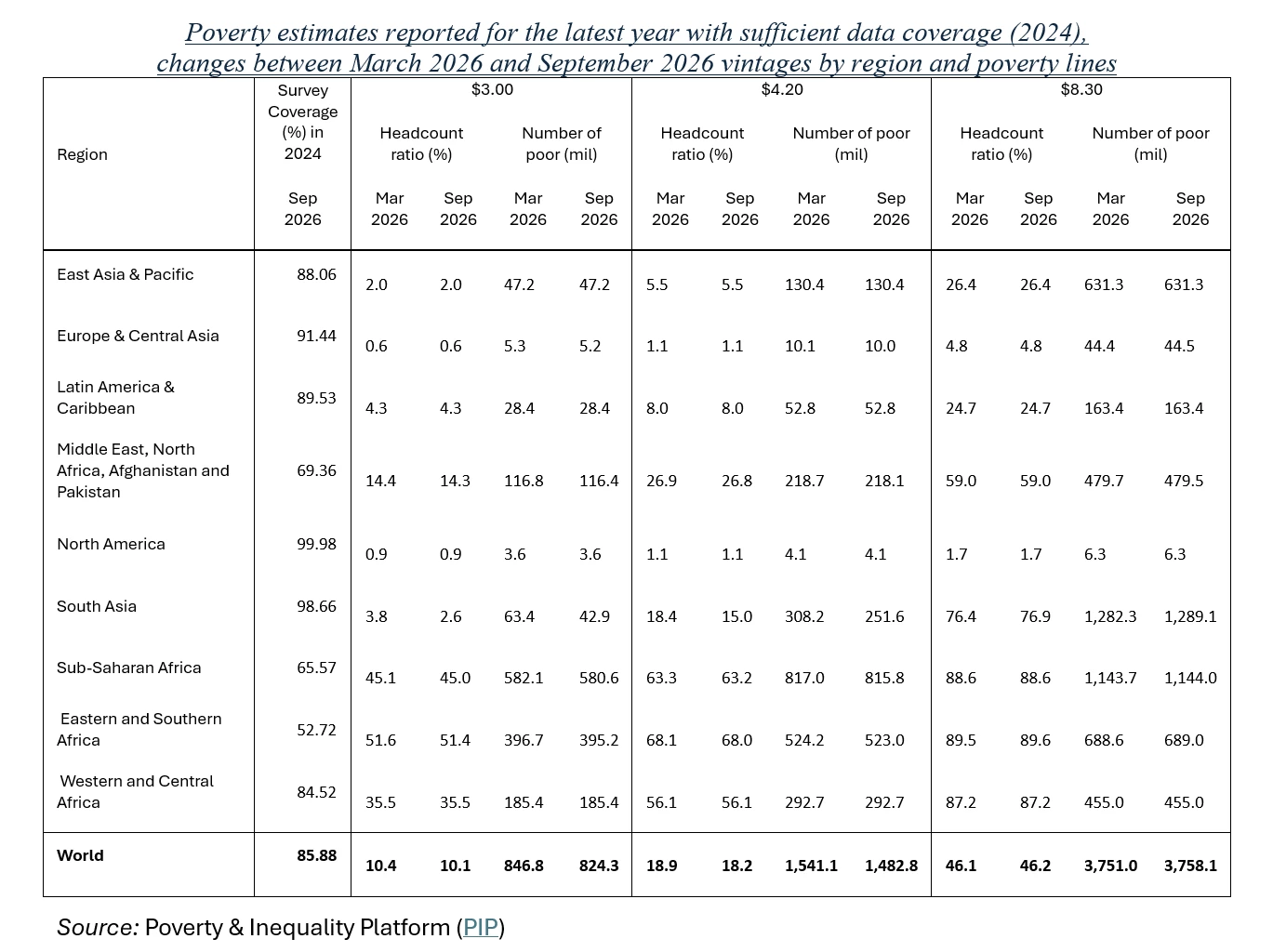
Compared with the March 2026 PIP vintage, the global poverty rate has been revised downward by 0.3 percentage points (22.5 million people), from about 10.4 percent (846.8 million people) to 10.1 percent (824.3 million).
Revisions to global and regional poverty estimates are driven by three main factors: new household survey data; improvements or revisions to country-year estimates; and updates to auxiliary data, including national accounts, population projections, and consumer price indices. A detailed description of these changes and the accompanying methodological updates is available in the What’s New document.
The observed minor downward revision stems primarily from the decrease in the extreme poverty rate in South Asia, after the inclusion of the latest survey, which replaces the previously used extrapolation. For a detailed context, including on the new India estimate, see the What’s New document.
Would you like to be updated with the latest news on PIP? Register to our newsletter here.
The authors gratefully acknowledge financial support from the UK Government through the Data and Evidence for Tackling Extreme Poverty (DEEP) Research Program.
Edited October 2026: Only Tables 1 and 2 were revised. In the original version, the labels for Eastern and Southern Africa and Western and Central Africa were mistakenly switched. No other text or estimates were changed.





Join the Conversation