
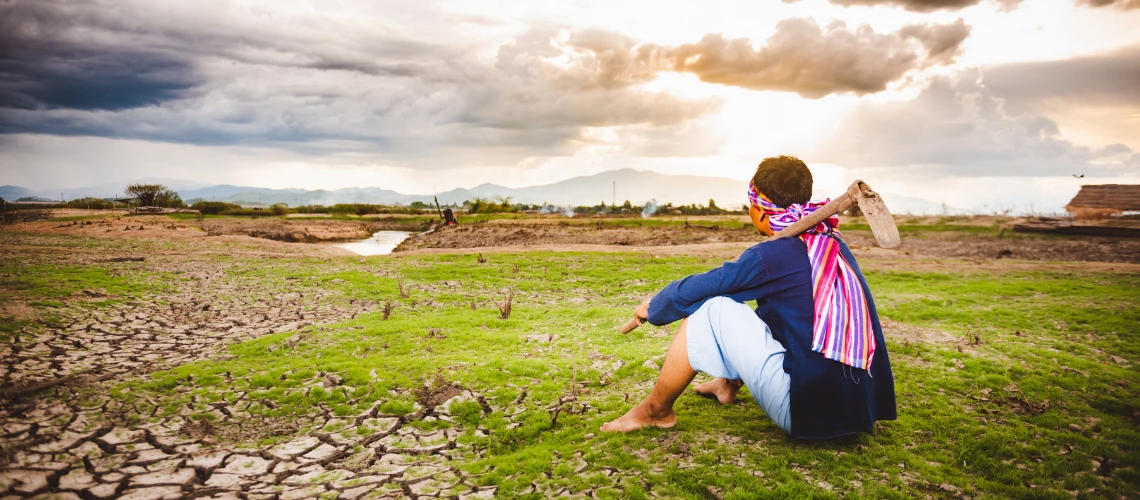
 Photo credit: yupachingping/Adobe Stock.
The signs have been there for years. Rivers are shrinking. Lakes are receding. Droughts are increasingly severe. The world is drier than ever.
But there is good news, according to the first edition of the World Bank’s Global Water Monitoring Report, Continental Drying: A Threat to our Common Future, which provides the most detailed assessment yet of the world’s fresh water.
Newly available data and enhanced satellite images show us exactly where water is disappearing and offer a menu of solutions for areas threatened by the water crisis. Governments, researchers, and communities now have the evidence they need to anticipate risk, design targeted responses, and plan for a drier, more variable future. That’s smart development—and an opportunity to safeguard jobs and incomes, increase farm productivity, and protect natural resources.
The view from above is sobering. Satellites show the planet loses 324 billion cubic meters of fresh water every year. Put into context, that’s about the combined annual flow of the Danube, Elbe, Meuse, and Rhine rivers, four of Western Europe’s largest waterways. It’s also enough water to meet the yearly needs of 280 million people.
The world’s fresh water reserves have dropped by 3 percent each year for the past two decades. The decline is much starker in more arid regions, reaching as much as 10 percent annually. And the trend is accelerating across large parts of Asia, Eurasia, North Africa, and North America.
This isn’t just a water issue. It’s an economic and development challenge. Safe water is foundational infrastructure that’s essential for everyday life as well as job creation and economic growth. Water scarcity undermines employment, food production, energy generation, and trade. It also threatens biodiversity and raises the risk of wildfires and other disasters.
When world leaders gather this week in Belem, Brazil, for the United Nations climate change conference COP30, their conversations will be informed by new knowledge on the water crisis—information that can help countries avoid the worst potential outcomes.
Our new monitoring report provides the most detailed assessment yet of the world’s fresh water. Using satellite data from NASA and the German Space Agency from 2002 to 2024—enhanced from a resolution of 330 kilometers to just 25 kilometers—the report allows for precise analysis down to the level of river basins and counties.
It also provides solutions. By matching water use to availability, modernizing irrigation, protecting aquifers, and rethinking agricultural trade, countries can turn water scarcity into an opportunity for smarter growth. For example, using water more efficiently in agriculture could save up to 40 percent of global water consumption, if paired with effective monitoring and regulations. Aligning crop production with areas where water is abundant and used efficiently can reduce stress on rivers, lakes, and aquifers.
Our analysis identifies three strategies to confront the drying crisis: managing demand, augmenting the water supply, and improving water allocation. It also highlights five cross-cutting levers that can accelerate change, including strengthening institutions, reforming tariffs and repurposing subsidies, adopting water accounting, leveraging data and technological innovations, and valuing water in trade.
For instance, augmenting water supply means doing more with what we have by expanding reuse and recycling, investing in rainwater harvesting, improving water storage infrastructure, and, where feasible, using desalination to secure reliable sources for coastal or arid regions. Valuing water in trade involves looking at how much water is used to produce the goods countries buy and sell. When governments understand this “hidden” water use, they can make smarter trade and production choices that help prevent water waste.
To make real progress, we provide governments with options to turn these new insights into action—through governance systems that allocate and value water wisely, expand reuse and storage, and ensure that incentives reward conservation. Many countries are already showing what works, such as transparent water accounting, fair pricing, strong institutions, and technologies that make reuse and monitoring possible at scale.
The new data and satellite images give us the power to adapt how we store, share, and safeguard the water we have. Partnership gives us the means to act. Leaders now have an opportunity to turn evidence into action, ensuring that future generations inherit a more resilient planet.
This piece was originally published in Devex.

Join the Conversation