
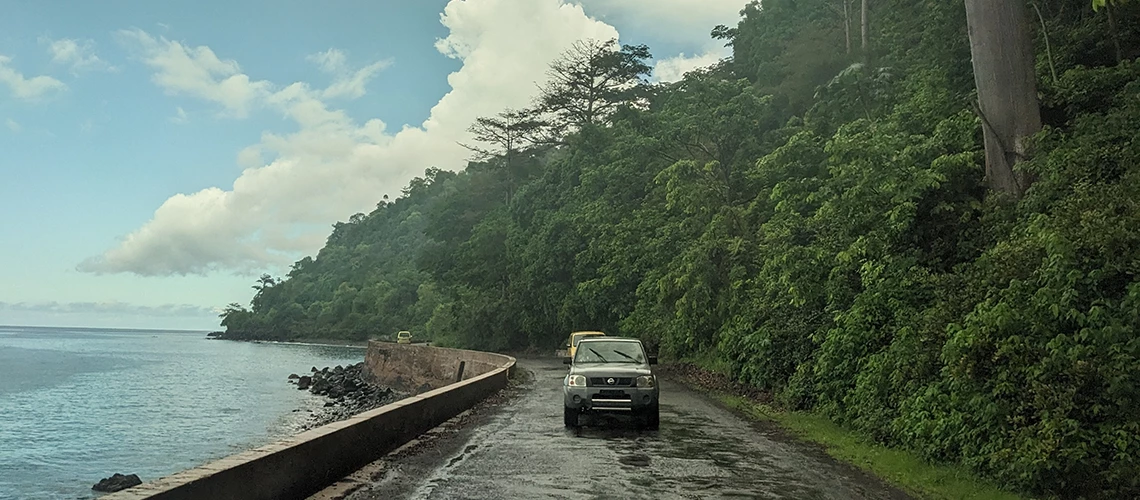
 Credit: Isaura Martins, Amend
The current El Niño is a reminder of how quickly climate shocks can become development challenges. Drought can wither crops and drain the reservoirs that power homes and factories. Heavy rainfall can wash away schools, roads, and other infrastructure. The effects vary from place to place, but the lesson is widely shared: countries need to build resilience through smart development that protects livelihoods, creates jobs, and drives growth.
That is the thinking behind the World Bank Group’s Country Climate and Development Reports (CCDRs). Driven by national development priorities, the series now covers 100 economies, with São Tomé and Príncipe the latest addition. Each CCDR supports countries with a practical roadmap for resilient, low-carbon growth that advances their wider development priorities, from jobs and energy security to better health. They are complemented by annual summary reports that highlight the key global insights, with four reports published so far on infrastructure and the macroeconomy, the interplay with nature and role of forestry, the vulnerability and agency of people, and the implications for jobs.
Reaching 100 economies is a milestone and a good moment to ask what we have learned. I see four lessons and two priorities for the road ahead.
Start with countries’ development priorities
Countries make progress when investments serve their priorities: better jobs, more reliable energy, cleaner air, better infrastructure, or greater resilience. That means listening to what countries identify as their most pressing development challenges and where they see opportunities for action. That principle, set out in the first CCDR for Türkiye in 2022, has guided the series ever since.
Many investments serve multiple goals at once. Resilient infrastructure costs less to maintain and provides a stronger foundation for growth. Affordable renewable power lowers energy costs while reducing exposure to global price shocks and emissions. Public transport eases congestion, improves air quality, and connects people to jobs. Financial inclusion helps households manage climate shocks and invest in their livelihoods.
Where countries see opportunities to pursue these goals, they can leapfrog to technologies that support growth and expand access to essential services. To highlight a few examples. In Niger, off-grid solar is a cost-effective way to expand rural energy access and a low-carbon solution. In Fiji, renewable power and energy efficiency reduce dependency on expensive imported fuels. In Morocco, low-carbon manufacturing can strengthen access to and competitiveness in European markets. In Thailand, flood management is essential to protecting the country’s position in global manufacturing value chains.
Boost job creation by helping workers and businesses adapt to change
Climate change is reshaping labor markets alongside demographic shifts, digitalization, artificial intelligence, and migration. Putting people at the center of development also means helping countries adapting to these changes and adopting reforms that remove barriers to opportunity, from skills gaps and limited mobility to exclusion, and gender barriers.
Tajikistan will need 65,000 temporary workers for rooftop solar installations. As demand for this work tapers off, there is a risk of workforce oversupply. The CCDR identifies policy options to support reskilling, training, and lifelong learning as demand changes. In Brazil, 88 percent of formal job switches occur within the same state, suggesting that regional development strategies could support areas with high concentrations of at-risk jobs.
Link investment decisions to economic policy
Experts often know how to use water more efficiently, improve energy efficiency, and better manage floods and extreme temperatures. But this knowledge is often stuck in silos, lacks political commitment to implement or has insufficient resources.
Linking decisions on energy, transport, agriculture, and water to growth, jobs, poverty reduction, and financial stability can help translate countries’ ambition into action. CCDRs have helped bring these issues from line ministries into discussions with finance and planning ministries, where priorities are set, budgets allocated, and implementation decisions are made. For example, in Côte d’Ivoire, the Council of Ministers endorsed the CCDR as a government-owned document and charged the Prime Minister’s office with taking it forward.
Turn insights into action
These diagnostics help countries identify opportunities they want to take forward, including by mobilizing development finance and World Bank Group operations. Today, 42 percent of CCDR opportunities are being addressed through World Bank Group financing.
Turning opportunities into action means choosing priorities carefully based on development gains, feasibility, and urgency. When these factors align with national priorities, progress comes quickly. A few years ago, the growth of solar power in Pakistan or electric mobility in Nepal might have seemed unrealistic. Both advanced because they aligned with national priorities and had strong leadership behind them.
Bring private-sector knowledge and finance to the table
Moving forward, closer engagement with the private sector can make recommendations more practical, investable, and responsive to market realities. Businesses and financial institutions know best what prevents firms from investing and innovating, and which reforms would help. The next generation of reports will draw more systematically on this private sector expertise to assess risks and help countries prioritize interventions.
Put nature on the balance sheet
The reports for Cambodia, Peru, Ethiopia, and Fiji show how natural assets support jobs, resilience, and growth. Future diagnostics will better integrate ecosystem services, nature-related financial risks and natural capital into economic analysis to inform country policy and investment choices.
Taken together, these lessons point to a clear role for the World Bank Group: start with country demand. Our role is to support countries with the best development knowledge, financing, and partnerships to turn their priorities into action and investment for climate-smart development.

Join the Conversation