
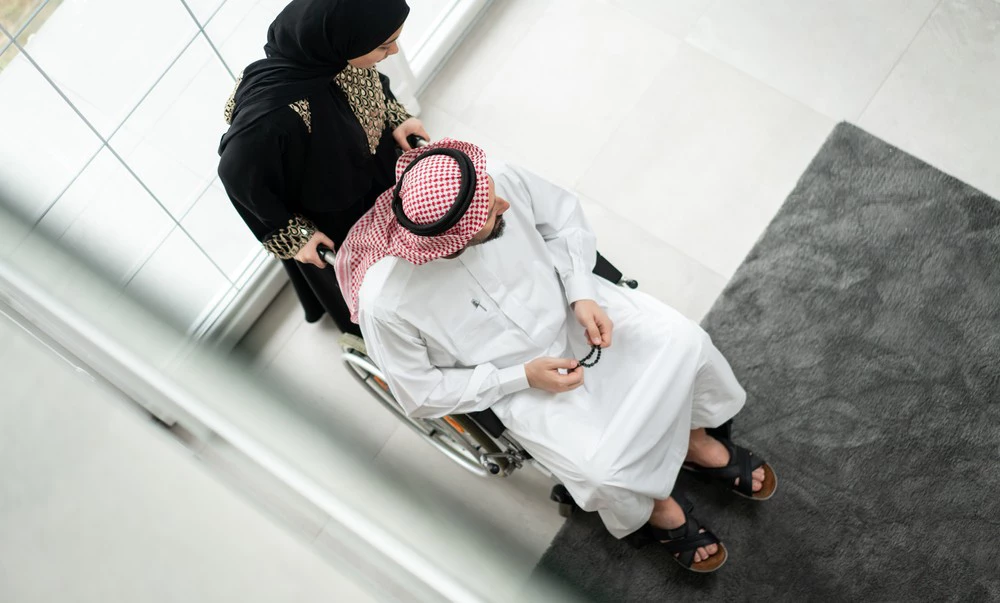
 Man in wheelchair being pushed by woman. (Shutterstock.com/Zurijeta)
The Kingdom of Saudi Arabia is redefining how it supports persons with disabilities. Moving beyond a purely medical model, the Kingdom is adopting a more holistic, rights-based approach, one that looks at a person’s environment, functionality, and social participation, not just their diagnosis.
This shift, in partnership with the World Bank Group (WBG), aligns with both Vision 2030 and the UN Convention on the Rights of Persons with Disabilities, ratified by Saudi Arabia in 2008. This experience is also being documented in a joint publication on the Kingdom’s journey of reform.
According to the General Authority for Statistics, disability prevalence in Saudi Arabia is estimated at 5.1%, which is relatively low compared to the global average of 16%. Out of the 1.35m beneficiaries, more than 850,000 are registered with the Ministry of Human Resources and Social Development (MHRSD) and are receiving various social services.
The Ministry’s partnership with the WBG on this project dates back to a 2018 multi-year technical cooperation program to design and implement the Kingdom’s disability assessment and social care reforms.
What’s Changing?
The Ministry has rolled out a new disability assessment model based on global best practices, including the International Classification of Functioning and the WHO’s WHODAS 2.0 which covers six life domains that together provide a fuller picture of an individual’s needs. These are mobility, cognition, self-care (including hygiene, dressing, and living alone, life activities (such as leisure, work, and school), and participation in society,.
Unlike the old system, which focused narrowly on medical conditions, the new model considers how disabilities affect daily life—and connects individuals to tailored support and services.
Why It Matters
The impact of this reform will only become evident in years to come with the roll-out plan. However, based on international experience, this revised assessment system will likely bring about some major improvements. First, it will make disability assessments fairer and more accurate. That in turn will lead to better targeting of financial support. Third, more personalized support to beneficiaries will enhance dignity and inclusion. Finally, it will raise professional standards and improve training for social workers.
The reform has been informed by global experience of disability assessments and social care more broadly. Saudi Arabia reviewed disability care systems in countries including Denmark, Germany, Japan, and the UK, and conducted a study tour to Australia to gain a deeper understanding of how to build a sustainable and effective social care market. This was followed by in-depth consultations with stakeholders in the Kingdom from both government and civil society to develop a comprehensive framework for social care service tailored to the Saudi population.
The reformed disability assessment process starts with the gathering of socioeconomic and demographic data to provide information about household composition and characteristics. An enhanced medical assessment of impairments is then carried out to evaluate the loss of body structure and functions. Newly introduced functional tools assess physical and mental functional abilities followed by the ability to work assessment which linksthose who are able to work with the job market.
To help implement this new system, about 250 Saudi social workers received training to become disability assessors and supervisors, with a further 400 social workers still to be trained. The Ministry has set up an e-learning platform that contains extensive training modules for licensing and certifying disability supervisors and assessors. The assessment model also has a grievance-and-redress mechanism to ensure that the system responds to any problems. A final step has been to develop a communications strategy that will raise awareness of the changes—including what has changed and why.
Looking Ahead
In the future, the Bank will continue to support the MHRSD in its efforts to improve care for the disabled and the elderly. This includes supporting the roll-out of the new holistic disability assessment model and linking it with the expansion of a social services package and quality standards for NGOs and private-sector service providers. MHRSD believes that NGOs have a critical role to play in achieving Vision 2030 as well as the UN’s Sustainable Development Goals.
Adjacent to these efforts, the WBG is engaged in several other initiatives in the Kingdom including development of an Aging Strategy in collaboration with the Ministry of Economy and Planning, and working with the Authority for Care of Persons with Disability to measure satisfaction of persons with disabilities and their carers with services
These efforts all aim to ensure better inclusion, participation, and targeted services for persons of disabilities and the elderly in Saudi Arabia.
Join the Conversation