
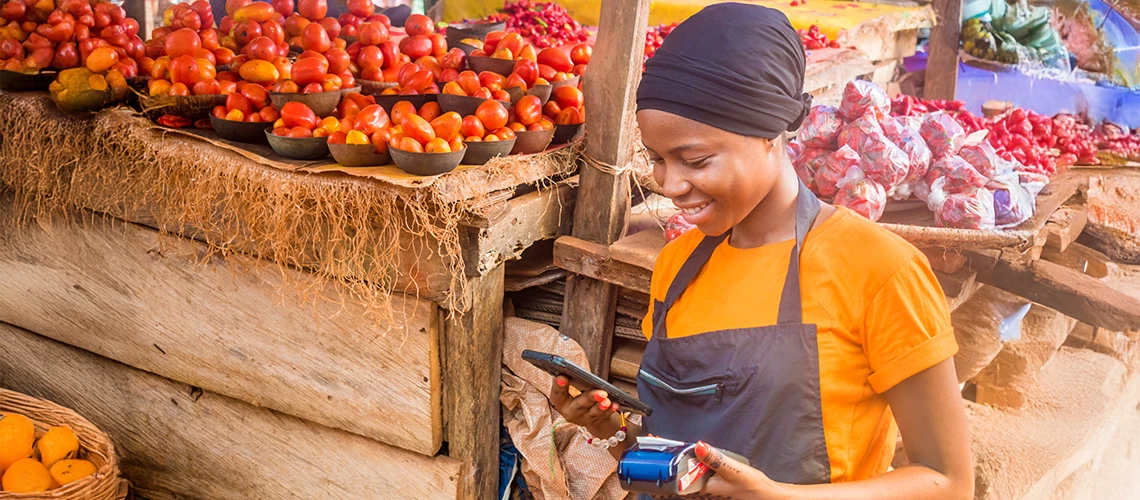
 New index helps see how much larger would an economy be if women had the same opportunities as men. | © Shutterstock.com
Governments track many statistics on women in the economy. They report on women’s participation in the labor force, differences in wages, the share of unpaid care and domestic work, and whether laws guarantee equal rights. Each of these indicators matters. But taken alone, these data show only part of the picture. None completely explains how much these barriers reduce growth and job creation.
The Global Gender Distortions Index (GGDI) fills this gap. It combines wage differences, participation gaps, and patterns of employment into a single measure and expresses the result as lost economic output. In simple terms, it asks: How much larger would an economy be if women had the same opportunities as men? In many countries, the number is eye-popping: up to 20% larger.
How the GGDI Works
The GGDI is grounded in economic theory and relies on labor force survey data that most countries already collect. It compares men and women across earnings, education, and job types. From these patterns, it calculates how much output is lost when women with the same skills as men are paid less or excluded from higher-productivity jobs. These losses, which are not explained by education or experience but by barriers in the labor market, are what the index defines as ‘distortions.’
The index separates distortions into two groups: first, demand-side barriers that come from employers and institutions. This includes hiring discrimination, unequal pay, or blocked access to higher-productivity jobs. Second, supply distortions that limit women's ability to participate in particular jobs. These distortions can reflect household responsibilities, safety concerns, of restrictive social norms.
This distinction is useful: by showing the source of the losses, the GGDI can help policymakers decide how to invest resources (e.g. whether to focus on workplace reforms or on services such as childcare and transport) to fix the distortions.
The index also values unpaid household work. While this does not appear in GDP, it contributes to overall welfare. By including it, the GGDI captures both the loss in measured GDP and the broader welfare loss. That makes it more comprehensive than measures that focus only on paid work.
What the Numbers Reveal
In many countries, removing barriers to women could raise output by 15 to 20 percent. These are large shares of income left unrealized. In other words, these are economic-growth opportunities that could fuel investment, create jobs, and lift households out of poverty.
Most of the losses come from employer-side barriers. Across countries and over time, demand-side barriers consistently dominate. This is material because demand-side constraints are arguably easier to address than supply-side constraints reflecting long-standing norms. Policy measures which open access to jobs, enforce equal pay, and remove workplace restrictions have the biggest payoff for growth.
“In some countries, giving women equal opportunities could increase output by up to 20 percent.”
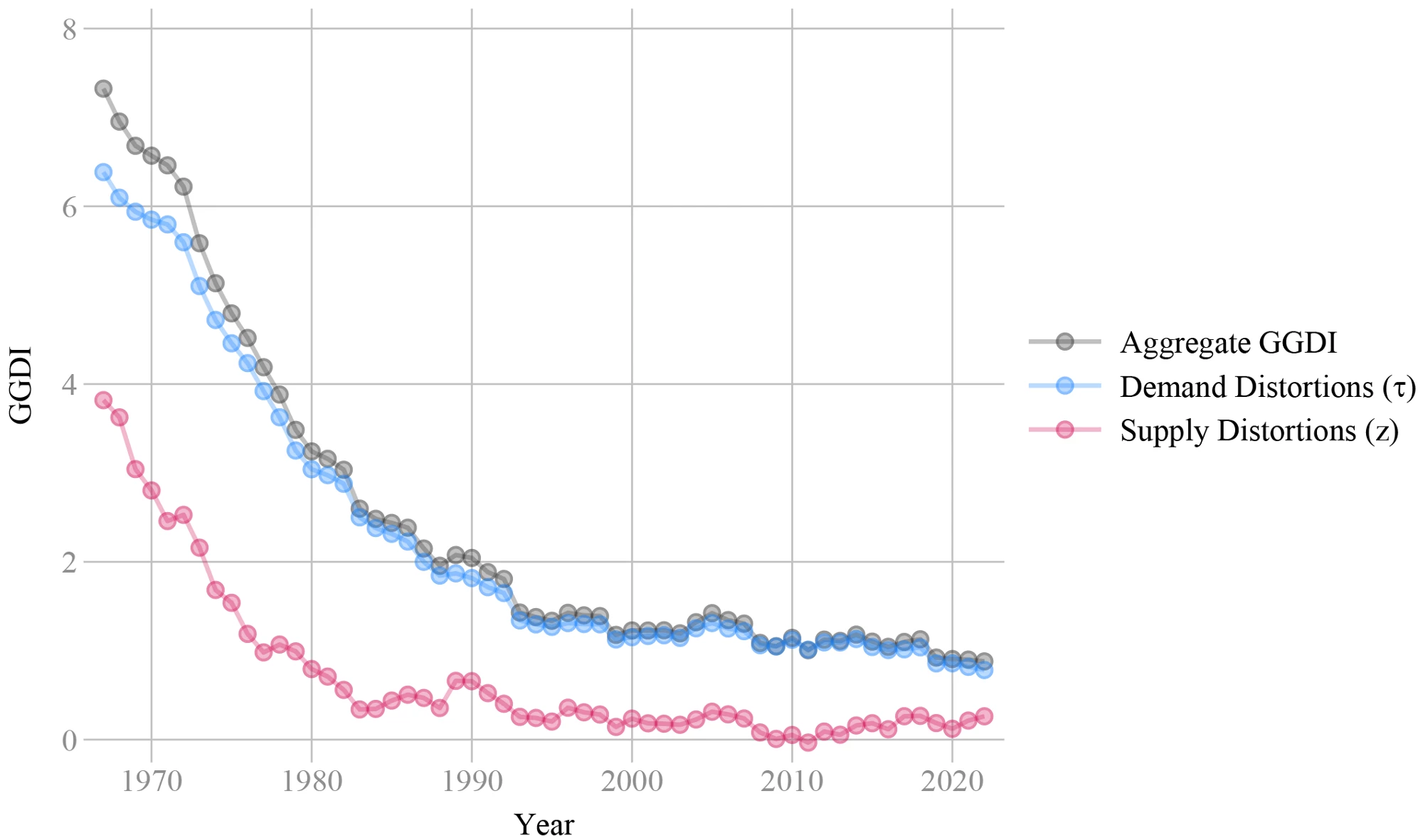
Figure 1: The GGDI in the U.S., 1970–2020. Distortions fell from about 7% of GDP to under 2%, with most of the decline driven by demand-side barriers.
 Source: Goldberg et al. 2025, Figure 1
The United States’ case illustrates how reforms change outcomes over time. In 1970, distortions reduced output by about 7% of GDP. By 2020, the loss was under 2%. The decline mirrored stronger legal protections, higher female participation, and expanded access to jobs. The penalty women faced in pay and job access fell from about 70% in 1970 to roughly 30% in 2020. Household and social constraints also eased, though less sharply. The U.S. case shows that sustained reforms can reduce economic losses significantly and contribute directly to long-run growth.
Revealing Cross-Country Differences
The GGDI reveals that variation exists even among countries with similar income levels. On average, richer countries record lower losses, but the differences across peers are striking. Egypt could increase output by about 24% by removing barriers for women, while Peru could increase it by only 5%, despite similar income levels.
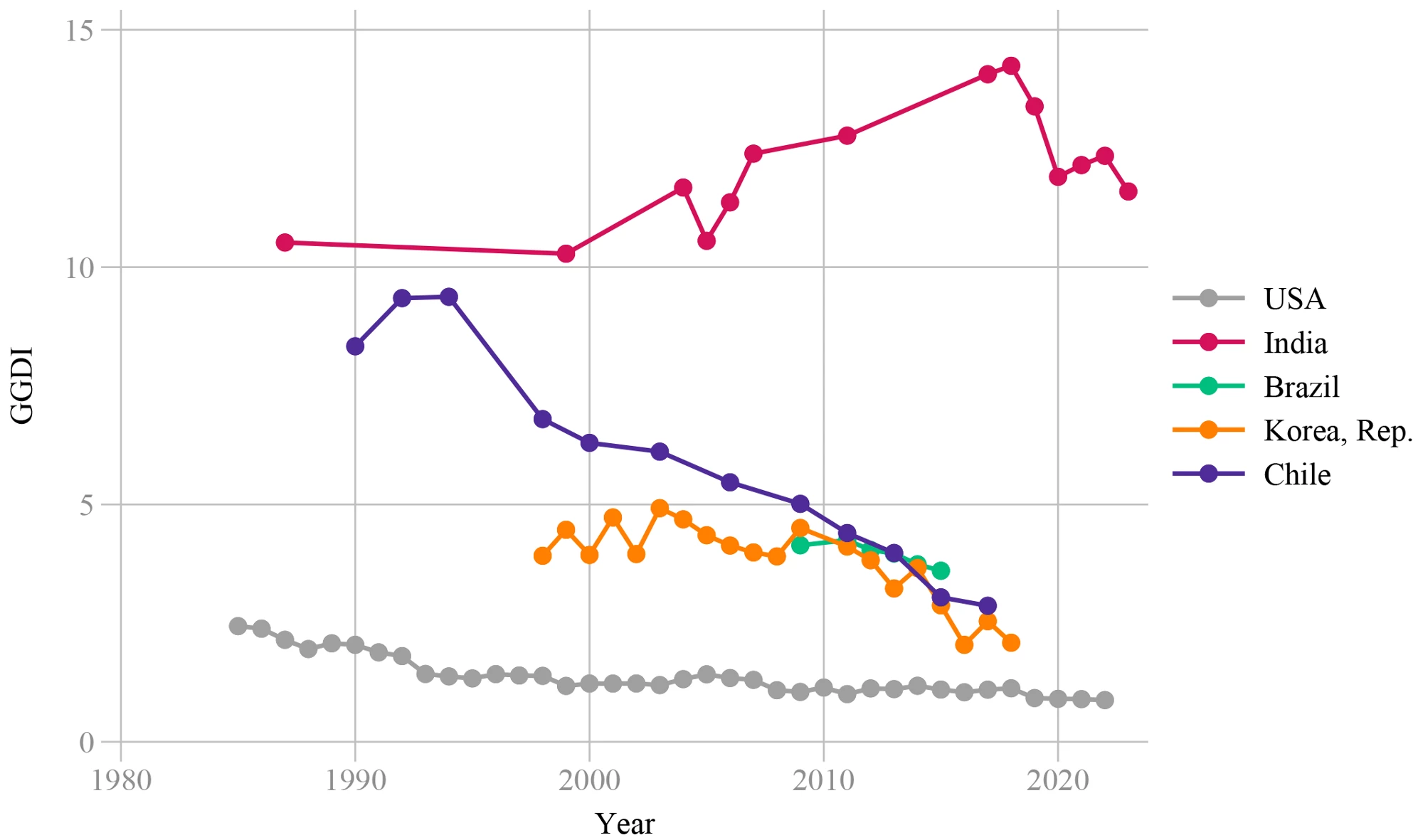
Figure 2: GGDI trends in selected countries. Distortions declined in Chile, remained high in India, and fell steadily in the U.S.
 Source: Goldberg et al. 2025, Figure 3
Chile and India show this divergence clearly. Chile reduced distortions from 8% in the early 1990s to 3% by 2018, combining growth with reforms that expanded women’s job opportunities. India, despite rapid economic growth, saw little change in distortions. Women remained excluded from higher-productivity jobs, and the economy left growth on the table. This contrast shows that growth alone does not guarantee equal opportunities; deliberate reforms are needed to unlock the gains.
Comparing the Index with What We Know
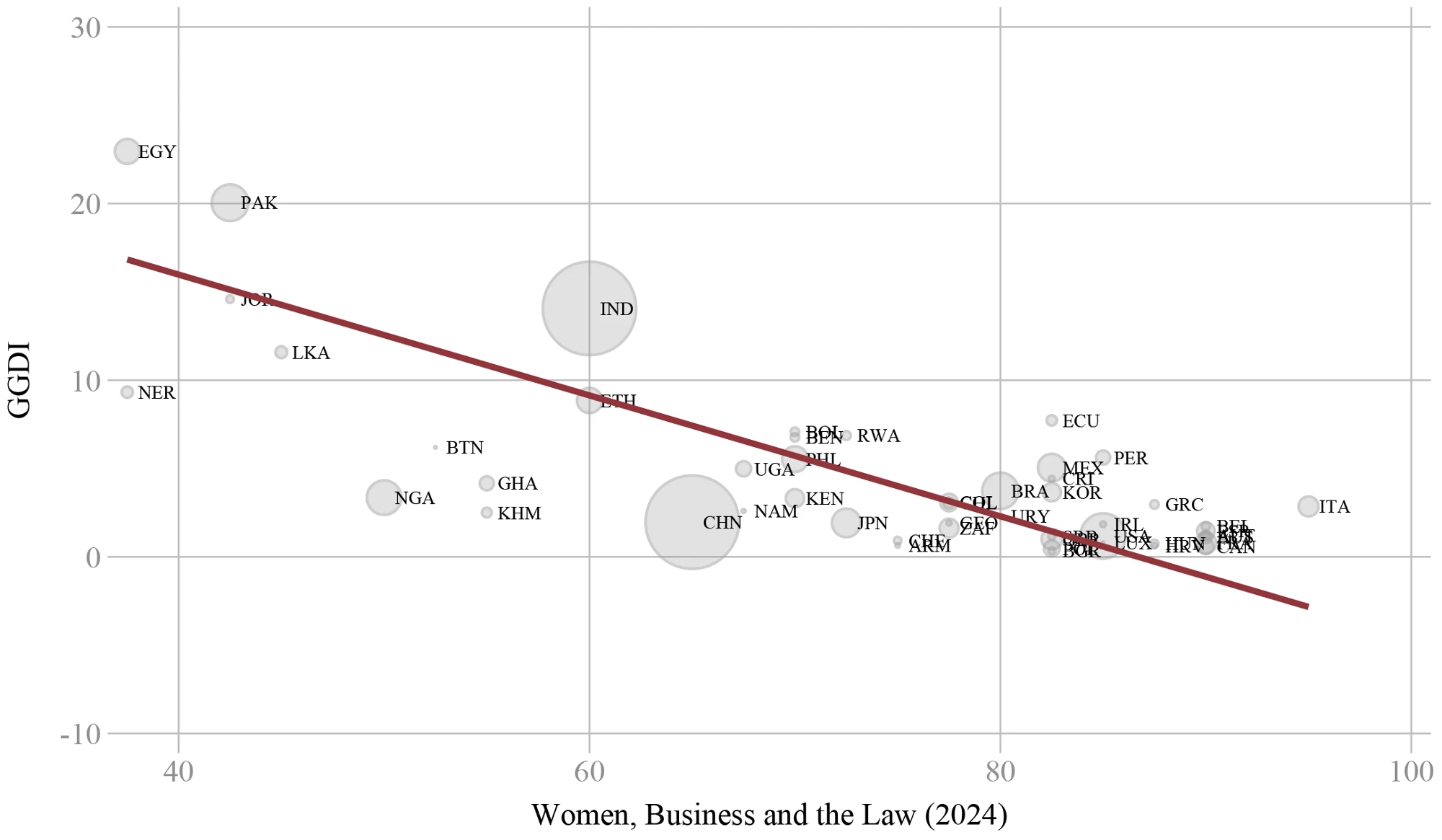
To validate the index’s output, we find that the GGDI aligns with other measures of women’s economic opportunity. When compared with the World Bank’s Women, Business and the Law (WBL) index (that scores countries on legal rights) the GGDI shows a strong relationship. Countries with stronger legal protections tend to record lower economic losses, with a correlation of about -0.74. This confirms that the GGDI reflects real differences across countries.
At the same time, the GGDI adds something new. The WBL index measures rights on paper. GGDI goes further and shows whether those rights translate into jobs and earnings. It highlights the cost that is incurred when they do not. Together, the two provide a fuller picture of how women’s opportunities shape growth.
Figure 3: GGDI compared with the Women, Business and the Law index. Countries with stronger legal rights for women show lower distortion losses
 Source: Goldberg et al. 2025, Figure 3
Unlocking Future Growth and Jobs
Ultimately, the GGDI is revealing on three core levels: one, it pulls together fragmented statistics into a single, growth-focused measure, and exposes new data points. For example, how barriers that limit women’s opportunities and affect talent allocation reduce national output, often by more than 15%, and how most of this loss comes from employer-side practices. Two, the index can be applied across countries, within regions, or over decades to track how reforms affect growth. And, three, it highlights sectors where distortions are highest, where reforms could deliver the biggest gains, and identifies periods when policy shifts make a measurable difference.
In short, the GGDI can help governments and policymakers bring women’s economic opportunity into their broader growth strategies. It shows where potential is left untapped and where action could unlock jobs, income, and long-term prosperity. For countries seeking faster growth, the GGDI offers a diagnosis, a clarity in policy direction, and a way to track results.






Join the Conversation