
This is the 16th in this year’s series of posts by PhD students on the job market.
As groundwater levels decline in places of high population density worldwide, policymakers are increasingly concerned about the environmental and economic consequences of depleting underground water stocks. One important externality resulting from groundwater decline is land subsidence, the sinking of the Earth’s surface due to groundwater depletion. Land subsidence occurs when aquifer levels fall within a groundwater basin, leading to loss of elevation for the overlying land and disruption for infrastructure located in the area. Subsidence is an externality because aquifers are hydraulically connected: falling water levels caused by pumping in one location eventually equalize over space, causing land to sink in potentially distant areas within the same basin.
Subsidence has been documented on almost every continent, but tends to be most severe in large, developing cities overlying severely over-drawn groundwater sources, with prominent examples including Jakarta, Tehran, and Mexico City. These cities have seen several meters of elevation loss in recent decades, which have resulted in acute structural problems for the buildings, roads, and other physical infrastructure in these places. As infrastructure sinks with the ground, it endures increasing stress that leads to tilting, cracking, and loss of structural integrity. Pipes and roads that are sinking unevenly can experience fissures and sinkholes. These damages diminish the value of homes, which represent the most important asset of many households.
In my job market paper we study the equilibrium housing market response to this hazard in Mexico City, one of the fastest-sinking urban areas in the world. Mexico City has experienced rapid sinking with the worst-hit parts of the city losing approximately a meter of elevation every 3-4 years. We combine a model of this slow-moving disaster with causal estimation of the impact of sinking on home values and development to quantify the total economic costs of subsidence.
Our main finding is that groundwater depletion imposes a costly externality on Mexico City homeowners, and information frictions that prevent the correct pricing of risk severely exacerbate these costs by putting additional valuable property in harm's way.
Measuring sinking in Mexico City
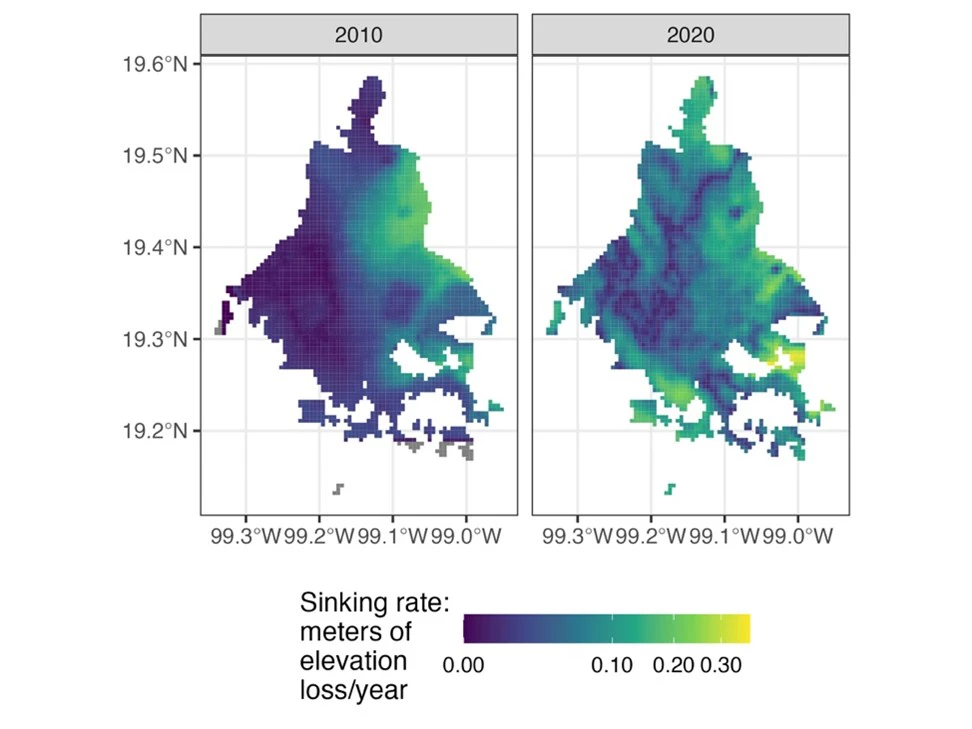
To precisely measure subsidence at fine geographic scale, we use a process called Synthetic Aperture Radar (SAR) Interferometry. SAR Interferometry involves processing radio-wave based satellite readings to measure elevation change between satellite passes. Combining original interferometry conducted by us with existing measures from the geophysics literature, we create an 18-year panel of sinking rates at 100-meter resolution which allows us to map sinking histories onto individual properties in Mexico City.
The information challenge: Future risk is ignored by many
While subsidence is a familiar and visible problem—most residents recognize the tilted buildings and cracked roads—evidence from a novel survey we ran this year on residents’ information and beliefs about subsidence reveals a disconnect between familiarity and foresight. We find evidence that residents sort over space based on their information about sinking, with residents living on the fastest-sinking plots being the least likely to report considering sinking when they moved. These same residents are more likely to report that the sinking on their property has been worse than expected, indicating they did not buy their homes "eyes wide open" about the future impacts of subsidence.
Figure 1: Sinking rates in Mexico City
A framework for understanding slow-moving disasters
Motivated by these and other survey evidence of information frictions, we incorporate the possibility that residents systematically under-estimate future sinking into our theoretical framework. Our spatial equilibrium model is built on three core elements: sinking damages homes, these damages can be 'reset' by redevelopment, and information frictions may prevent homebuyers from pricing future risk. By examining comparative statics in equilibrium, we gain important intuition about how realizations differ from future risk in the case of evolving environmental hazards. While realized sinking attracts redevelopment by lowering the opportunity cost of demolishing and replacing the existing, depreciated unit, information frictions about future risk lead to an inefficient over-supply of new housing in hazardous neighborhoods.
Estimating housing market responses to sinking
Our first empirical step is to estimate the direct causal impact of realized and expected future subsidence on home values. Our identification strategy leverages the fact that sinking is caused by non-local groundwater pumping, so plot-level sinking is plausibly exogenous to other housing market trends. We implement a repeat appraisal design with granular data on bank appraisals, which allows us to compare changes in the value of the exact same building over time as the land beneath it sinks and to verify the absence of confounding trends.
Our main finding is that while realized subsidence imposes substantial costs, prices do not predict future sinking in any capacity. We find that a meter of realized sinking causes a 6% fall in appraised property value, which translates to an average decrease of 1.5% over 10 years. We find evidence that this depreciation is driven by physical degradation of the home, increased maintenance spending, and infrastructure damage in the surrounding neighborhood. By contrast, when we test for the capitalization of expected future sinking, this effect is statistically and economically zero, and this lack of foresight is supported by our survey evidence that demonstrated profound information frictions.
Turning to the supply side, we use data on housing developers in Mexico City to test the model's prediction that realized sinking draws in redevelopment, finding that a meter of sinking more than doubles this probability.
Policy implications
We use our parameter estimates together with the model structure to quantify the total costs of subsidence in Mexico City. We estimate that current rates of sinking cost Mexico City a total of $33 billion USD, which represents about 1% of the present value of the city’s GDP.
Strikingly, information frictions that over-supply housing in risky areas play a substantial role in driving these costs: Alleviating information frictions by, for example, implementing disclosure laws, would reduce the costs of subsidence by 55%.
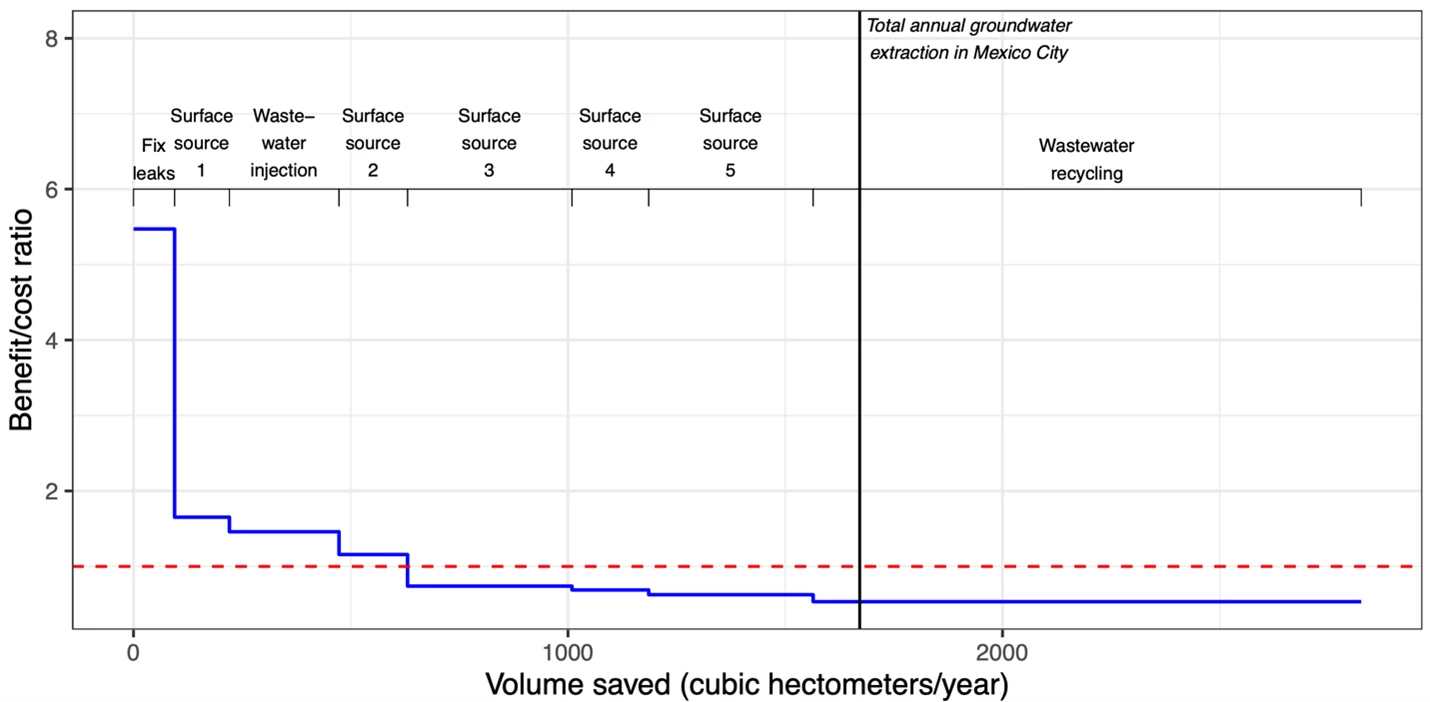
While the implied Pigouvian tax on groundwater pumping would very high compared to the price of residential water in Mexico City, we find substantial potential for other groundwater pumping abatement policies to generate net benefits. We study four potential interventions for offsetting groundwater pumping, including 5 potential alternative surface water sources, and find that repairing leaks in the water delivery system and wastewater injection emerge as the most cost-effective options.
Figure 2: Cost effectiveness of groundwater recharge policies
Summing up
In short, subsidence imposes large costs in Mexico City, and these are severely exacerbated by information frictions that result in too much housing being built in harm’s way. While sustainable water management represents a major financing challenge for large cities, this study shows that it is costlier to allow groundwater resources to deplete further, damaging valuable housing stock and infrastructure.
Lucy Hackett is a PhD candidate at UC Berkeley. This project is co-authored with Carolina Rodríguez-Zamora at the Banco de México.

Join the Conversation