
This is the 21st in this year’s series of posts by PhD students on the job market.
Motivation: Problem of (Mis)Trust
Imagine you run a small juice shop that sells through a delivery app like Uber Eats or DoorDash. Every morning you hand off your juice to a driver, trusting the driver to deliver the whole amount without tampering with the juice by diluting with water. The app uses dynamic pricing, so the prices change every day. While prices fluctuate, you never see individual transactions. Two weeks later, a lump-sum payment appears in your account without a detailed breakdown of what was sold, when, or at what price. With no feedback to guide you, how would you know whether your drivers were honest, your deliveries complete, or your earnings fair?
That is the reality that many smallholder dairy farmers in Uganda face each day. They rely on informal transporters, drivers with boda bodas (motorcycles), to collect and deliver milk to cooperative collection centers. Once the transporter leaves the farm, farmers cannot see what happens to the milk after pick-up. These information gaps create space for opportunism: a few missing liters here, a little added water there, creating mistrust along the supply chain and ultimately affecting market dynamics, product quality, and milk prices. When farmers stop trusting their transporters, they often end up selling milk locally at lower prices or leaving the market altogether.
Context: Uganda’s Dairy Sector
Uganda’s dairy industry is one of the fastest growing in East Africa, contributing about 7 percent of agricultural GDP. Over two million households sell small quantities of milk each day to local cooperatives. These cooperatives are the backbone of rural milk markets, but they face constraints that make accountability difficult.
Because payments are issued every two weeks, and prices fluctuate daily, farmers lack a clear record of how much milk was received or at what price. This opacity is costly in a perishable commodity: when milk spoils or is diluted, quality and income both suffer.
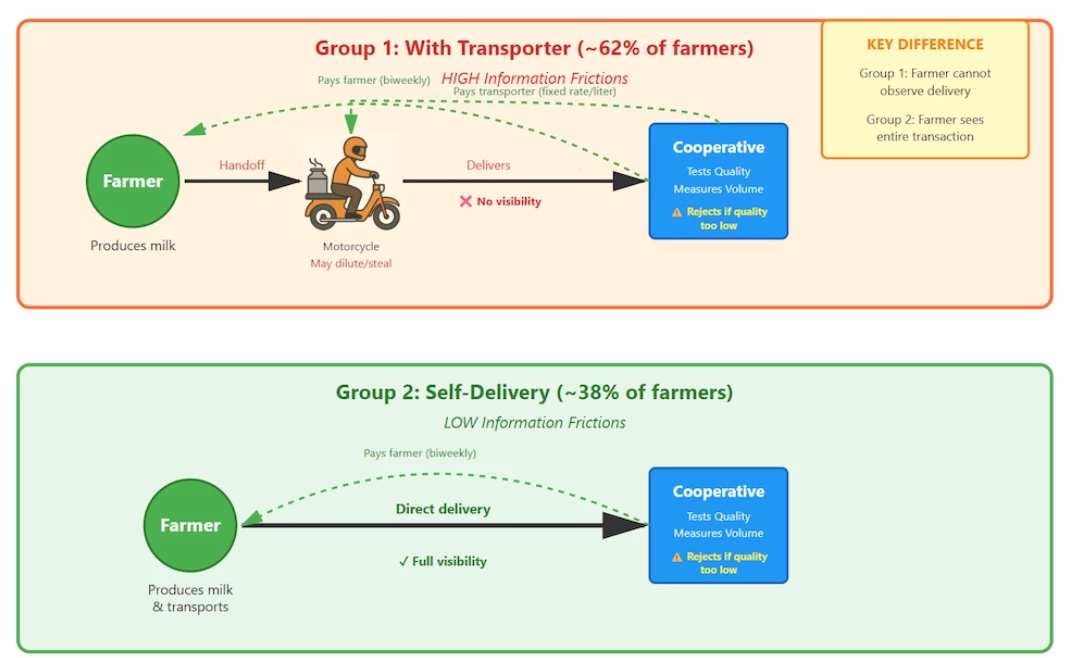
By using a transporter, farmers gain access to markets they otherwise would not be able to reach. However, without direct observation of what happens after pick-up, some transporters underreport volumes, skim milk, or add water to inflate quantities.
Figure 1: Diagram of Farmers by Delivery Method
Solution: Turning Paper into Digital Proof
To address these frictions, in my job market paper (with David Henning), we tested a simple idea: digital receipts.
Every day, we digitized milk delivery records from dairy cooperatives and texted each farmer a summary of their deliveries. Messages were sent twice a week in the local language, RuNyankore. Even when a farmer made no delivery, the system sent a “zero liters” message to close the information loop.
In other words, paper records were converted into verifiable SMS notifications, creating a digital trace of each transaction. By making deliveries visible in near real time, digital receipts aimed to strengthen accountability, improve milk quality, and build trust between farmers, transporters, and cooperatives.
Testing Transparency via Digital Receipts
We partnered with Uganda’s Dairy Development Authority (DDA) and 13 dairy cooperatives across Western Uganda. We randomly assigned 766 farmers to treatment or control. The treatment group started receiving SMS receipts, while the remainder continued without them.
We digitized daily cooperative records, surveyed farmers and transporters, and ran independent milk-quality tests. Treatment began in September 2024 and ran for three months.
This randomized design allows us to isolate the causal impact of digital receipts on transparency, accountability, milk deliveries, and milk quality, while comparing outcomes across two groups facing different levels of information frictions:
- those who use transporters (high information frictions), and
- those who self-deliver milk (low information frictions).
Impacts for Farmers Using Transporters
Digital receipts transformed hidden transactions into observable ones. In this high information-friction scenario:
- Discrepancy detection rose by 20 percentage points: Treated farmers were more likely to notice inconsistencies between milk handed over and milk recorded at the cooperative.
- Transporter switching increased by 14 percentage points: When misbehavior became visible, farmers acted by switching away from dishonest transporters.
- Trust in current transporters declined: As information improved, hidden misbehavior became observable. In the short run, relationships that once relied solely on trust were replaced by verifiable accountability.
- Milk quality improved: Treated farmers delivered milk that was less diluted with water. The improvement (about 0.1 degrees) equals roughly 13% of the seasonal quality gain seen during the rainy season.
These results show that receipts disciplined transporters. By increasing the probability of detection, the intervention reduced the payoff from cheating, making honest behavior incentive-compatible.
Impacts for Farmers Who Self-Deliver
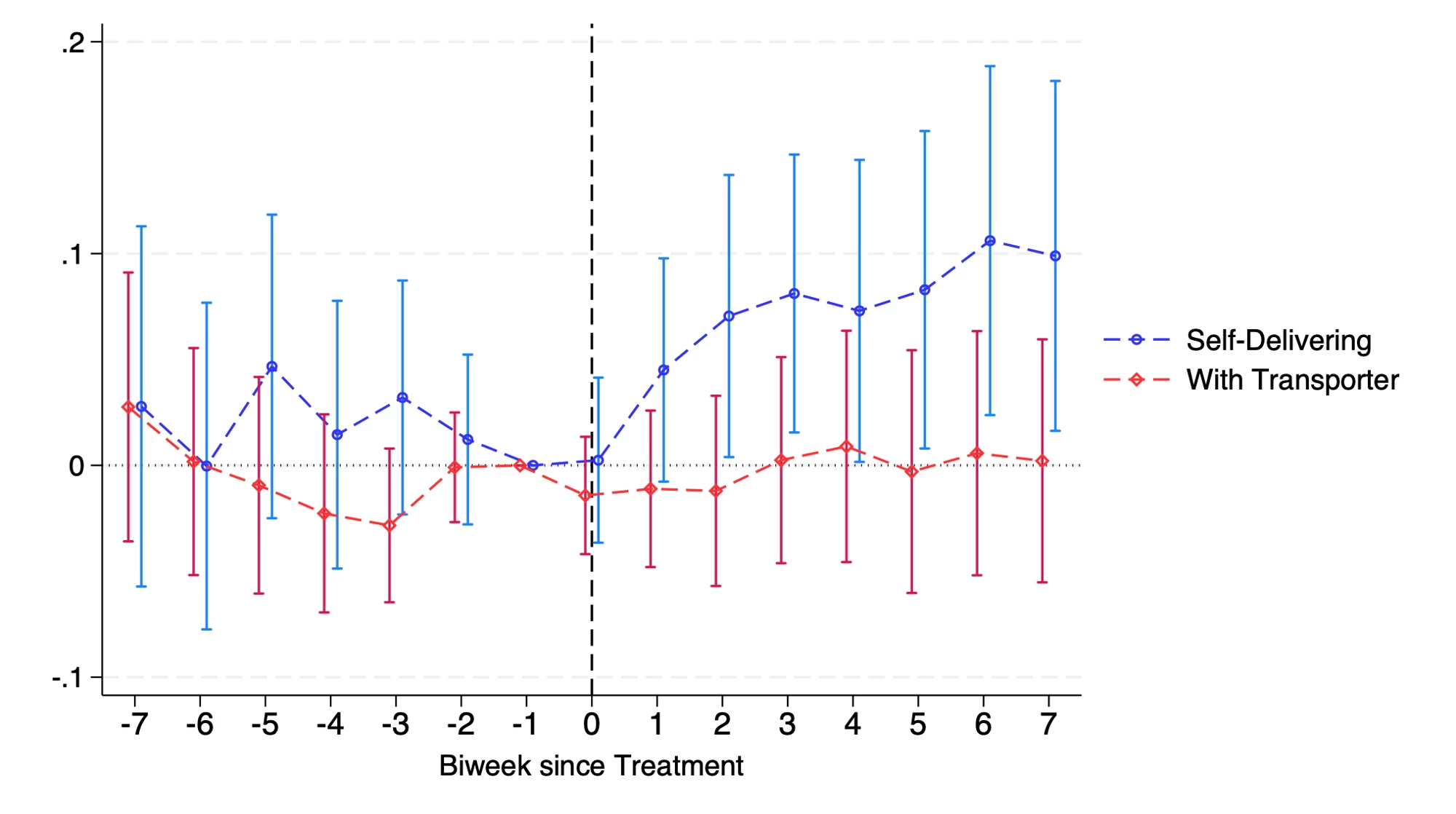
Results looked very different where information frictions were low. In Figure 2, we show that treated self-deliverers were 5 to 9 percentage points more likely to deliver milk during and after the intervention.
Volumes per delivery did not increase, transport capacity on foot or bicycle is fixed, but participation became more consistent. Digital receipts appear to act as a behavioral nudge: reinforcing trust in cooperative record-keeping and reminding farmers of their link to the market.
Figure 2: Event Study on Delivery Likelihood
Why It Works: Making Behavior Observable
The results align with a simple idea from game theory: when behavior becomes observable, incentives change.
In Uganda’s dairy chain, farmer–transporter relationships are informal, repeated interactions built on trust. Digital receipts didn’t create formal contracts, but they introduced observability. Once farmers could verify deliveries, opportunistic behavior became riskier, shifting the equilibrium.
As a result, relational contracts adjusted: Some relationships ended while others strengthened. This new equilibrium produced two key effects:
- Quality upgrading: Less dilution means safer milk and higher processing yields.
- Public-health externalities: The water used for dilution often comes from untreated sources. Reducing dilution with such water decreases pathogen exposure and improves milk safety.
At the same time, transparency exposed hidden misconduct, temporarily lowering reported trust. Making misbehavior observable can challenge relationships, but over time it can replace blind trust with credible accountability.
Implications
Digital receipts cost little to implement, leveraging basic SMS technology already in farmers’ pockets. By converting paper logs into real-time information, they reduce the space for opportunism in markets where monitoring and formal enforcement are weak.
As rural connectivity expands across Sub-Saharan Africa, tools like SMS receipts can be scaled across value chains where lack of transparency still limits accountability and efficiency.
Pedro Magaña Sáenz is a Ph.D. candidate in Applied Economics at the University of Wisconsin–Madison.

Join the Conversation