
This is the 18th in this year’s series of posts by PhD students on the job market.
Despite strong environmental legislation, most developing economies struggle to translate regulation into improved environmental outcomes. This shortfall is often attributed to limited state capacity, but the deeper problem lies in regulatory behavior. Excessive regulatory discretion creates incentives for selective enforcement and capture by powerful actors. This dynamic is particularly evident in India, where environmental rules are set nationally but enforcement is delegated to state agencies that operate under varying degrees of political influence. My job-market paper (with Elena Stella) examines how shifts in state-level political power impact enforcement in one of India’s most polluting industries: the sugar industry in Maharashtra.
Why the Sugar Industry?
The sugar industry in Maharashtra is the ideal setting for various reasons. First, sugar mills are major sources of both water and air pollution and are officially classified among India’s “17 Grossly Polluting Industries”. Second, many mills are chaired by politicians or ex-politicians, making the sector an ideal setting to examine how political power intersects with regulation. We build a comprehensive database linking every sugar mill in Maharashtra to politicians who have contested state or national elections. To capture indirect relationships, we complement this with a large-language-model (LLM)–based tool that scans news articles, public filings, and other documents for hidden ties. This allows me to track which mills are politically connected as well as their political affiliation.
Political Realignment as a Natural Experiment
In India, the state cabinet plays a central role in appointing and overseeing regulatory bodies, giving politically connected firms direct channels to influence how rules are enforced. To causally estimate the impact of political connections, we exploit an unanticipated political crisis in 2022 that led to the mid-term collapse of Maharashtra’s ruling coalition government. The collapse was triggered by an internal split within the coalition, unrelated to economic or environmental factors. This sudden realignment reshuffled cabinet power overnight — some political parties lost access to state cabinet positions while others gained them — without any election. Because many sugar mills are chaired by politicians, the crisis abruptly altered which mills had direct access to cabinet decision-making. This quasi-random redistribution of political influence over the state pollution regulator creates a natural experiment to examine how political power shapes enforcement.
How Environmental Enforcement Works
In India, pollution standards are set federally by the Central Pollution Control Board and enforced locally by each state’s Pollution Control Board. Because enforcement is local, regulators have wide discretion over how often to inspect facilities and how strictly to apply penalties. State Pollution Control Boards grant operating licenses, conduct inspections, and, when violations are detected, issue legally binding “directions”, ranging from mandates for costly technological upgrades to orders suspending production. Although enforcement is formally bureaucratic, it is politically permeable: state cabinets exert direct and indirect influence over regulatory agencies, so regulators’ incentives to sanction polluters often depend on the political alignment of firms and the government in power. When a government reshuffle occurs, it creates sharp variation in firms’ political access to that authority.
Cabinet access matters for enforcement
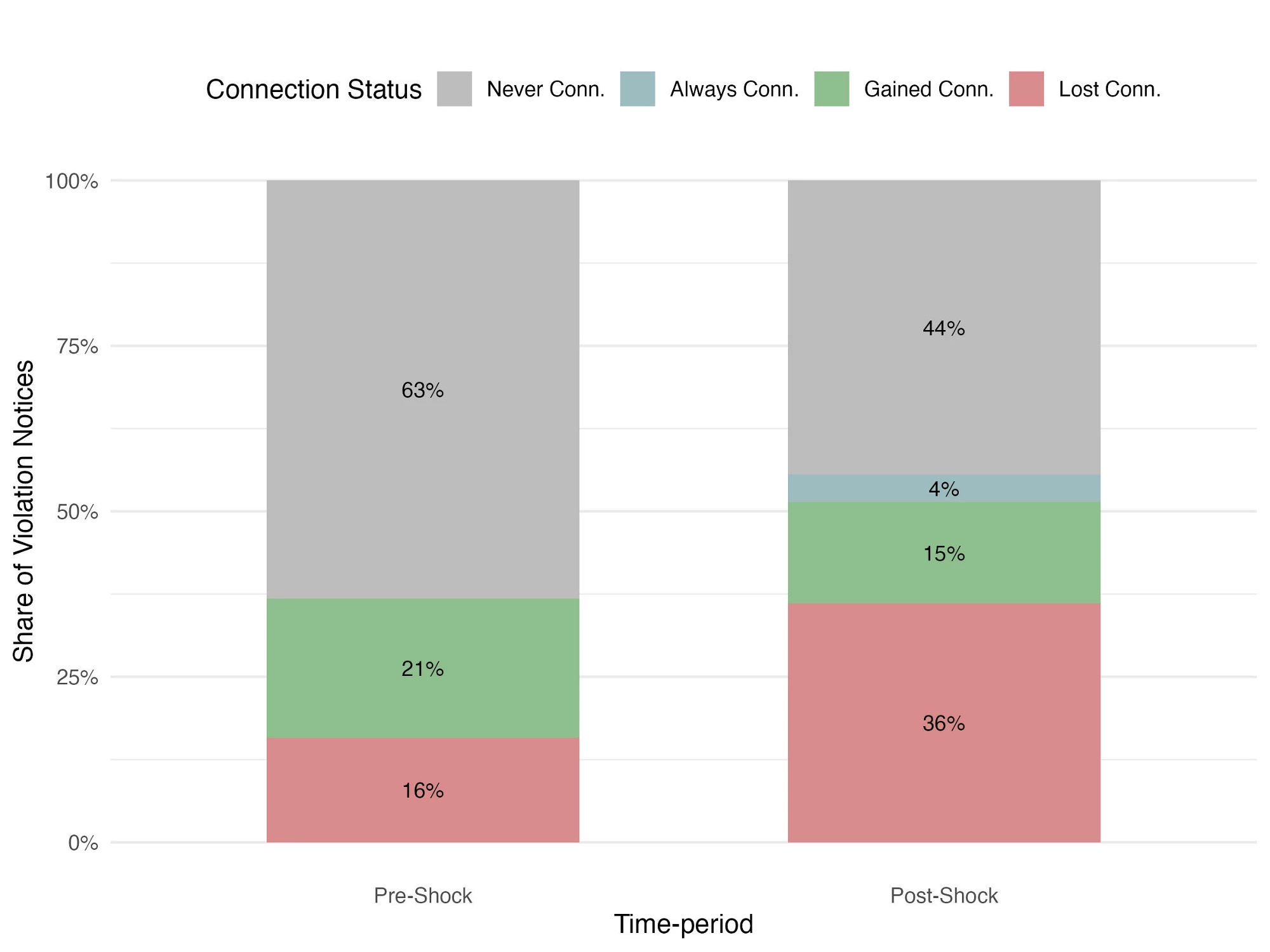
Our first set of results indicate that political connections are salient for environmental enforcement. Using novel administrative data on every MPCB direction issued to sugar mills between 2021 and 2024, we study how enforcement changes after the 2022 crisis. Mills that lost cabinet access saw a sharp increase in regulatory action: post-shock, they receive nearly 12 percentage point more violation notices from the pollution control board, which given the baseline of 14% is nearly a doubling of enforcement intensity. In contrast, mills that gained new cabinet access showed no change in enforcement intensity.
This suggests that enforcement responds to shifts in political power. Mills tied to the opposition experience a sharper rise in regulatory action once their patrons lose power. Rather than shielding allies, enforcement appears to be used more actively to punish rivals, reflecting how political incentives shape where regulatory effort is directed.
Capture or Compliance?
While losing cabinet access leads to more enforcement, this alone does not prove regulatory capture. Another potential explanation is that political access lowers the cost of compliance by providing mills with easier access to government-backed loans or other resources. When that access disappears, compliance becomes costlier, and pollution may increase. To disentangle these channels, we examine how enforcement changes across different types of inspections: those that regulators undertake proactively (discretionary) versus those they are required to pursue in response to complaints or higher-level interventions (non-discretionary). The idea is that notices triggered by complaints or higher-level interventions reflect underlying changes in pollution behavior, while discretionary notices are indicative of capture.
We find that the increase in enforcement is driven almost entirely by discretionary inspections, conducted at the regulator’s own judgment. Violation notices from discretionary actions increase by roughly 8 percentage points — a tripling relative to the 4% baseline. Non-discretionary inspections, which regulators are legally obligated to conduct and which reflect underlying compliance by mills, remain unchanged. This demonstrates that the same regulatory capacity can produce very different outcomes depending on who holds political power, consistent with the presence of political capture.
Takeaway for environmental governance
These findings suggest that improving governance and enforcement is not simply a matter of limited capacity, but of how that capacity is used. When regulators have wide discretion without adequate accountability, enforcement can be captured by vested interests. Improving environmental outcomes therefore requires not only more resources, but, more importantly, more effective use of existing resources. Robust institutional designs that limit discretionary power, along with transparent enforcement systems, can help ensure that regulatory decisions remain independent of political or external influence. Strengthening these mechanisms could lead to better outcomes at current capacity levels.
--
Sanjana Ghosh is a PhD student at Kellogg School of Management – Northwestern University. Her research interests are in Environmental and Energy Economics, focusing on firms and regulations.

Join the Conversation