
This is the 19th in this year’s series of posts by PhD students on the job market.
Urban flooding is a widespread and costly phenomenon across sub-Saharan Africa that is expected to increase as urban populations expand into flood-prone areas. Firms located in flood-prone areas face decisions about whether to invest in flood mitigation technologies prior to rainy seasons. Installing wooden pallets or shelving inside the firm protects inventory and does not impact nearby structures. But, if a firm builds a barrier to divert floodwater, the new structure may redirect water towards their neighbors, potentially protecting their own firm at the expense of others. Firms making individual investment decisions may not fully internalize the externality of greater flooding for their neighbors, possibly overinvesting in spillover generating technologies.
In my job market paper, I conduct a randomized control trial with small retail firms in Dakar, Senegal to explore the impacts of individual defensive investments. I answer the following questions: Does reducing the cost of investment induce firms to make defensive investments? Do these investments generate spillovers? And, does having firms attend a short, group meeting help mitigate these spillovers?
Flooding Is Bad for Small Retail Firms
The rainy season (July – October) in Dakar, Senegal brings substantial flood risk. In flood-prone areas, 84% of firms report flooding in nearby streets during the last rainy season and 36% of firms report flooding in the firm itself. Firms that flooded in the previous rainy season did so an average of three times, and the water lasted around two days for each flood.
Urban flooding causes significant losses for these small retail firms. Flooding forces firms to close, destroys inventory, and can decrease customer traffic. Firms that flooded last year lost 38% of the median firm monthly revenue in inventory in the flood. Furthermore, even nine months later, firms that flooded experience almost a 30% decrease in customer traffic compared to firms with the same flood risk that did not flood. Flooding is costly for these firms and 62% report wanting to do more to protect themselves. Cost is the overwhelming reason why firms choose not to make these desired defensive investments.
The Experiment: Vouchers for Investment Technologies and Community Meetings
I incentivized some firms to invest in flood-loss mitigation technologies to test whether reducing the cost spurs investment and whether individual defensive investments have spillover effects. Firms were grouped into small local communities of three to six nearby (on average less than 100m apart) stores. I randomly assigned each local community to a control or one of two treatment arms. Control firms participated in surveys but had no further payment or interaction with the survey team. In one treatment arm, firms got their individual choice of an equal-valued ($12 USD) voucher for either two bags of cement or two wooden pallets. In the other treatment arm, firms attended a local community meeting. At this meeting, firms made a collective decision on which voucher type each firm at the meeting would receive. The meeting subtly encouraged firms to think about how their voucher choice could impact their neighbors as they started to make their investment decisions by asking them which voucher choice was best for the group gathered to start the discussion. The meeting also allowed for discussion about flooding and potential adaptation.
Reducing the Cost Spurs Investments
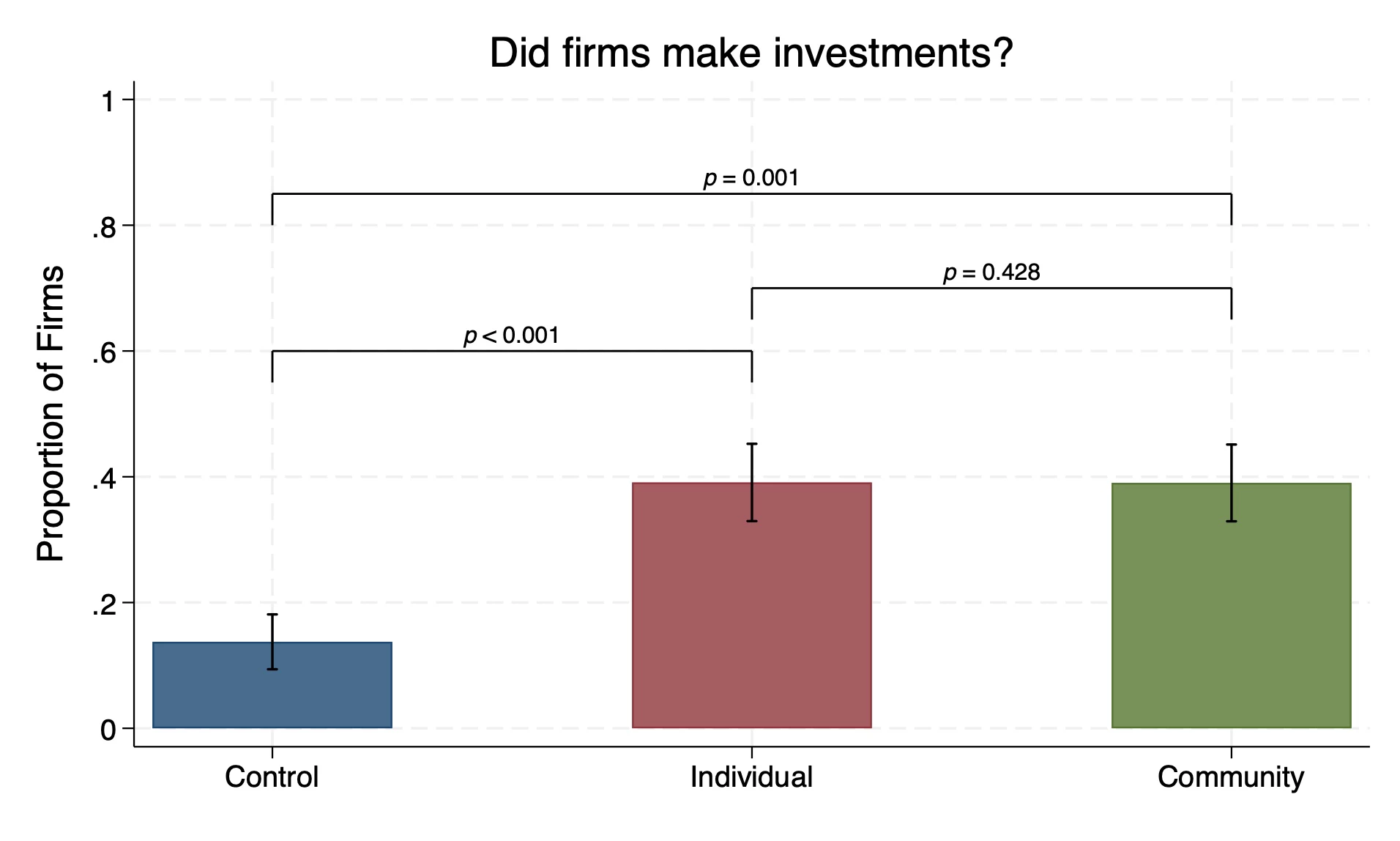
Across both treatment arms, firms vastly preferred (84%) vouchers for cement. Firms then used the vouchers to make defensive investments (see Figure 1). Firms in both treatment arms roughly doubled their rate of investment in barriers, wooden pallets, or shelving units compared to the control. There is no significant difference in the rate of investment or voucher preferences across the two treatment arms. In both cases, firms used cement vouchers to build or improve existing structures paying any additional costs beyond two bags of cement themselves. However, firms that receive vouchers with a local community meeting were more likely to build new structures as opposed to improving existing structures.
Flood-Related Losses Only Decrease when Coupled with Community Meetings
Only firms that received vouchers and went to a local community meeting experienced decreased flood-related losses. Firms who got vouchers with a local community meeting lost around $17 USD (10% of median baseline monthly profit) less in inventory due to flooding relative to the control group, on average. These same firms also experienced shorter temporary firm closures due to flooding. Firms that received a voucher individually without a community meeting did not experience an improvement in flood-related inventory losses or temporary firm closures for firms assigned to receive a voucher individually relative to the control. Flood-related losses decreased when firms attend local community meetings, but not when they made their voucher choice individually.
Uncoordinated Investments Cause Additional Temporary Firm Closures
While firms build at similar rates across both treatment arms, there are clear differences in flood-related losses that suggest it matters how firms make their investments. To directly study the impact of spillovers, I use information on the location and elevation of firms that received vouchers. Firms with an additional uphill neighbor who made their voucher choice individually were 7% more likely to have to close due to a flood. This temporary firm closures also lasted longer. In contrast, I find no evidence that investments by firms after attending local community meetings impacted their neighbors. These results suggest that individual investments cause spillovers as additional water gets diverted downhill. The local community meetings pushed firms to invest in ways that reduced flood-losses while minimizing spillover effects on nearby firms.
Implications for Incentivizing Defensive Investments
Urban flooding poses significant challenges for small retail firms in Dakar, Senegal. Firms are willing to invest in flood mitigation technologies when I subsidized material costs. Uncoordinated investments produced negative spillover effects, but short community meetings allowed firms to reduce flood losses while minimizing the impact on their neighbors.
The one-year inventory savings for firms who attended a local community meeting exceeds their voucher cost. Combining the estimated inventory savings with conservative estimates of the total cost firms spend building new structures, I estimate annualized rate of return on investment with community meetings to be 2.3%. While the return is relatively modest, investments without community meetings fail to reduce flood-related losses.
Policy makers should pay particular attention to potential externalities when devising policies that incentivize individual defensive investments intended to mitigate damage from natural disasters. Investment policies should encourage individuals to think about how their actions may impact others. Policy makers should also leverage community resource management strategies to help promote investments that improve individual outcomes while minimizing spillovers.
Molly Doruska is a PhD candidate at Cornell University.

Join the Conversation