
Low agricultural productivity in developing countries is often linked to limited mechanization. Using tractors for land preparation can significantly increase farm productivity, but most farmers are too small to afford their own. In principle, rental markets could overcome this barrier and help them mechanize. In practice, however, they remain underdeveloped in agriculture.
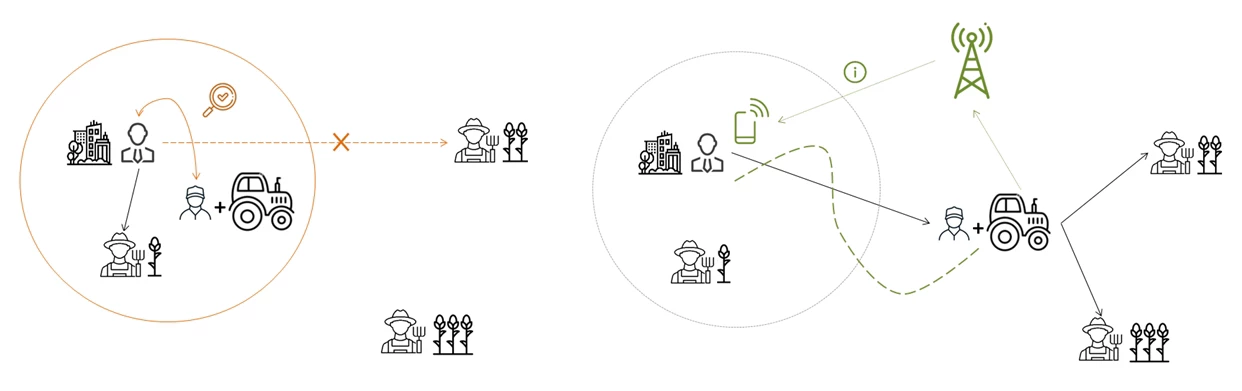
Tractors – unlike stationary machinery – need to move across space to be shared efficiently, creating unique challenges. Tractor owners typically hire operators to drive their tractors and provide mechanization services to farmers. However, they cannot easily observe the operators’ actions, giving rise to moral hazard. For example, operators may underreport the number of jobs or acres serviced, which lowers owners’ revenue and raises maintenance costs. To mitigate these risks, owners prefer to keep tractors close to home or in areas where they can rely on trusted contacts to supervise and control them directly, e.g. through unannounced field visits or checking fuel consumption upon return (Figure 1, left).
However, the areas where tractor owners are willing to send their tractors are not necessarily those where they are most needed or most productive. Two features likely exacerbate the monitoring problem and this resulting gap between where tractors are and where they are needed. First, with rapid urbanization tractors are increasingly owned by entrepreneurs and wage workers based in cities, who invest in them to rent out to farmers on the side, often far from the most productive rural areas. Second, because planting seasons differ across regions, tractors are in demand only briefly in any one location, making efficient and profitable use dependent on their ability to move with the rains.
In my job market paper, I study how these monitoring frictions matter for the spatial allocation of tractors in Kenya, leveraging the introduction of a GPS tracking app for tractors that allows owners to monitor their operators remotely (Figure 1, right). Using georeferenced activity records from all tractors that adopted the new monitoring technology – covering about 1,200 tractors and 900,000 fields over seven years – along with home locations inferred from nighttime pings, I show how digital monitoring changes spatial patterns of tractor use and how this affects productivity.
Figure 1. Illustration of Tractor Activity under Traditional vs. Digital Monitoring
Does digital monitoring increase tractor mobility?
To assess the effects of digital monitoring, I look at how each tractor’s activity evolves over time compared to the first month after adoption, when owners and operators are still adapting to monitoring. I find that tractors gradually extend their range of operations, servicing jobs that are on average 55 km further away from home after one year of monitoring, which corresponds to an increase of about 80% over the baseline mean (Figure 2). This pattern reflects greater mobility and is consistent with a reduction in the moral hazard problem, as owners build trust and learn to use the additional information from the app to better manage their operators.
Where do tractors go?
The previous result suggests that tractors expand into new areas over time. To understand how these areas differ, I link job locations to agro-ecological potential yields from the FAO-GAEZ database via location and compute the marginal return to mechanization for each location as the difference in predicted yields between high- and low-input scenarios. Using the same specification, I find that tractors increasingly shift toward areas where marginal returns are higher (Figure 2). This suggests that the observed reallocation after adoption is efficiency-enhancing, as owners give their operators more freedom to experiment and learn where demand is high.
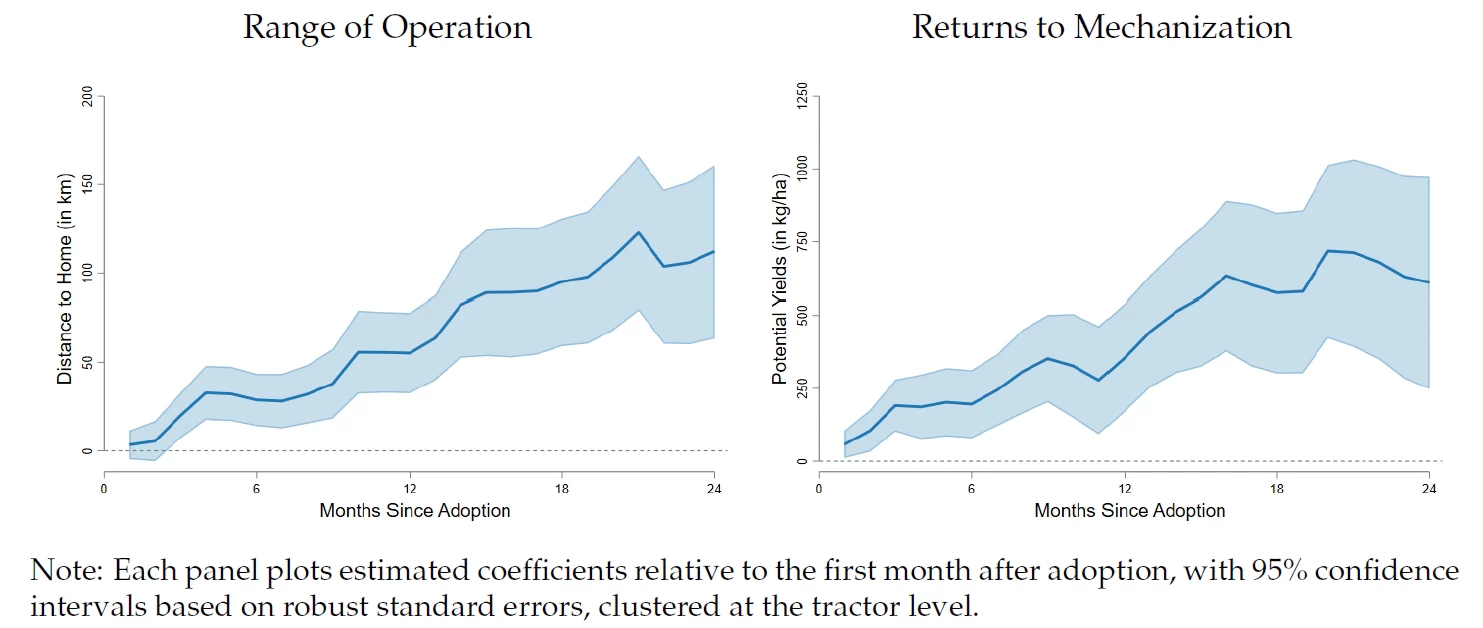
Figure 2. Tractor Mobility and Spatial Reallocation After Adoption
What about actual yields?
Next, I examine whether greater mobility and improved sorting translate into higher agricultural productivity, using satellite data. I construct a proxy for productivity based on a measure of vegetation health and density (Normalized Difference Vegetation Index), taking the difference between its value at the peak and the start of the growing season. This captures mechanization, as fields that were prepared with a tractor would start bare and green up more strongly after planting. I then compare each serviced field to a nearby field with similar pre-treatment characteristics before and after the tractor visit. I find that fields serviced by a monitored tractor experience a large jump in field-level vegetation growth in the year of the visit (about 0.4 SD). Since the control fields may or may not have been mechanized, this estimate represents a lower bound on the overall effect of mechanization on productivity, or the differential effect of monitoring relative to average mechanization levels.
Quantifying aggregate efficiency gains
Because measuring aggregate output effects empirically is difficult and would miss equilibrium effects of reallocating scarce capital across locations, I develop a quantitative spatial model of tractor location choice to quantify the gains from reduced monitoring frictions. In the model, tractor owners decide where to send their tractor given some cost of moving that include monitoring costs. Better monitoring makes these choices less sensitive to distance. I calibrate the model using my unique GPS data and structurally estimate how digital monitoring shifts these costs, exploiting the same gradual adaptation process as documented above. Simulating equilibria where tractors behave as if they had just adopted digital monitoring versus after five years of experience, I find that improved monitoring reduces spatial misallocation by about 15% and raises aggregate output by around 2%.
Takeaways
This paper shows how monitoring frictions on the supply side of tractor rental market can constrain tractor mobility and limit the efficient spatial allocation of capital. The findings highlight how digital technology can be used as an easily scalable and cost-effective tool to expand farmers’ access to mechanization and raise agricultural productivity. More broadly, the results suggest that reducing information frictions in sectors involving the delegated operation of mobile capital (e.g. trucking, ride-hailing, public transportation) can unlock productivity gains in developing countries and beyond.
Sophie Nottmeyer is a recent PhD graduate and Job Market Candidate at CEMFI.

Join the Conversation