
This is the 16th in this year’s series of posts by PhD students on the job market.
In India, 250 million married women of working age remain out of the labor market, and more than one in three report that they would not be allowed to work even if an appropriate job came up (Desai et al., 2012). In many instances, husbands are the primary decision-makers over their wives’ labor market decisions. At the same time, most men and women in India express support for the idea of women working outside the home (Bursztyn et al., 2023). These facts raise the possibility that what husbands oppose is not women working per se, but rather specific activities that are associated with work. I study one such activity – common to most jobs in most sectors – interacting with male colleagues. In addition to posing potential safety risks, spousal opposition to such interactions may reflect spousal jealousy.
High levels of spousal jealousy are common in my setting. In my experimental sample, 60% of women report that their husbands would be jealous or angry if they interacted with other men at work. In a first experiment, I test whether the presence of male co-workers suppresses women’s labor supply and consider four possible mechanisms – spousal jealousy, workplace safety, social image concerns, and quality of interactions with workplace peers (for example, women might find other women more supportive or easier to talk to). I use a second experiment to isolate spousal jealousy as a causal mechanism.
Providing a women-only workplace produced a large increase in labor supply
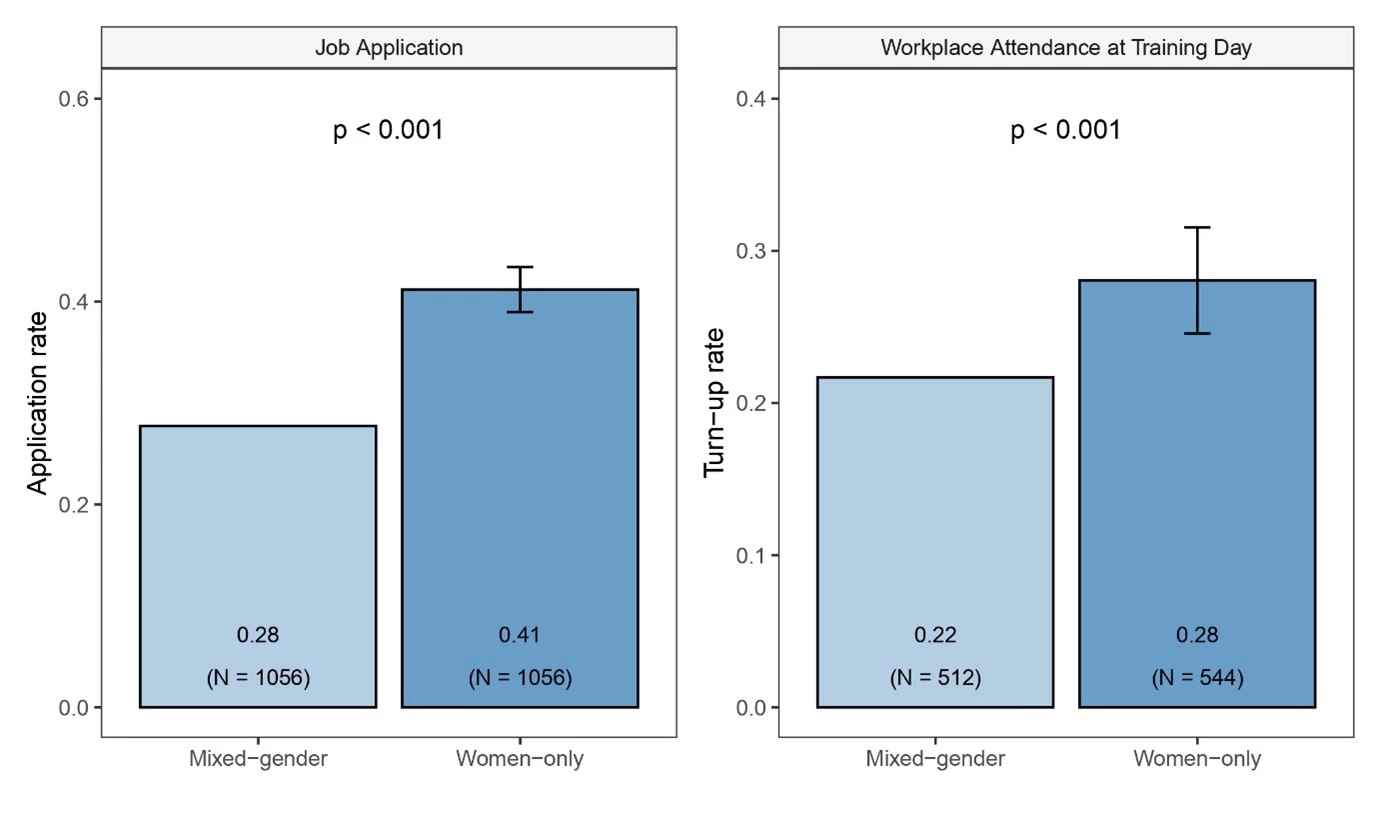
In the first experiment, I partnered with a business process outsourcing firm in Patna, Bihar to offer identical two-week job opportunities to married women in either a mixed-gender or a women-only office. The jobs, pay, tasks, and amenities were identical; only the gender composition differed. I randomized whether women were eligible to work in either the women-only or mixed office. Women were 46% more likely to apply for jobs in the women-only office and 31% more likely to actually show up for work. These effects are large: I also randomized wage offers for the two-week contract across participants and found that the gain in labor supply from having a women-only workplace was equivalent to offering 2.5 times the wage.
Does this reflect workplace safety concerns?
To test whether workplace safety concerns are driving these preferences, I cross-randomized whether women received information about rigorous safety measures at the workplace: security cameras, female security guards, sexual harassment training, and reference checks. The safety treatment significantly improved women's perceptions about how safe it would be to work at the mixed office but had no impact on job application rates or workplace attendance, suggesting workplace safety concerns cannot explain the patterns.
Effects were significantly stronger in households with more jealous husbands
I also measured spousal jealousy by asking women whether their husbands exhibit jealous tendencies. I find that preferences for women-only workplace were significantly stronger in households with more jealous husbands. These results were robust to controlling for age, education, religion, caste, and several other factors. While this provides suggestive evidence that the results are coming from spousal jealousy, it does not rule out that preferences for the women-only office are coming from some unobservable factor that is correlated with jealousy. In particular, in the first experiment, I cannot rule out that women simply prefer working with other women because they make for better co-workers. I therefore conduct a mechanism experiment to isolate spousal jealousy as a causal factor.
Isolating the spousal jealousy mechanism
In the second experiment, I recruited 210 married women who were interested in a women-only job that came with a compulsory online peer support program. In this program, women would receive work advice from a more experienced colleague at another office through phone calls, video calls, and WhatsApp messages — all standard modes of communication in Indian offices. Interactions occurred remotely on office devices in private, minimizing physical safety and social stigma concerns.
To measure preferences for female peers, I offered women and their husbands the option to forgo 20-35% of the salary to guarantee assignment to a female peer rather than risk having a (presumably male) standard peer. For ethical reasons, to ensure no potential future spousal conflict, when the peer support program was implemented, all women were matched with a female peer, even those that did not pay the fee, but importantly, they did not know this when making their choices. Over half (53%) of households paid the fee to guarantee a female peer when the discussions happened one-on-one (Figure 2). The fee was roughly equivalent to a full day of total income for the median household. This substantial willingness to pay reinforced the results from the first experiment that women have strong preferences for female co-workers that extend beyond workplace safety or social image concerns. However, it could still be that households preferred the female peer because they would make for a better mentor.
Husband monitoring reduced demand for female peers
To test whether spousal jealousy drove these preferences, I introduced a treatment, called the husband program, where husbands could join the peer support discussions or receive recordings if they could not attend. Demand for female peers dropped substantially (by 19 percentage points) when husbands could monitor conversations (Figure 2). This decline was significantly larger in households with more jealous husbands.
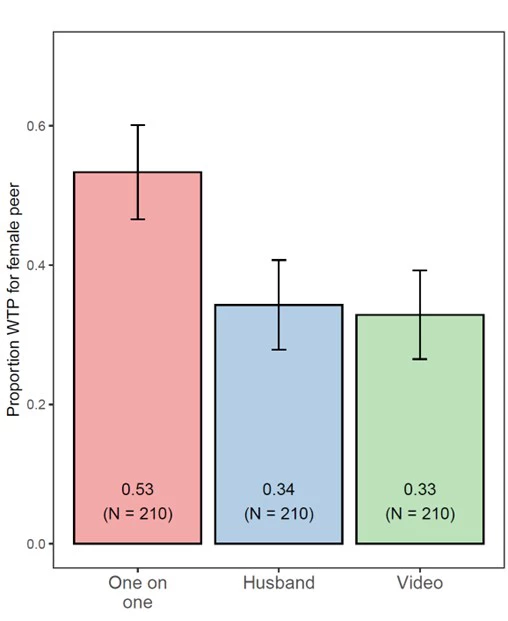
Figure 2: Demand for a female peer across peer support programs
Eliminating the peer quality mechanism
One could still argue that perhaps female peers are valuable because they offer better advice but the value of this drops when the husband is present. To rule out peer quality completely, I introduce another treatment arm, called the video program, where women watched pre-recorded videos of their peers rather than interacting directly, and were told the script was identical regardless of the peer's gender. If households cared about peer quality, preferences for female peers should disappear when the content is exactly the same. Yet one-third of households still paid for a female peer when simply watching videos, suggesting that peer quality is unlikely to explain the results and pointing to spousal jealousy being a constraint on women’s labor market choices. Qualitative interviews with a separate sample confirmed this interpretation: 84% of respondents said husbands would prefer their wives watch videos of a female peer due to jealousy.
Labor market implications
The results have important implications for labor market efficiency. Implementing a women-only workplace may be costly for firms, and as such, these workplaces are not exceedingly common. In India, only 9% of manufacturing firms with 20 or more workers have all-women production employees. Given that many women exhibit strong preferences for women-only workplaces, they may be restricted to working in select firms or industries. This may result in misallocation of labor across firms and sectors, including the home sector (Hsieh et al., 2019). Even if women do find work opportunities, if these preferences give firms monopsony power over workers, this may allow firms to drive down women’s wages (Sharma, 2023).
The results may also help us to understand the mechanisms driving other important empirical findings in the literature, for example, women’s aversion to working outside the home (Ho et al., 2024; Jalota and Ho, 2024) and mixed-gender transportation (Garlick et al., 2025). These activities all involve the potential for unmonitored interactions between women and men outside of their family.
Policy implications
The study has several important policy implications:
- Providing women-only workplaces can dramatically increase women’s labor supply. Achieving a similar increase through purely economic incentives would require raising wages by approximately 2.5 times.
- I find that a low-cost workplace safety intervention had no impact on women’s labor supply, but nevertheless improved women’s perception of safety at mixed-gender workplaces and could thus potentially enhance worker welfare.
- While this project takes spousal jealousy as a given and studies workplace interventions that work around it, future work should explore psychological interventions that target jealousy directly.
Kailash Rajah is a PhD candidate at the Massachusetts Institute of Technology.

Join the Conversation