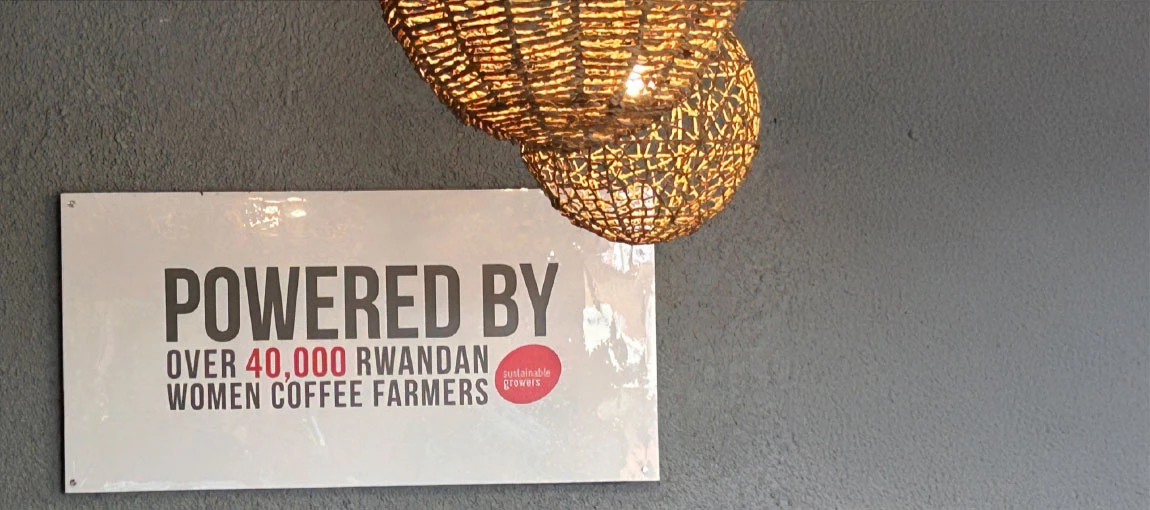
 A sign inside Question Coffee highlighting its roots in a network of Rwandan women coffee farmers who supply specialty-grade beans through Sustainable Growers. Photo: Abhas Jha/World Bank
On a clear Tuesday morning in Kigali, I sat in Question Coffee Café, a space that at first feels like a teleportation device to Brooklyn or Berlin. There is the familiar hiss of a La Marzocco espresso machine, minimalist wood counters, and latte art shaped with precision. But the first sip quickly grounds you in Rwanda: the tea-like brightness and citrus notes of Red Bourbon, distinctive, local, and unmistakably Rwandan.
The aesthetics may be global, but the product is deeply rooted in Rwanda’s rural economy. And the more I asked questions, the more it felt like this café was not just serving coffee, it was operating as a jobs laboratory.
The economics of "small"
Jean Aime Niyunkuru, the Executive Manager of Question Coffee, walked me through the numbers. The enterprise now works with 56,000 farmers across Rwanda, the Democratic Republic of Congo, and Tanzania, organized through 27 cooperatives. Women comprise about 57% of Rwanda’s roughly 400,000 smallholder coffee farmers, making them a majority in the sector, though they often face barriers like limited land control, lower-paid roles, and unequal market access. Question Coffee aims to work specifically with women because its model targets them to address these gaps, providing premium prices, tools, and direct cooperative links that enhance economic independence.
Programs like Question Coffee’s have drawn women in by forming women-led cooperatives and offering targeted training, reaching over 30,000 participants across Rwanda. While women do not necessarily produce more volume than men overall, trained participants yield higher-quality coffee commanding better prices, with evidence of increased supplier numbers (e.g., tripling at one partner company
To an economist, the baseline looks fragile. Most of these farmers work plots of about half a hectare. On a spreadsheet, this is marginal land, susceptible to climate shocks and price volatility.
Yet the story he told was about an economic shift, albeit at the micro-level.
"What has really changed for the women farmers is that they can now contribute to family expenses and assets," he said. "Women now have a new sense of confidence and influence in their community. Income becomes voice."
Voice changes who decides what gets planted, which child stays in school, and how a family rides out a bad season.
Escaping the "c-price" trap
Behind that voice is a rigorous investment in agronomy by Bloomberg Philanthropies and the Sustainable Growers’ Relationship Coffee Institute, which since 2013 have organized year-long trainings for farmers. This isn't just about pruning. It is an economic intervention designed to decouple farmers from the "C-price"—the volatile global benchmark set by traders in New York that treats coffee as a generic raw material like oil or wheat.
When farmers are stuck in the C-price market, a frost in Brazil or speculation on Wall Street can crash prices below the cost of production, regardless of how hard they work. To escape this, they must target the "specialty market," where prices are based on quality, not global speculation. To qualify, coffee must score 80+ points on a standardized scale. Achieving that requires "climate-smart" farming, organic fertilizer production, and financial literacy so farmers (especially women) can read the profit-and-loss statements behind their harvest.
Question Coffee is the urban engine of this system. It operates as a social enterprise with a circular mandate:
- The Showroom: Provide a high-visibility retail market for women-grown specialty coffee.
- The Funding Model: Net proceeds from every cup sold in Kigali fund the next round of training.
- The Experience: Give visitors a place to discover Rwandan coffee "from seed to sip."

Baristas at Question Coffee prepare specialty brews while sharing the stories behind the beans. Photo: Abhas Jha/World Bank
Why robots can’t take this job
Later, I asked Leah Tuyshime, the café manager, what outsiders miss about this industry.
"People don't see the effort," she said. "From planting the seed to harvesting the first bean can take up to four years. That creates a very particular relationship with risk."
This is where the "Future of Work" debate usually misses the mark.
We often assume automation threatens low-skill labor first. But in this context, the geography and the business model act as firewalls. A robot can assemble a smartphone on a flat factory line. But it cannot yet navigate the unstructured chaos of a Rwandan slope during the rainy season to differentiate a "perfectly ripe" cherry from an "almost ripe" one.
More importantly, a robot cannot manage trust.
- It cannot sit with a cooperative leader to balance fertilizer loans against school fees.
- It cannot stand behind the bar at Question Coffee, sense a customer’s curiosity, and translate the technical details of a coffee’s "Nyamasheke wash" into a story that inspires and motivates a tourist to book a trek to see the bean farm, generating $200 more for the business.
The value here is the coffee and the context surrounding the bean. Humans are the only ones capable of maintaining that high-context narrative.
So what? Jobs and inclusive urbanization
As we meet counterparts in Kigali this week, this is the model we keep circling back to. The World Bank’s upcoming phase of engagement in Rwanda is heavily focused on jobs and inclusive urbanization. The challenge we face is that large-scale manufacturing is becoming increasingly capital-intensive. The old pathway of moving millions of people from farms to factories is narrowing.
So, where will the good jobs come from?
Question Coffee offers a blueprint for "inclusive urbanization." It demonstrates that a thriving city shouldn't be an island disconnected from the countryside; it should be the engine that adds value to rural produce.
By using the density and connectivity of Kigali, this model stitches together a sophisticated value chain:
- Rural Production: Cooperatives upgraded into high-value specialty exporters.
- Urban Interface: A layer of baristas, roasters, and logistics experts who translate rural labor into premium products.
- Market Access: The city serves as the showroom that makes rural quality legible to global buyers.

The entrance to Question Coffee in Kigali—an urban showcase for Rwanda’s women-grown specialty coffee and a key link between rural cooperatives and global consumers. Photo: Abhas Jha/World Bank
This is the core of our World Bank jobs agenda. We aren't looking to build cities that just house people, we are looking to build cities that orchestrate these kinds of complex, service-intensive ecosystems.
Which African cities will learn how to turn half-hectare farms and four-year crop cycles into steady, dignified, urban-linked livelihoods?
Rwanda is quietly trying to answer that question, one cup at a time.
Join the Conversation