
A paradox is unfolding across low- and middle-income countries (LMICs). Inflation is receding and the punishing interest rates of recent years are finally easing, offering some relief. International market bonds issuances are gradually returning — at more sustainable prices — providing countries with much needed financing that helps reduce the risk of default and temporarily eases fiscal strains.
Yet for most LMICs, these are modest consolations — and far from sufficient to offset the profound setbacks of this decade. After all, LMICs paid out $741 billion more in principal and interest on their external debt between 2022 and 2024 than they received in new financing — the largest amount in at least 50 years.
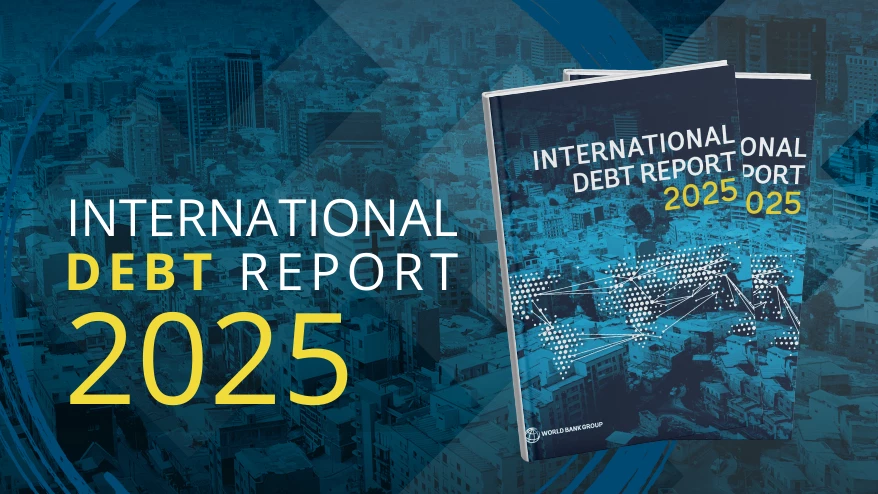
The 2025 edition of the International Debt Report (IDR), the World Bank’s flagship annual publication on debt, reveals that the growth of LMICs’ external debt stock slowed significantly in 2024, increasing just 1.1 percent to reach US$8.9 trillion. However, there’s more to this story than the headline number suggests.
So, what shifted beneath the surface this year to drive LMICs debt stocks?
One major factor was the increase in debt reorganization by LMICs. Such efforts hit their highest level since 2010, with most agreements involving IDA-eligible countries. Reorganizations included restructuring under the Group of Twenty Common Framework, debt swaps, and agreements with private creditors, notably bondholders.
And progress is occurring — on the margins. Haiti, Ghana, Somalia, and Sri Lanka, for example, secured restructuring agreements that shrank their long-term external debt by anywhere from 4 percent to 70 percent. With support from the Global Sovereign Debt Roundtable, Ghana completed its restructuring in half the time of previous processes. Collectively, these steps helped keep LMIC debt stocks lower than they would otherwise have been in 2024.
Another notable shift was in financing patterns. Overall net debt inflows to LMICs rose sharply in 2024 to roughly US$210 billion. However, bilateral flows, i.e., from government-to-government lending, fell to their lowest level since the global financial crisis, dropping to around US$4.5 billion. For IDA‑eligible countries, they declined even further and barely stayed positive, at under US$2 billion. Flows from banks and other private creditors also contracted steeply, by about 75 percent to US$15 billion. With these sources of funding not being as readily available as before, many LMICs looked elsewhere to meet urgent fiscal needs — turning to bond markets where possible and relying more heavily on multilateral lenders like the World Bank to keep critical investments and services on track.
As a result, bondholders and multilateral institutions drove the increase in LMIC debt stock, together supplying the vast majority of long‑term inflows. Multilateral creditors remained pivotal, providing nearly half of long-term net financing to LMICs. The World Bank’s net flows reached a record high of about US$36 billion. For IDA eligible countries, the Bank delivered significantly more in low-cost financing than it received in principal repayments, underscoring its role as the largest provider of net new financing.
Furthermore, while external indebtedness eased for some LMICs, domestic borrowing rose in many countries. Of 86 countries with available data on domestic debt, 62 saw it increase from 2023 to 2024, and more than half recorded domestic government debt as growing faster than external debt — signaling a pivot to local financing.
And while the growth of domestic capital markets is a welcome development, it also has potential downsides. As governments borrow more locally, local banks tend to hold more sovereign bonds instead of lending to businesses, crowding out private investment. Domestic debt also typically carries shorter maturities, heightening refinancing and rollover risks.
For the second year running, LMICs’ interest payments on external debt hit a new record. Payments are now more than twice the level a decade ago, driven largely by public sector borrowing. Higher debt service costs squeeze budgets for essential services and social protections. The effects are most acute in high-debt countries, where large shares of the population already struggle to afford a minimum daily diet for long-term health.
In addition to a comprehensive report on recent debt levels and trends, IDR 2025 provides an analysis of the near-term macroeconomic outlook and risks facing LMICs amid shifting global financial and trade conditions. It examines changing debt patterns by region, the impact of elevated debt servicing burdens on development priorities, and progress on the debt transparency agenda. The report underscores the critical role of the World Bank in advancing sound debt management practices, improving debt data accuracy, and fostering collaboration between borrowers and creditors.
Access the full IDR 2025 and related International Debt Statistics database here.
Join the Conversation