 Updated World Development Indicators help track universal health coverage by measuring both access to essential health services and financial hardship from out-of-pocket health spending. Pictured, a paramedic outside a hospital in Valencia, Spain's third largest city. / Photo: Shutterstock
In a remote village, a mother watches her child struggle with a high fever. The nearest clinic is hours away and even if she gets there, paying for treatment would mean skipping meals, pulling the other child out of school, or delaying the rent. Situations like this are common across the world, where out-of-pocket payments for health care remain a routine part of everyday life.
Universal Health Coverage (UHC) aims to ensure that all people can access the health services they need — of sufficient quality, when and where they are needed — without suffering financial hardship. UHC is a cornerstone of global development and a central commitment of the Sustainable Development Goals (SDGs). Ensuring access to quality health services is not only important for improving health outcomes, but also for boosting human capital. Protecting households from medical costs is not just a health issue. It is a way to prevent shocks from becoming a poverty trap and to help countries invest in their people.
Despite progress, the world remains off track to achieve universal health coverage (UHC) by 2030. Service coverage has expanded and financial hardship from health spending has declined, yet billions of people still lack access to essential services, and many households continue to experience substantial reductions in living standards due to out-of-pocket health payments. During the period since the adoption of the Sustainable Development Goals in 2015, progress on both service coverage and financial protection has slowed, highlighting the need for stronger policy action and improved measurement to better inform decision-making.
Figure 1. Global trend in the Service Coverage Index and financial hardship with extrapolation to 2030 (last year of the SDG era)
The SDG framework has tracked progress toward universal health coverage (UHC) since 2015 using two indicators — SDG 3.8.1 and 3.8.2. In 2025, following a comprehensive review of the SDG indicator framework, the United Nations Statistical Commission approved revisions to both indicators proposed jointly by the World Health Organization (WHO) and the World Bank. These updates, reflected in Tracking Universal Health Coverage: 2025 Global Monitoring Report and the World Development Indicators (WDI), offer a more accurate and policy-relevant assessment of UHC progress.
Measuring UHC: two complementary dimensions
The revised global UHC monitoring framework continues to rely on the following two indicators:
SDG indicator 3.8.1, the UHC Service Coverage Index (SCI), is a composite measure proxying coverage of essential health services.
SDG indicator 3.8.2 tracks the proportion of the population facing financial hardship due to out-of-pocket (OOP) health spending.
Together, these indicators reflect the two core dimensions of universal health coverage (UHC): service coverage and financial protection. They assess whether health systems deliver essential services broadly and equitably, and whether people can use those services without facing financial hardship or being pushed into poverty.
Designing global indicators for UHC, however, is inherently complex. Countries differ widely in disease profiles, health system organization, and data availability. Measures that are meaningful in one setting may be less informative in another, making it challenging to identify indicators that allow for fair and comparable assessments across diverse contexts.
What’s new in the UHC Service Coverage Index
The UHC Service Coverage Index is a composite measure with a score ranging from 0 to 100, based on 14 tracer indicators across four domains: reproductive, maternal, newborn and child health (RMNCH); infectious diseases; noncommunicable diseases; and service capacity and access. While the index score cannot be interpreted as the percentage of the population that has its needs for health care met, the joint performance of the different indicators is interpreted as indicative of overall service coverage.
In 2025, the SCI has been revised in two important ways.
First, three of the 14 tracer indicators have been updated to better align with other SDG indicators, to replace a proxy with an actual measure of coverage, and to improve data availability.
Table 1. Revisions to UHC Service Coverage Index tracer indicators
Second, the SCI now uses a new weighting scheme. Previously, tracer indicators were equally weighted within each domain. While transparent, this approach led global SCI trends to be disproportionately driven by infectious disease interventions — especially antiretroviral therapy (ART) for HIV, which accounted for more than 60 percent of the global SCI change between 2000 and 2021.
The revised SCI adopts a population-weighted geometric mean, which reflects the number of people affected by each tracer indicator. This reduces the dominance of individual services and produces a more balanced measure of service coverage, while preserving the SCI’s overall structure as a geometric mean of the four domain subindices.
A more inclusive measure of financial hardship
The revision of SDG indicator 3.8.2 represents a substantive shift in how financial protection is measured. The original indicator focused on catastrophic health spending, defined as out-of-pocket (OOP) payments exceeding 10 or 25 percent of total household income or consumption. While this captured very high health expenditures, it did not fully reflect the burden faced by poorer households, for whom even modest OOP payments can crowd out spending on basic needs. Impoverishment due to health spending was therefore monitored separately, but not formally included in the SDG indicator. The revised indicator integrates both dimensions within a single framework based on households’ discretionary budget, defined as total income or consumption net of the Societal Poverty Line (SPL), which represents the cost of basic needs. Financial hardship is identified when OOP health spending exceeds 40 percent of discretionary resources. This approach provides a more comprehensive yet parsimonious measure of financial hardship, using a single indicator and a globally relevant definition of basic needs that supports comparability across countries.
Figure 1. Revisions to SDG indicator 3.8.2
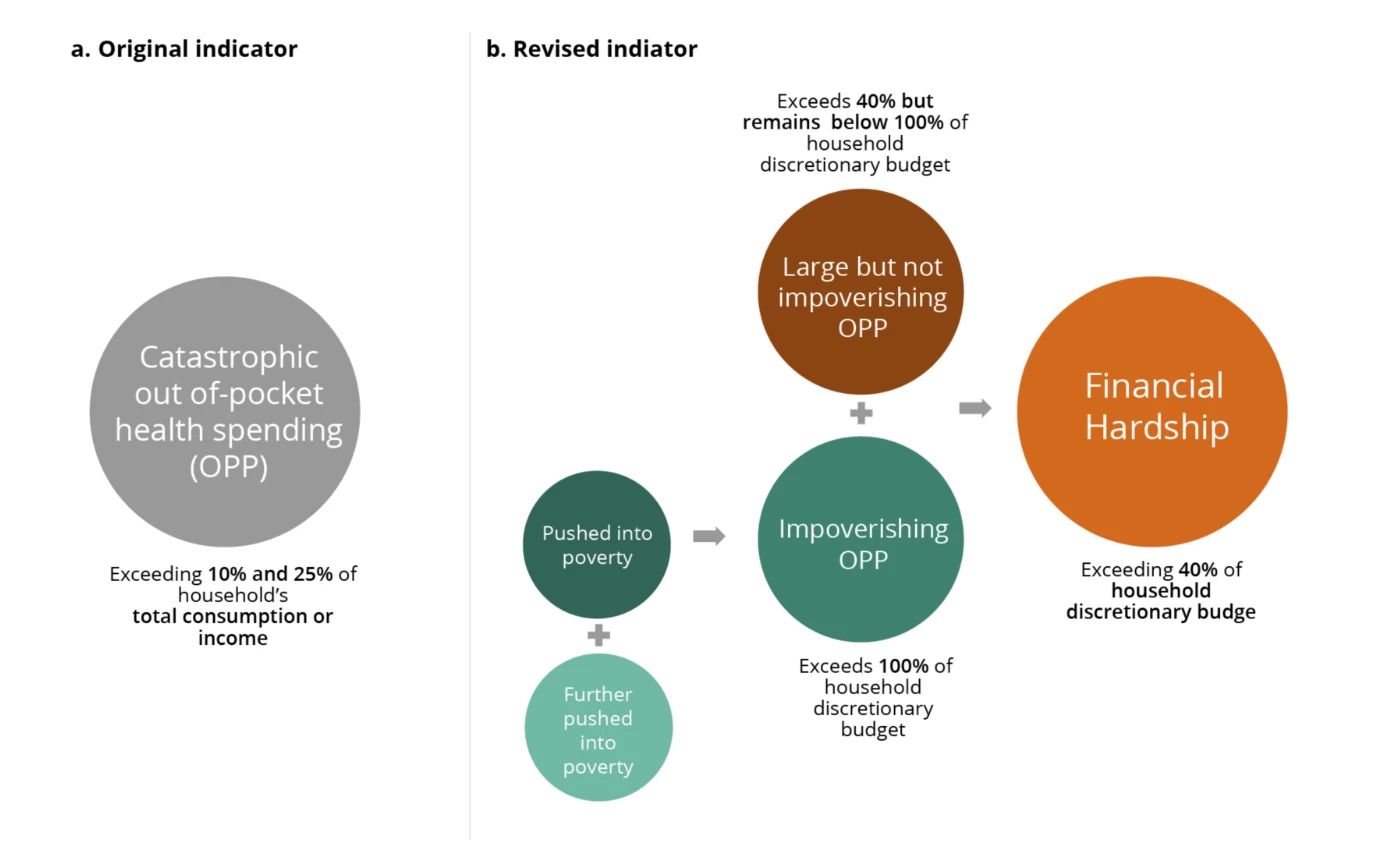
Within this unified framework, the revised SDG 3.8.2 captures two mutually exclusive forms of financial hardship. Impoverishing out-of-pocket (OOP) health spending occurs when health payments absorb resources needed to meet basic needs, pushing households into poverty or deeper below the poverty line. Large but non-impoverishing OOP spending, by contrast, does not cause impoverishment but substantially reduces households’ discretionary resources and their ability to consume other essential goods and services. By integrating both dimensions within a single indicator based on a common definition of basic needs, the revised measure strengthens the focus on equity while simplifying global monitoring and maintaining comparability across countries at different income levels.
What this means for the World Development Indicators
These methodological updates are now incorporated into the WDI, strengthening its role as a global public good for monitoring health and development outcomes. The revised SCI is accompanied by the inclusion of its four domain subindices, enabling users to examine service coverage patterns in greater detail. The updated financial hardship indicators provide a clearer, poverty-sensitive view of how health spending affects households’ economic well-being.
Table 2. Revised UHC indicators in WDI
Together, these improvements enhance the analytical value of UHC indicators in the WDI, supporting policymakers, researchers, and development practitioners in assessing progress, identifying gaps, and designing evidence-based health reforms. As countries work toward UHC, high-quality, transparent, and comparable data remain essential to inform policy decisions — and these revisions represent an important step forward in measuring what truly matters for people’s health and financial security.
Explore more UHC data in the World Development Indicators (WDI) and Data 360, and find detailed methodology in the Tracking Universal Health Coverage (UHC): 2025 Global Monitoring Report.
More information on the support the World Bank Group provides to countries towards UHC is available through the Health Works website.




Join the Conversation