
 Financial districts and urban growth in frontier market economies reflect the expanding role these countries are playing in global investment and development. Pictured: Hanoi Stock Exchange in Viet Nam. / Image: Shutterstock.
Developing economies are commonly classified by income level, institutional capacity, or exposure to fragility and conflict. Financial markets use a different lens, distinguishing between emerging markets and frontier markets. While emerging markets have been studied extensively, frontier markets — a subset of developing economies with meaningful but still limited access to international financial markets — have received relatively little macroeconomic analysis as a group.
The term “frontier markets” was coined by the International Finance Corporation — the World Bank Group’s private sector arm — in the early 1990s, serving as shorthand for the next generation of emerging markets. The concept has since gained traction among investors as more developing economies have obtained access to international equity and bond markets.
The importance of frontier markets extends well beyond financial markets. These economies today account for about one-fifth of the world’s people, but only around five percent of global GDP — while populations in emerging markets and advances economies stall. Many of these frontier markets have significant demographic potential, important natural resources, or expanding services sectors. With the right policies, they could become major engines of job creation, private capital mobilization, and future global growth.
Classification and why it matters
Financial market index providers classify an economy as a “frontier market” (or its more developed sibling, an “emerging market”) based on perceived levels of financial market development, macroeconomic advancement, and reform progress. Index inclusion can lead to significant capital inflows, either through index investing or via broader signaling effects.
Precise definitions of what constitutes a frontier market vary across providers. In a recent study, we construct a new composite classification, combining the assessments of three major equity index providers (FTSE Russell, MSCI, and S&P Dow Jones Indices) and one bond index provider (J.P. Morgan).
If a majority of these equity indexes classify an economy as frontier rather than emerging, our study does the same. The same logic applies for emerging markets. Economies that issue tradable external dollar bonds at scale, as captured by J.P Morgan’s Emerging Market Bond Index, but that are not in the emerging or frontier equity indexes, are also included in the frontier markets group. In addition, all high-income emerging market and developing economies are considered emerging markets. Remaining economies that appear in none of the indexes are classified as “other developing economies”.
The resulting taxonomy allows for clean cross-group comparisons and facilitates analysis of links between financial market access and economic development. It is intended solely for the analysis in our work and carries no implications for World Bank Group operations or policies. That said, frontier markets are significant parts of the portfolios of the different development arms of the World Bank Group, and outcomes in these economies, including on job creation and private capital mobilization, will be pivotal for global development progress.
Composition and characteristics of frontier markets
The number of frontier and emerging markets varies over time. In all, there were 56 frontier markets as of 2025, up from 39 in 2012. In recent years, the most common shift has been previously unclassified economies being added to at least one frontier market equity index or, more often, JP Morgan’s bond index (as a result of significant sovereign issuance). Frontier markets have not been reclassified as emerging markets by equity index providers since 2012, although FTSE Russell plans to upgrade Viet Nam from frontier to emerging status from September 2026. In addition, four frontier markets (Bulgaria, Costa Rica, Panama, and Romania) have become emerging markets since 2012 by attaining high-income status.
Frontier markets are geographically diverse, spanning all regions of World Bank Group operations (see figure 1.A). They are mostly middle-income countries and are typically poorer than emerging markets, though with significant variation in per capita incomes. Today’s frontier markets already account for a fifth of the world’s population, a share projected to rise significantly, but only account for around 5 percent of global GDP (see figure 1.B).
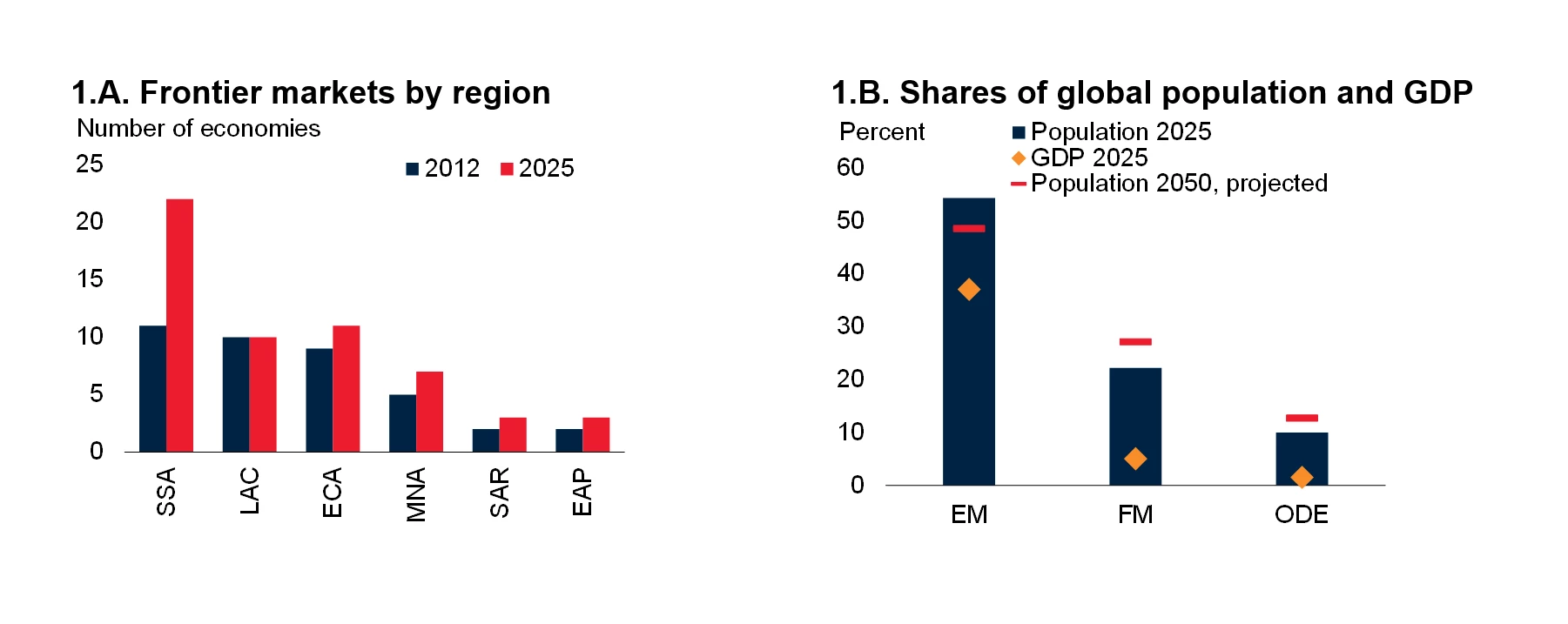
Sources: World Bank. Note: EAP = East Asia and Pacific; ECA = Europe and Central Asia; EM = emerging markets; FM = frontier markets; LAC = Latin America and the Caribbean; MNA = Middle East, North Africa, Afghanistan and Pakistan; ODE = other developing economies, neither EM nor FM. SAR = South Asia; SSA = Sub-Saharan Africa. A. Sample includes 39 FMs in baseline 2012 classification, and 56 FMs as of 2025 classifications. B. Sample includes 37 EMs, 56 FMs, and 57 ODEs, by 2025 classifications.
In terms of economic structure, around half are commodity exporters, mostly of energy or agricultural goods. More generally, frontier markets exhibit diverse growth models: some have large commodity exports or manufacturing-oriented industries, while others have pursued growth through services, including tourism.
Measured by laws on the books, frontier markets have become significantly more financially open over time (see figure 2.A). This openness in principle has also translated into increased financial flows across borders. While still limited compared to the levels in emerging markets, the portfolio liabilities of frontier markets relative to output have more than tripled since the turn of the century (see figure 2.B).
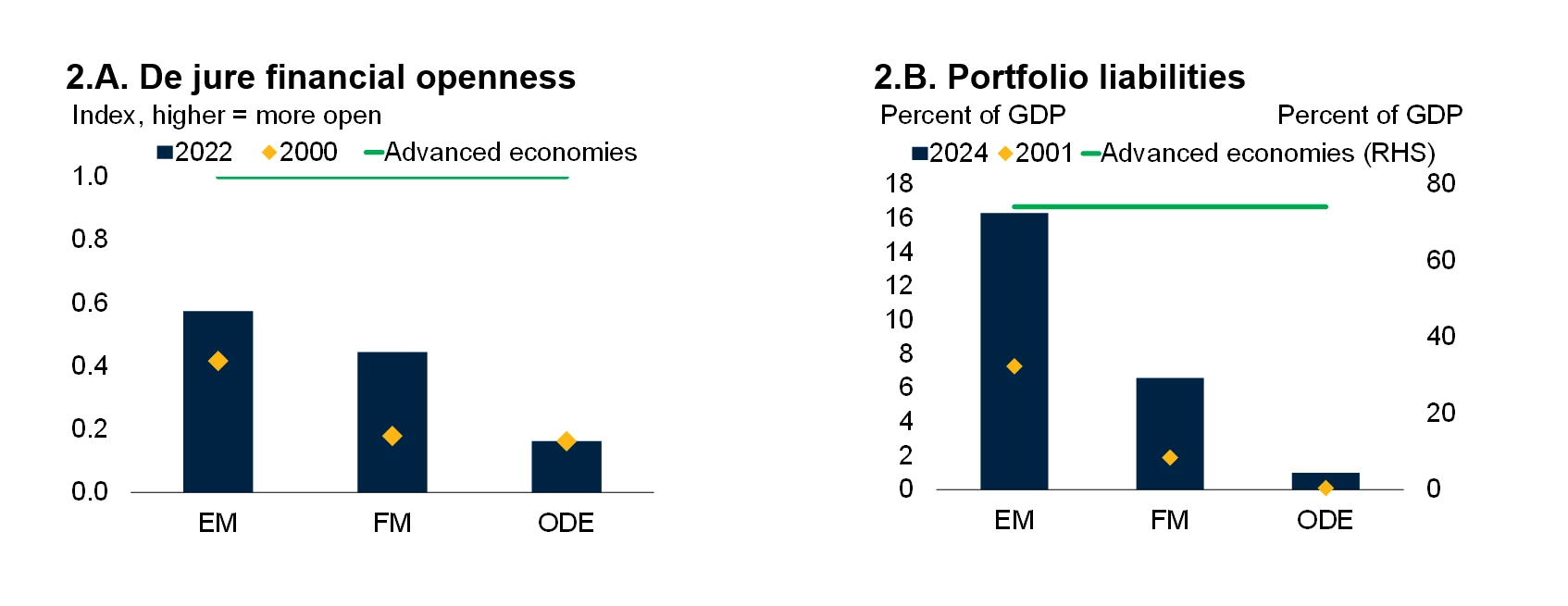
Sources: Chinn and Ito (2006); IMF Coordinated Portfolio Investment Survey (database); World Bank. Note: EM = emerging markets; FM = frontier markets; ODE = other developing economies, neither EM nor FM. Samples based on 2012 baseline classifications. A. Financial openness is proxied by the Chinn–Ito Index, which measures a country’s degree of capital account openness, with a normalized value of 1 indicating the most open (Chinn and Ito 2006). Group medians for 2000 and 2022, based on a balanced sample comprising 32 advanced economies, 34 EMs, 37 FMs, and 69 ODEs. Green line shows median value for advanced economies (latest data available). B. Portfolio liability positions reflect the value of foreign-held equity and debt securities and are based on derived data constructed from partner-reported holdings of these instruments. Values are group medians for 2001 and 2024, based on a balanced sample of 32 advanced economies, 34 EMs, 38 FMs, and 68 ODEs. Green line shows the median value for advanced economies in the latest data available.
In principle, greater access to international finance can bring important benefits, by unlocking resources for productivity-enhancing investment in economies that remain capital-constrained.
Sovereign bond issuance as a share of GDP doubled between the 2000s and the early 2020s in the typical frontier market, reflecting an appetite for market financing from frontier market governments (refer to figure 3.A). Frontier markets also account for a larger share of global capital flows now, at around 3 percent of the total, than at the turn of the century.
However, this has not translated into sustained investment growth in these economies as a group. On a per capita basis, investment growth in frontier markets has fallen from an annual average of 5 percent in the 2000s to just 2 percent over the first half of this decade Frontier markets have seen sharp declines, but this is part of a broader slowdown in investment in emerging market and developing economies (see figure 3.B). In turn, per capita output growth has halved in frontier markets, consistent with slowing growth prospects globally.
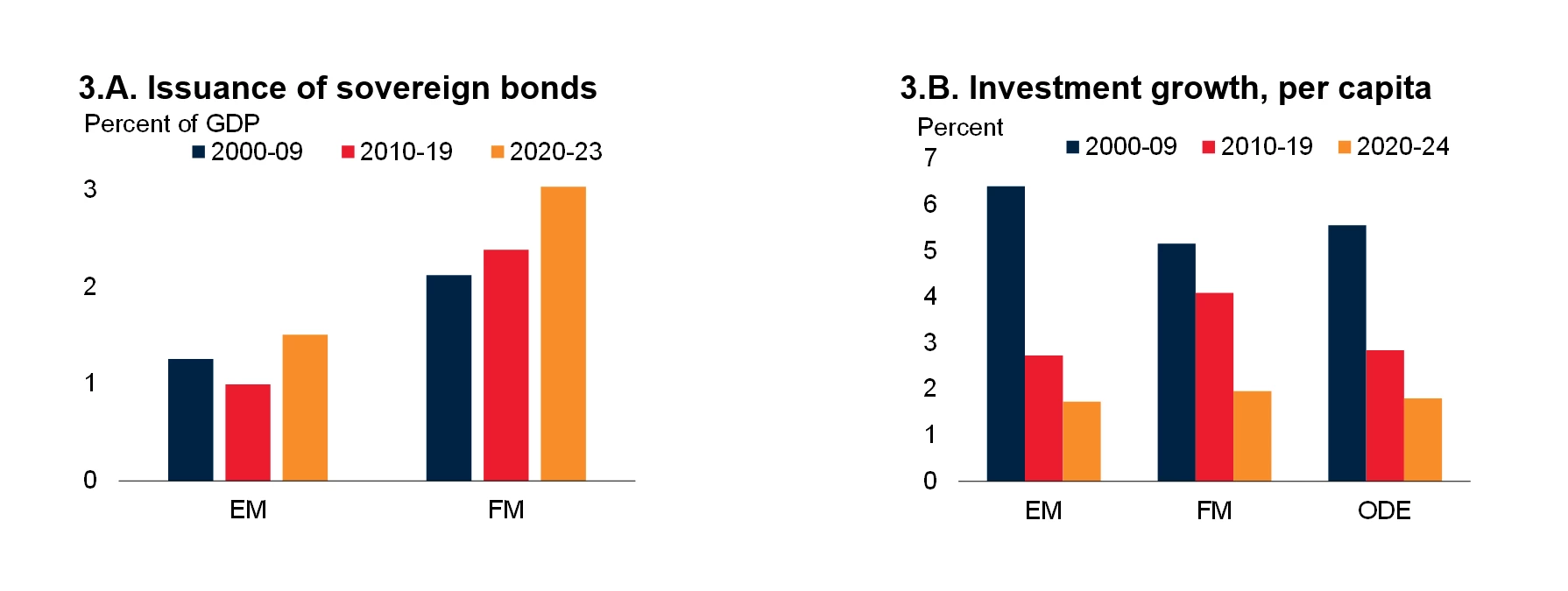
Sources: Feenstra, Inklaar, and Timmer (2015); Haver Analytics; World Bank. Note: EM = emerging markets; FM = frontier markets; ODE = other developing economies, neither EM nor FM. Samples based on 2012 baseline classifications. A. Sample includes up to 30 EMs and 26 FMs. Bars show the median value of sovereign bonds issued in percent of GDP for each country group. B. Sample includes 30 EMs, 34 FMs, and 42 ODEs. Bars show period averages of median values in each group.
Frontier markets have a huge potential for future growth, underpinned by demographic dynamics, market access, and important resource endowments. Yet in many cases, their financial market development and integration remain partial, resulting in vulnerabilities as well as opportunities.
Some frontier markets have succeeded in delivering stronger per capita GDP growth over the last 25 years. These faster-growing frontier markets exhibited several common features: typically, they registered much stronger investment growth, delivered improvements in governance, and have also contained increases in government debt relative to other frontier markets. Harnessing the potential of these economies while containing the associated risks will be a central challenge for policy makers. Doing so will be essential if the frontier markets of today are to become engines of growth, job creation, and prosperity in the years ahead.
For further details, see Frontier Market Economies: Promise, Performance, and Prospects.




Join the Conversation