
 Community meeting on the reconstruction of a village hit by volcanic eruption in Yogyakarta, Indonesia. Photo credit: Nugroho Nurdikiawan Sunjoyo/World Bank.
Think of this: In a small, rural community a mother receives a mobile alert that her monthly cash transfer has arrived just in time to buy school supplies and food. Down the road, the local council approves a small grant to build a footbridge that will connect the community to markets, schools, and a clinic.
These moments may feel routine in development today, but they are part of a much bigger story of innovation at the World Bank Group.
Innovation is essential for development, helping us adapt faster, design smarter solutions that deliver impact at scale, and do more with less. At the World Bank Group, innovation has always been critical to our mission. But innovation doesn’t happen by accident. It requires intention, investment, rigor, and a culture that encourages experimentation and learning.
Evolution of innovation at the World Bank Group
To better understand how the World Bank Group innovates, we analyzed 7,576 of our project evaluations conducted between 1998 and 2025 by the Independent Evaluation Group (IEG). The big data analysis revealed patterns across decades of development, providing new insights into what drives innovation, when it scales, and why it sometimes stalls.
We found that over the past 25 years, innovation at the World Bank Group has shifted from scattered efforts led by visionary individuals to a more strategic, institutional approach. In the early 2000s, new lending tools and knowledge-sharing platforms, such as the Learning and Innovation Loans and the Development Marketplace, encouraged experimentation. By the 2010s, innovation gained momentum through the creation of Global Departments, Innovation Labs, and a new focus on digital development. By 2020, one in six projects incorporated some element of innovation, reflecting a steady rise in institutional commitment. Today, innovation is embedded in many aspects of our work.
Five key lessons
In particular, our analysis surfaced five key insights:
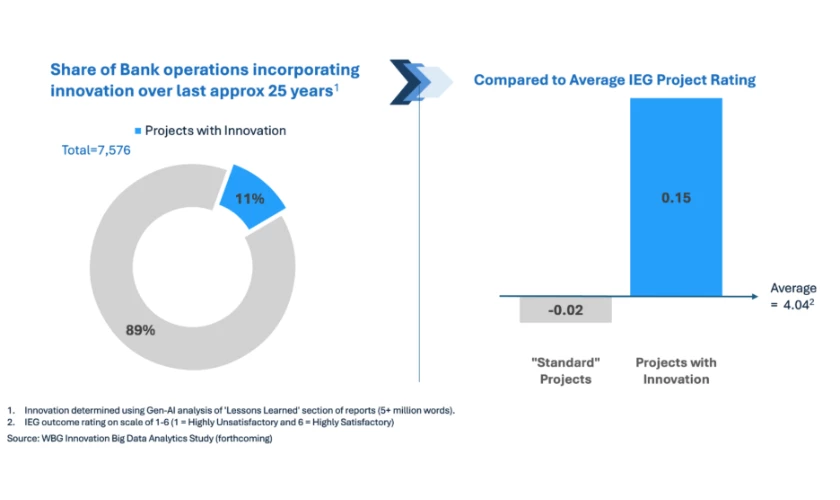
1. Innovation improves outcomes: Projects incorporating innovation generally performed better than “standard” projects. As seen in the chart below, about 11 percent of projects over the 25-year period incorporated innovation, and these projects on average achieved higher, statistically significant outcomes on IEG’s rating scale.
2. Key ingredients for scaling: In the 1990s, only one in five pilots was replicated in another project. By the mid-2010s, nearly half of pilots had some degree of replication, thanks to flexible financing, digital tools, and deliberate capacity building for clients.
3. Four key drivers: Successful innovations usually involved technology, a new approach to operational delivery, collaboration with civil society and the private sector, or a new financing model.
4. Context is critical: Simpler, frugal innovations tended to thrive in fragile settings, while more complex digital systems worked best in middle-income countries with strong local ownership.
5. Leadership and culture are decisive: Champions who promoted learning and protected experimentation made the difference, while risk aversion and rigid processes often held innovation back.
From pilots to platforms
Through our analysis, three examples stood out as models of innovation at the World Bank Group, illustrating how early experimentation can lead to scalable platforms.
E-Procurement: What began as cautious digital pilots in the 1990s is now standard practice. Countries first moved procurement online, followed by a host of innovations that included open-contracting portals, remote verification and, more recently, artificial intelligence-driven “red-flag” analytics. The secret to success wasn’t just the technology, it was phased rollouts, rapid feedback loops, and problem-solving supervision.
Community-Driven Development (CDD): Early programs beginning in the 1990s showed that when communities shape priorities and manage small grants, assets are better used and maintained. Today, CDD approaches are paired with digital tools and livelihoods programs and they are customized for fragile settings—proof that collaboration and adaptation help innovation endure.
Conditional Cash Transfers (CCTs): A well-tested pilot has evolved into a global delivery platform. Modern CCTs use mobile wallets and even climate-triggered top-ups.
These platforms didn’t emerge by chance—they were built through disciplined piloting, smart adaptation, and a relentless commitment to solving real problems.
A bold vision for a knowledge bank
The development landscape is marked by “wicked” challenges, such as pandemics, fragility, climate shocks, and the need for inclusive and sustainable jobs. Meeting these challenges require moving from fragmented experimentation toward a coherent, data-powered innovation agenda that stays laser-focused on improving development outcomes.
World Bank Group President Ajay Banga has set a bold vision for transforming our organization into a true knowledge bank, one that delivers faster, more impactful solutions for our clients. As part of this, we launched the Department for Innovation in 2024 to act as a central resource that enables innovation across the organization and helps accelerate and scale novel solutions to the toughest development challenges. It’s a core part of the Knowledge Compact for Action, the World Bank Group’s commitment to turning ideas into better development results for peoples’ lives and livelihoods.
Stay tuned for the release of our report on innovation at the World Bank Group in 2026.

Join the Conversation