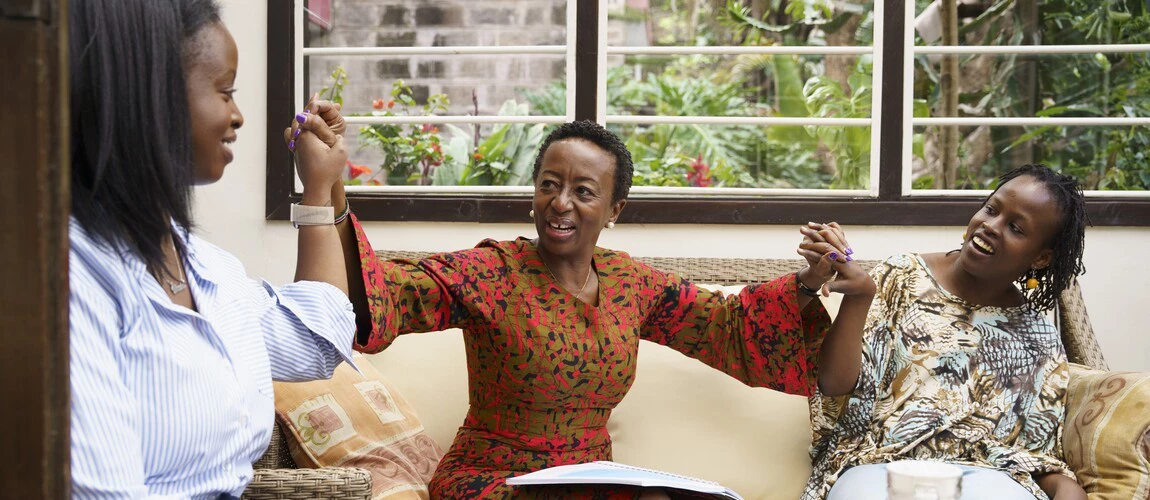
 Building safer, stronger societies and economies starts with ensuring that women and girls live free from violence. Copyright: Kelvin Juma @ We-Fi / World Bank
According to the World Health Organization, one in three women—an estimated 840 million globally—has experienced physical or sexual violence in her lifetime. And UN Women estimates that violence based on gender costs roughly $1.5 trillion every year—about 2 percent of global GDP. In some countries, losses reach 3.7 percent of GDP. That is more than many nations spend on education in a year.
Behind every statistic is a woman whose safety has been violated and with it, her chance to work, learn, and lead freely. Safety—both physical and psychological—is the foundation of all opportunities and growth, whether personal or economic. Economies are built by individuals, who thrive when they are and feel safe.
Violence shatters that foundation. And the cost of violence ripples outward, shaping the future of families and entire economies. It can make it impossible to learn, to work, or even to feel secure at home, in public, or on the job. Harassment—still far too common and just one of the many forms of gender-based violence—silences ambition and drains productivity, talent, and innovation. For example, in a case study in Papua New Guinea, we found that violence against women-related absenteeism and turnover consumed three to nine percent of annual payroll. In Peru, we found that workplace sexual harassment was linked to a 43 percent drop in productivity. This equates to billions in lost output every year.
Yet there is hope, and growing recognition that change is possible. The World Bank Group is partnering with governments and the private sector on targeted initiatives to address and prevent gender-based violence before it happens.
First of all, guided by our Gender Strategy at the World Bank Group, we have embedded prevention and survivor support activities across many sectors, such as health, education, transport, and social protection. Currently we support 90 projects in more than 60 countries that address and/or prevent violence against women and girls. Through this work, we are demonstrating that violence has no place in our world, and that safety for women and girls can unlock shared growth.
Building on this foundation, we are focusing on removing barriers that keep women from fully participating in the economy—because when women can work safely, earn income, and access essential services like childcare, they are not only empowered economically, but also protected from the conditions that can lead to gender-based violence.
One example is access to energy, a key priority for the World Bank Group. When rural communities gain access to reliable electricity, women no longer have to walk long distances after dark to collect firewood or fetch water—reducing their exposure to harassment and violence. Reliable energy also powers street lighting, safe public spaces, and businesses that create jobs, helping women move, work, and live with greater safety and confidence.
And the same holds true across other sectors — when safety is built in, change follows. In partnership with BRAC we found that a vocational and life-skills training program for adolescent girls in Uganda reduced rates of gender-based violence and boosted self-employment. In cities from Cairo to Quito, safe and reliable public transport has allowed women to take jobs farther from home, opening doors once closed by fear. In Tamil Nadu, India, a new initiative is helping women access safe hostels and transport, as well as hotline call centers to report harassment—removing key barriers to mobility and safety.
In Samoa, a World Bank-financed project is addressing technology-facilitated violence by strengthening digital safety measures and awareness. The initiative also links these efforts to job opportunities, ensuring women can access safe online work environments. In Tanzania, we are implementing the internationally recognized Bandebereho model, which promotes positive fatherhood and gender equality to shift gender-power imbalances and reduce intimate partner violence—while reinforcing women’s economic empowerment and access to jobs as a shared commitment that strengthens family well-being and drives development for everyone.
Creating safety is not the work of governments alone. It depends on strong partnerships with the private sector and others who share this vision. The private sector plays a vital role. Since 2014, IFC’s Respectful Workplaces Program has partnered with over 100 businesses to combat gender-based violence. The program had increased productivity, reduced absenteeism, and improved the retention and progression of women employees. And in 2024, IFC launched Empower Finance, a program that supports nine institutions serving over 30 million customers in five countries to address financial abuse, a common form of violence against women. At the policy level, we support the ILO Convention 190, affirming that every worker has the right to a world of work free from violence and harassment.
During these 16 Days of Activism, let’s reaffirm a simple message: When women can live and work in safety, everyone gains—families, businesses, and economies. But progress cannot happen or continue alone. We must continue to invest in proven solutions, and act collectively—across governments, the private sector, and civil society—to end violence against women and unlock the full potential of every woman, every community, and every economy.
Together we can create the safety that unlocks opportunity for all.
Join the Conversation