
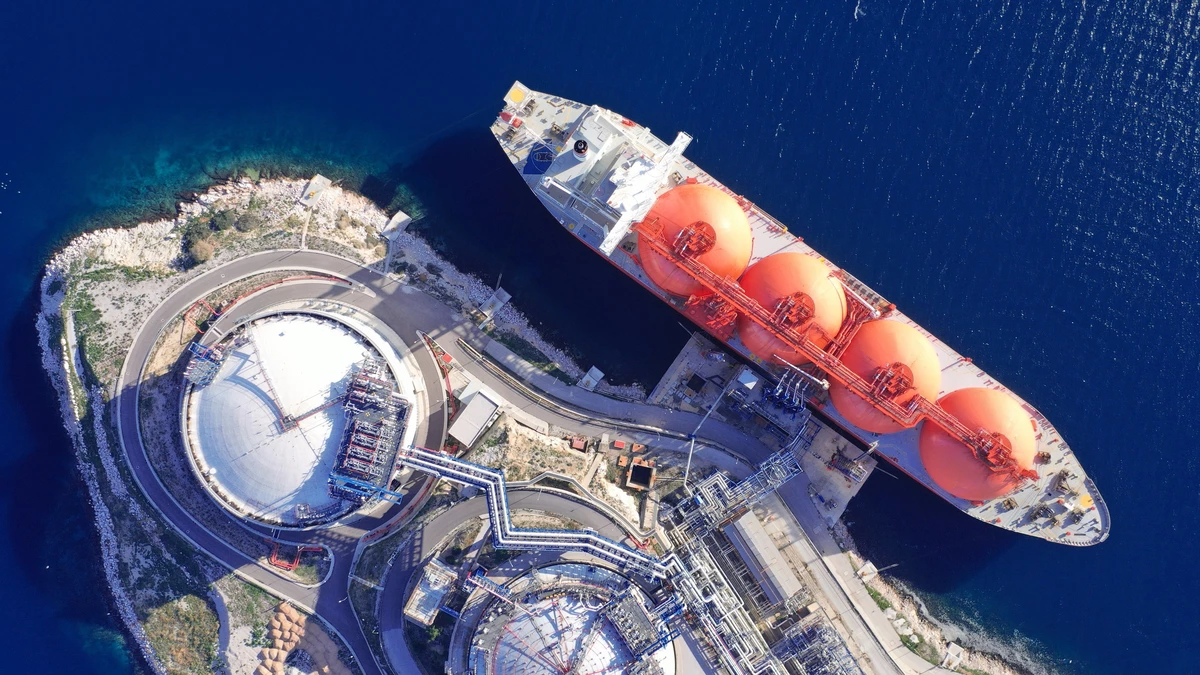
 Liquefied natural gas infrastructure is reshaping global gas flows, driving a widening divergence between U.S., European, and Asian price benchmarks. / Photo: Shutterstock
This blog post is part of a special series based on the October 2025 Commodity Markets Outlook, a flagship report published by the World Bank. This series features concise summaries of commodity-specific sections extracted from the report. Explore the full report here.
The World Bank Group’s natural gas price index increased by 5 percent in November over the prior month, after declining 5 percent in 2025Q3 over the previous quarter. Changes in the U.S. and European benchmark prices have been strikingly divergent in recent months. U.S. natural gas futures broke through the $5/mmbtu threshold for the first time in three years in early December, reflecting strong demand for shipments of U.S. LNG to Europe and a cold snap. Conversely, the European benchmark has been trading lower every month since June, with current European prices reaching their lowest level since spring 2024.
Growth in global gas demand fell in 2025 but is expected to rebound moderately in 2026. Global consumption rose by only 0.5 percent through the first three quarters of 2025, as high prices and macroeconomic headwinds curbed consumption. Unlike in previous years, Europe was the main source of demand growth, buoyed by cold weather, low electricity production from renewable sources, and required storage injections. Asia’s demand remained virtually unchanged from 2024, due to lower industrial consumption, higher LNG prices, and strong renewable electricity production. In particular, China’s LNG imports plummeted in 2025, reflecting higher domestic production and weak demand. In 2026, a projected 2 percent rise in consumption assumes a rebound in the Asia Pacific region, as industrial activity recovers and demand from the power sector increases.
Strong production in North America drove the expansion of global supply in 2025. U.S. natural gas production is estimated to have increased by about 3 percent in 2025, driven by high prices and increasing demand abroad. More than half of U.S. LNG exports have been shipped to the European Union, where seasonal natural gas storage levels have weakened from the high levels experienced since the beginning of the Russian invasion of Ukraine. Production in Russia shrank in 2025, owing to recent reductions in pipeline supply to Europe and tepid growth in domestic demand. Looking forward, global natural gas production is expected to grow by about 2.5 percent in 2026, mostly driven by further growth in LNG exports in North America and Qatar, as new terminals come online. Growth in natural gas production in Russia is expected to remain constrained by international sanctions, the confirmed termination of purchases by Europe, and delays to upcoming projects.
Natural gas prices are set to diverge as market risks are tilted to the upside. After surging in 2025 by an estimated 60 percent y/y to an annual average of $3.5/mmbtu, the U.S. benchmark is projected to rise by 11 percent in 2026 and stabilize in 2027 on higher LNG exports. Europe’s benchmark, in contrast, is expected to ease by about 10 percent in 2026 and 2027 amid moderate demand and ample LNG availability. Japan’s LNG prices are likely to shadow Europe’s as both regions continue to compete for cargoes. Upside risks dominate the outlook: heightened geopolitical tensions—especially in the Middle East—stronger competition from China, rapid growth in AI-driven data centers, and colder-than-expected temperatures could all push prices higher. Higher gas prices could spur increased coal use, as is currently occurring in the United States, underscoring the tight interdependence of global energy markets. On the downside, easing sanctions on Russian supply could temper markets.


Join the Conversation