This isn’t a distant dream – it is the promise that rests at the heart of modern transport.
Transport is the backbone of our global economy and society. It connects us to opportunities, markets, and services. Transport is also a major contributor to air pollution, while road traffic crashes take a devastating human and economic toll. Underinvestment in transport is costing billions and deepening inequality.
The path forward is clear: we need to invest in transport systems that are inclusive, efficient, safe and resilient. In addition to investment, however, we also need clarity – through coherent measurement – of what is necessary to accelerate and scale what works in order to ensure we maximize the benefits of our investments.
For far too long, our understanding of global transport has been like a puzzle with missing pieces. Data is collected in silos—by mode, by region, by specific issue—making it incredibly difficult to see the bigger picture. This hinders the ability to direct resources where they have the highest payoff, hold ourselves accountable, and tell a clear story of progress. Without a unified way to track the journey, it is hard to know if we are on the right path.
We have a unique opportunity to drive real change through better understanding. Helping to guide these efforts is a new SuM4All report, Sustainable Transport by the Numbers: Tracking Global Progress, which advocates for a unified, global tracking framework anchored in a concise set of high‑impact indicators to elevate transport on the development agenda, guide policy and financing, and ensure accountability.
A New Roadmap: Tracking What Matters
This new report proposes a framework that prioritizes a high-level set of high-impact, globally relevant indicators aligned with eight goals underpinned by a concise set of eight candidate indicators: universal access, efficiency, safety, green mobility, finance, gender, resilience, and jobs. This approach cuts through “indicator overload” and focuses attention on outcomes that policymakers can act on.
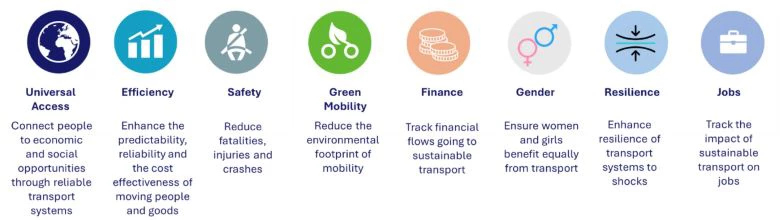
By tracking a select number of transport indicators, we will be able to reduce data collection and processing – making tracking and reporting more efficient and sustainable. Focusing on a manageable number of indicators also optimizes the use of resources dedicated to data collection and analysis, while also helping to tell a compelling story of progress over time.
This newest report complements ongoing efforts by SuM4All to close persistent transport data gaps by proposing robust, harmonized indicators that support accountability and global alignment. This report can play a role in strengthening how we understand and assess the transport sector’s contribution to sustainable development.
The report recommends that we:
Adopt a unified framework: Governments, UN agencies, and development partners must rally around a shared set of indicators and a clear institutional architecture for global, regional, and national tracking.
Invest in data capacity: Support national statistical offices and transport ministries – especially in low- and middle-income countries – to collect, analyze, and share transport data. Treat transport data as critical infrastructure and leverage new technologies like AI and satellite imagery to fill data gaps.
Build data partnerships: Engage private mobility providers, logistics platforms, academia, and civil society to unlock new datasets and strengthen accountability
Turn Data into Action: The ultimate goal is not just to collect numbers, but to use them to guide better policies, smarter investments, and more effective reforms that improve people’s lives. Institutionalize reporting: Establish regular progress updates and a Global Sustainable Transport Progress Report to sustain momentum throughout 2026–2035.
A Decade to Deliver
The UN Decade of Sustainable Transport (2026–2035) is a window to align measurement, policy, and investment. If we utilize this window to not only invest – but guide investment through improved understanding – we have the opportunity to improve air quality, make roads safer, and provide equal access to opportunity.
With a clear map and a shared commitment to tracking our progress and closing the investment gap, we can ensure that no one is left behind. Greener transport is smart development. Let’s make this decade journey count.
***
Contributors to this blog included: Carolina Monsalve, Shokraneh Minovi, Josephine Irungu and Mary Fabian

Join the Conversation