
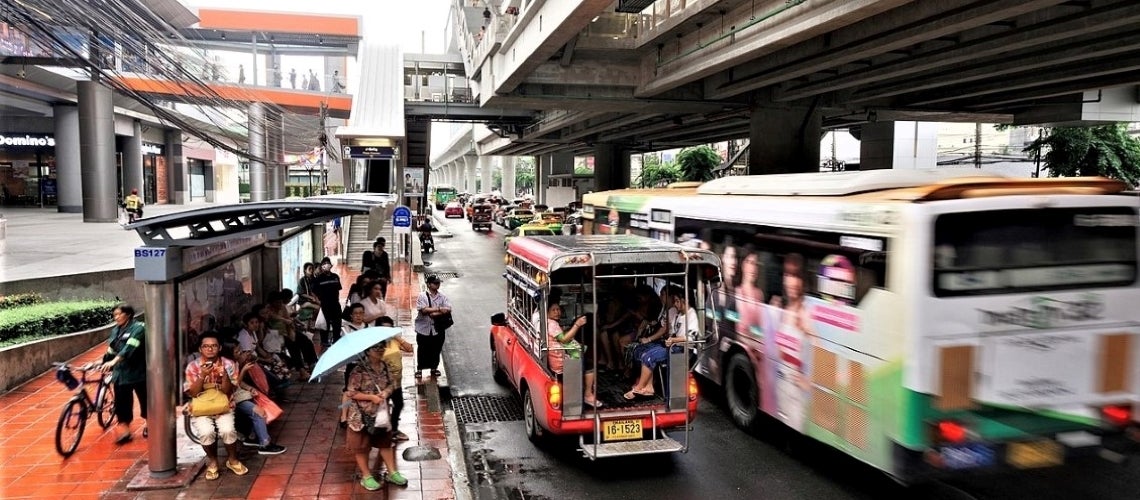
 MRT Phasi Charoen station and bus stop in Bangkok, Thailand. | © Rachasak Ragkamnerd.
For several decades now, Asia as a region has maintained high growth rates, even contributing significantly to global economic growth. The region has economically outperformed the rest of the world since the 1980s.
Nevertheless, Asia is not on track to achieve the 2030 Sustainable Development Goals (SDGs).
The reality is that Asia’s rapid, consistent economic growth hasn’t been inclusive. While reduction in extreme poverty has taken place at almost the same speed as GDP growth in the past two decades, those lifted out of this poverty are still vulnerable. The extreme poverty line of $1.9 per day just doesn’t cut it. The region also suffers from climate change far more than other regions with many cities suffering from air pollution and becoming vulnerable to the rising sea levels.
Now, the COVID-19 pandemic has disrupted basic infrastructure services delivery, further impacting the progress on SDGs.
For infrastructure projects already under construction, Asia faces the highest number of disruptions globally. So, given these climate, social, and now market constraints, can the private sector continue a business-as-usual approach to infrastructure? We know that construction is the biggest industry in the world, and yet, even outside of crises, it is not performing well. The construction business represents 13% of global GDP, but construction has seen a meager productivity growth of 1% annually for the past two decades. Time and cost overruns are the norm and overall earnings before interest and taxes are only around 5%, despite the industry’s significant risk.
Adding to this complicated landscape, more attention is needed to whole lifecycle costs and benefits of infrastructure, which means incorporating environmental, social, and governance (ESG) considerations in investment decisions. There has been a lot of discussion on environmental aspects; I’d like to bring attention to the middle pillar of social factors as climate vulnerability ultimately has an impact on the people.
There are two ways to look at this. The first is solely based on the selection of social infrastructure projects. The second approach seeks to socially influence economic infrastructure projects.
On the first, while there is no universal categorization of social infrastructure, the recent surge in social bonds give us a starting point. There are guidelines that delineate eligible infrastructure for social bonds principles namely projects that provide or promote affordable basic infrastructure (like clean water, sanitation, transport, energy), access to essential services (for example education and vocational training, healthcare, financial services), affordable housing, employment generation including through the potential effect of financing for small to medium enterprises and microfinance, food security, and socioeconomic advancement and empowerment.
All in all, the basic characteristics of social infrastructure projects often make it more difficult for the private sector to see business opportunity. Social projects are smaller and under local jurisdictions— adding institutional complexity. Project outputs are harder to define. There is a strong role for community engagement and public service obligations, as there are often multiple off-takers. Most social PPPs are government-pay models and, while the projects are economically feasible, they may not be financially viable. More often than not user fees don’t cover full capital and operational costs and, on top of this, the rates and affordability of user fees are frequently in question.
Progress will likely be slow and incremental. That’s why we need to go farther and take on both the selection of social infrastructure and the inclusion of social factors in economic infrastructure (the second approach).
What needs to change to socially influence economic infrastructure projects? Three main tiers of public decision making could change:
At the policy level, regulations are lagging. Even when environment-target based regulations are moving slowly, social-target based regulations are at nascent stage. To move more quickly, governments can embody regulations, just transition principles, disclosure requirements, and Scope 1-2-3 type-metrics for social factors.
At the public investment planning level, many governments lack consideration of whole lifecycle approach to planning. This approach uses cost-benefit analysis as the filter to select public investments, which should reflect all the costs and benefits to an investment’s economic-socio environment.
At the project level, public procurement agencies must include sustainable procurement practices, greenhouse gas emissions and circular economy targets in their requests for proposals. Social KPIs should define and monitor workers, households’ direct and indirect beneficiaries, social benefits, and waste management.
I write about this with Asia as a backdrop because, in many ways, Asia’s the face of climate emergency, extreme poverty, and inequality—it’s also COVID-19’s ground zero. But my points transcend regions: environmental and social considerations are interlinked and cannot be dealt with in isolation. Social impact necessitates good governance and transparent operations. All this needs to be in place to have real social impact. The private sector must step up in partnership or risk further exacerbating the existential threats to livelihoods and our common planet.
Related Posts
Climate finance: Creating the conditions we need to invest in emerging markets
New steps in Asia: data + connectivity = better infrastructure investment
Time to move beyond business-as-usual in Asia: 3 recommendations for the private sector
Factoring climate risk into infrastructure investment
From profit maximization to purpose maximization in infrastructure
What’s next for ESG and investment decisions?
SDGs and PPPs: What's the connection?
This blog is managed by the Infrastructure Finance, PPPs & Guarantees Group of the World Bank. Learn more about our work here.

Join the Conversation