
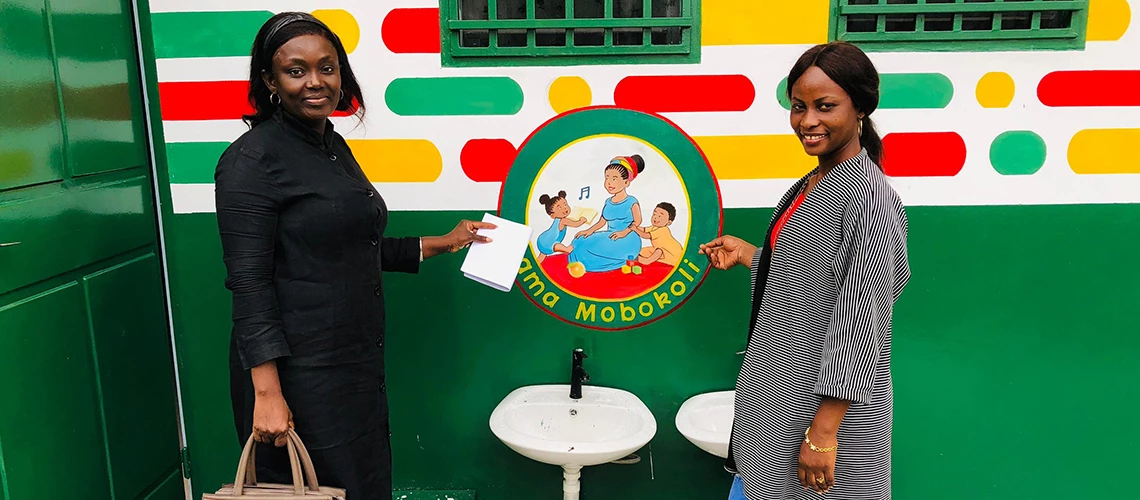
 Two mamapreneurs at the Soukissa daycare center in Brazzaville - Credit : Gloire Bokoba/ MEDRAC.
“Had I asked people what they wanted, they would have said faster horses!” This quote, often attributed to Henry Ford, conveys a powerful insight about the nature of innovation: People don’t always know what they need—or what’s possible—until they see it. Transformational products and services require vision and a leap beyond the conventional. We believe this is the case for childcare services in the Republic of Congo, and indeed, in much of Sub-Saharan Africa.
The average family in Congo has more than four children. Yet, according to UNICEF, only a third of children aged 3–5 have access to early childhood education programs. For children under the age of three, access is even lower. For the fortunate few, private daycare centers exist, but fees can exceed $100 per month—an expense out of reach for most families, as the minimum wage in Congo hovers around $150 per month. Public or subsidized childcare facilities are few and far between.
Meanwhile, for years, the World Bank has supported micro-entrepreneurs in Congo with capital and skills development as part of the Social Protection and Youth Economic Inclusion and the Lisungi Safety Net System projects. Many of the women we work with are micro-entrepreneurs in trades like tailoring or hairdressing, where competition is fierce and profit margins are slim. Again and again, they tell us that having young children at home makes it nearly impossible to dedicate the time and energy needed to grow their businesses.
We wondered, how might we support entrepreneurs to develop new products and services where we suspect there is strong unmet demand? And might there be a solution to the childcare challenge along the way?
Serendipitously, we came across Kidogo, a social enterprise in Kenya which works with women entrepreneurs on affordable, high-quality childcare businesses in low-income neighborhoods, typically charging a dollar a day per child. Supported by the Invest in Childcare Initiative and the Social Protection Response Program, we partnered with Kidogo to adapt their model for Brazzaville in partnership with our local implementing partner, MEDRAC Africa.
We began by recruiting our first cohort of “mamapreneurs”—women eager to open and operate childcare centers. They completed a three-month training program covering early childhood development, entrepreneurship fundamentals, and hands-on skills like first aid and fire safety. Providing safe, quality childcare is the central tenant of the project. Support to mamapreneurs does not end with training.
After completing their coursework, the mamapreneurs undertook a two-week internship at a public crèche operated by the Ministry of Social Affairs, Solidarity and Humanitarian Action (MASSAH). Ministry officials rigorously assessed their know-how and awarded training certificates to those who passed written and oral exams. And on-the-job learning continues with weekly visits by expert coaches.
In parallel, to foster nationwide systemic change, we worked with MASSAH to evolve the institutional framework for childcare, which entails defining quality standards that are realistic for the new daycare centers, as well as establishing monitoring arrangements. Creating a market requires both a compelling new product or service, and the institutional framework for new businesses to flourish.
Last month, the first daycare center launched at Soukissa Market in Brazzaville’s Ouenzé neighborhood. Six mamapreneurs now manage three classrooms, serving 36 children. Two additional centers are set to open soon. We were worried about low demand and parents’ willingness and ability to pay for services, given the lack of familiarity with formal childcare services. But fortunately, uptake has been strong.
Tuition costs are about $30 per month, which includes a healthy breakfast, lunch, insurance and basic health-care monitoring. In early August, we had the opportunity to visit the Soukissa daycare center with Irène Mboukou-Kimbatsa, the Republic of Congo’s Minister for Social Affairs, Solidarity and Humanitarian Action. We asked her whether she liked what she saw, and whether she thinks the model is worth pursuing. “Absolutely!”, she said. “We should double down.”
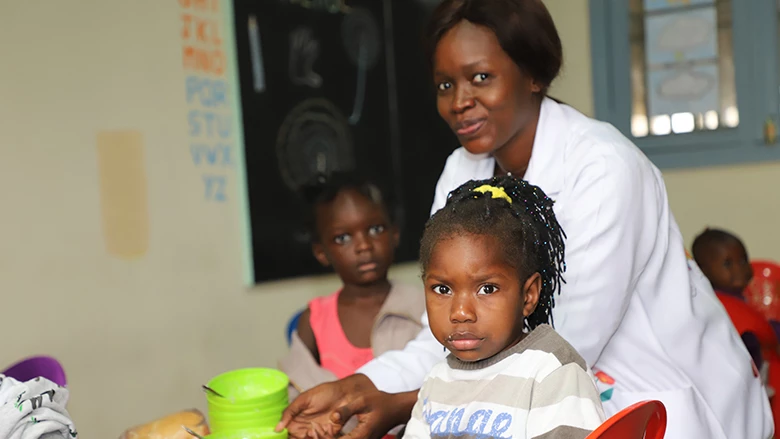
Snacktime at the Soukissa crèche - Credit: Franck Bitemo/ World Bank.
The Soukissa daycare center is demonstrating that childcare is a service with a triple bottom line: (1) it generates jobs and income for prospective entrepreneurs, (2) it builds children’s human capital and school readiness, and (3) it enables parents to work productively, knowing that their children are well cared for. This is testament to what is possible when the public and private sectors come together to foster innovation and unlock new markets.
To be clear, it has not been easy. A lot of time and energy was invested in finding and creating appropriate spaces to offer childcare, developing a rigorous training curriculum, establishing on-going support to mamapreneurs, and setting realistic quality standards.
We now look to take the lessons from this pilot to scale-up and unlock the potential of entrepreneurship in childcare nationwide in the Republic of Congo and beyond. By working together—government, civil society, and the private sector—we believe vibrant markets for care services can be created, changing lives and generating millions of meaningful jobs in the process.



Join the Conversation