
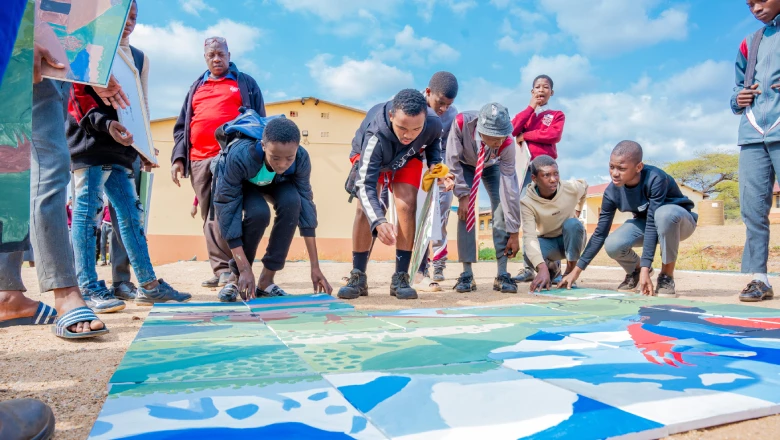
 Students at Ndabazezewe High School in Eswatini arrange their canvasses to create a large mosaic mural. Photo: Tribe Studios / World Bank.
In the village of Ngomane, Eswatini, behind the local primary school, sits a small wetland. A hand-painted green flag, planted at the center of it, dances in the breeze, announcing its presence and grandeur. A young girl in a green and white gingham school smock stands beside this wetland, reciting a poem: “I am a wetland, a treasure of grace. In the heart of Eswatini, my sacred space... .”
This performance, the flag, and other creative expressions—mosaic murals, conservation flags, and “seed bombs”—were all part of the Art Never Dries student workshops, a project funded by the World Bank Group and co-designed with the government of Eswatini and Eswatini-based teaching artist Khulekani Msweli. Together, we aimed to raise awareness and foster community connections around the experience of drought in Southern Africa.
Eswatini’s Proactive Approach to Drought Resilience
The Kingdom of Eswatini is no stranger to drought, and in fact, its government has been preparing for it over the past decade. In 2015-16, a historic drought caused widespread destruction, consuming 19% of annual government expenditure, a devastating 7% of the country’s GDP.
This drought was a wake-up call for many countries in the region. But in Eswatini, it sparked a transformative journey. The government, through the newly founded National Disaster Management Agency (NDMA), recognized the urgent need for a proactive approach and launched one of the most comprehensive programs of drought resilience investments on the continent. With the support of the World Bank Group, through the Eswatini Water Supply and Sanitation Access Project, NDMA implemented a wide range of measures that are fortifying the country against the potential risks of drought. The country has made significant strides. From strengthening water infrastructure to developing a drought early warning system that integrates indigenous knowledge and citizen science, Eswatini is building a future where communities are better prepared for climate shocks.
Art Never Dries: Building Drought Resilience with Community Art
To celebrate and amplify these efforts, we launched Art Never Dries, a pilot community art project that invited students to creatively explore drought resilience. During the five-day workshops, students at Ngomane Primary School and Ndabazezwe High School participated in programming focused on water conservation, traditional ecological knowledge, and the power of community action. Community elders joined the workshops to share indigenous knowledge on drought monitoring and resilience building, enriching the experience for everyone involved.
The final products are a sight to behold. At Ndabazezewe High School, a pair of group mosaic murals presented a stark contrast between two possibilities for Eswatini. In the first, livestock have passed away, the earth is dry cracked. It is a landscape plagued by droughts. In the other, students painted their hopes and dreams: a lush landscape with a bright red native bird in the foreground. The Swati people listen for the calls of this bird, the Inkanku, to signal the time for planting—because its song harkens the time when rain will come. Students also painted their feelings on jerry cans; vessels used throughout Southern Africa to carry water.
At Ngomane Primary, students created decorative maize stalks, conservation flags, seed bombs, and spoken-word poetry. The maize stalks and conservation flags raise awareness about important flora and fauna. The seed bombs, balls containing dried mud and seeds of local drought-resistant plants, are intended to be thrown into open areas where plants will thrive when rain is scarce. To bring it all together, a drama troupe at Ngomane Primary created a spoken word poem to celebrate the wetland marked by their hand-painted conservation flags:
I am a wetland, a treasure of grace.
In the heart of Eswatini, my sacred space.
A jewel so rare, with beauty quite grand.
Vital for life. My riches at hand.
I cradle the essence of biodiversity.
Supporting life stands in a delicate tapestry,
with critical habitats for creatures to thrive
in my gentle embrace countless species live.
I play a crucial role, a guardian of drought.
Enhancing resilience: that's what I'm about.
As water storage, I embrace the rain,
absorbing the access, easing nature's strain.
When the stones graze the heavens, I open my arms,
stirring its droplets with its charms.
In times of dry spells, I am ready to share,
recharging the ground with water and care.
So I implore, cherish, protect.
Conserve my existence, show me respect.
For I am a wetland, your treasure, your friend.
Together we’ll flourish, let this bond never end.
Bringing Art Never Dries to the Disaster Risk Management Forum
This initiative is part of a broader effort to support Eswatini as a regional leader in building drought resilience with other countries throughout Southern Africa. In September 2025, during the regional Disaster Risk Management Forum, the country launched the Eswatini Drought Centre of Excellence, a hub for innovation, collaboration, and knowledge-sharing.
Spearheaded by the NDMA and supported by partners including the University of Eswatini, the World Bank Group Water Department, Cooperation in International Waters in Africa, the Global Water Security and Sanitation Partnership, and the Global Environment Facility, the Centre will serve as a model for other countries in the region.
Art Never Dries played a central role in the Centre’s launch. We showcased the voices and visions of Eswatini’s youth through their creative works and a video documenting the process. These works offered a deeply human perspective to the technical and policy-driven work of drought resilience.
Moving forward, these artifacts will be displayed in the institutions supporting the Centre of Excellence and featured on our website in a virtual gallery, allowing people around the world to witness the resilience and creativity of Eswatini’s youth.
A Collective Journey Toward a Resilient Future
As the world continues to confront the realities of rising temperatures and volatile weather patterns, Eswatini’s story offers a powerful lesson: resilience is a collective journey. By engaging young people, honoring indigenous knowledge, and using art to bridge generations, we are building a future that is not only more prepared, but more connected.
Resilience is not just about infrastructure or policy. It’s about people, culture, and creativity.
We invite you to watch the video, explore the virtual gallery, and support community-based resilience efforts in your own region.
Together, we can paint a brighter, more drought-resilient future.




Join the Conversation