
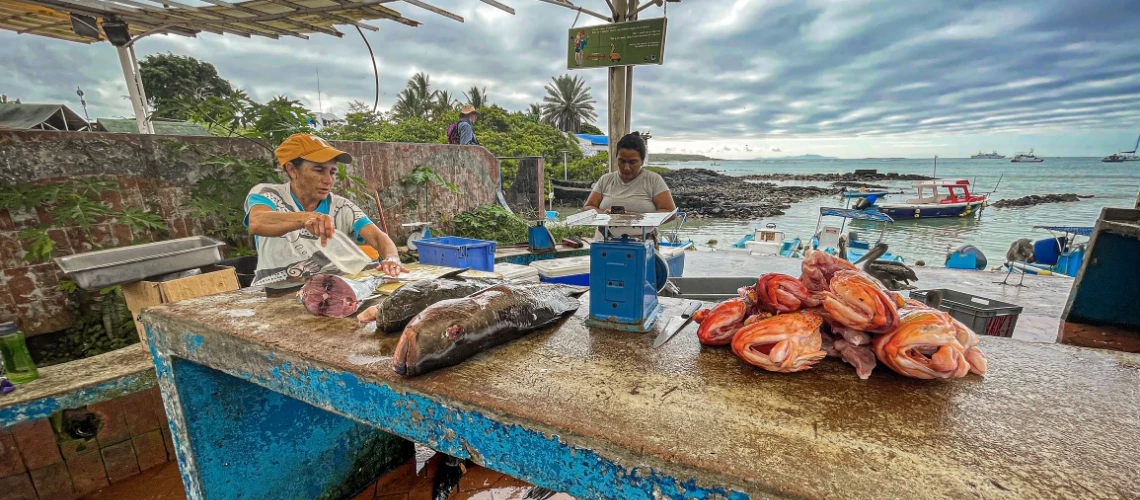
 Fishing port in Isla Santa Cruz, Galápagos, Ecuador. Photo archive: Fabricio Terán/World Bank.
When we think about the future of the oceans, we tend to look out to sea: the vessels, the nets, the catch, the waves. Yet an essential part of the ocean economy also takes place on land — on docks, in markets, in processing plants, in community associations, and in the households where the daily lives of coastal communities are sustained.
Sandra García, president of the Asociación de Mujeres Estero Porteño in El Oro province and a member of the Federation of Cooperatives and Associations of Artisanal Fishers of Ecuador (FENACOPEC), represents a reality that rarely receives the visibility it deserves: women do not merely participate in artisanal fishing — they organize, process, market, care for, and sustain a significant share of the coastal value chain.
Her leadership reflects a broader transformation within a historically male-dominated sector, where women are gaining ground in community organizing, productive innovation, and ocean sustainability. This is also one of the central themes of the forthcoming World Bank Group report, Advancing Gender Equality and Social Inclusion in Ecuador's Blue Economy, which examines how women participate across the country's blue economy value chains.
Yet the report's data reveals a paradox. In offshore small-scale fisheries, women account for just 17% of participants, compared to 83% who are men. In extractive activities linked to aquaculture and shellfish harvesting, male participation similarly exceeds 80%.
When the full value chain is examined, however, the picture shifts considerably. In Ecuador, women carry out approximately 80% of seafood processing and close to half of all marketing activities. They are the ones who clean, transform, and sell products, build family and community networks, and connect fisheries work to markets. Much of the value-added activity and small enterprise development within the blue economy depends on their labor and leadership. Though their presence at sea remains limited, women are at the center of the coastal economy.
They are also central to conservation. In Esmeraldas, women lead 8 of the 14 associations within REDAUMSLEA (the Economic Integration Network of Mangrove User Associations in the cantons of San Lorenzo and Eloy Alfaro).
Through these associations, they help steward 118,000 hectares of mangrove ecosystems — critical habitats for fisheries and aquaculture, natural barriers for coastal protection, and vital sources of biodiversity, food security, carbon sequestration, and economic sustenance. When women participate in mangrove governance, they are also protecting the natural asset base that underpins the entire value chain.
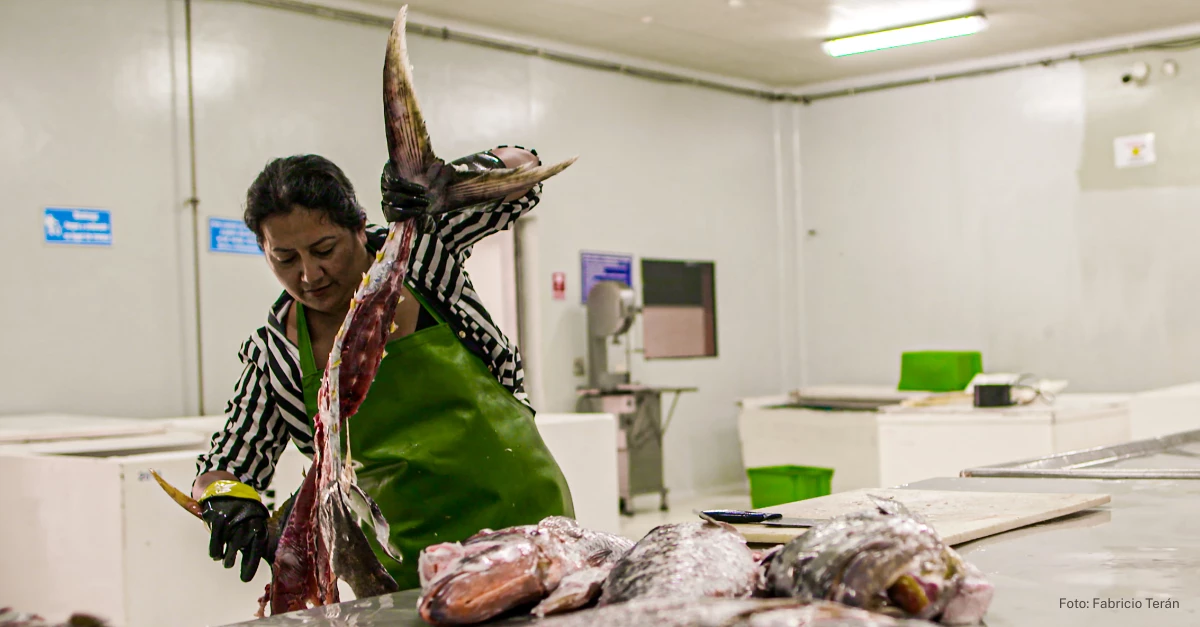 Women in Santa Cruz, Galapagos, transform fish waste into poultry feed. Photo: World Bank
Strengthening Leadership and Breaking Down Barriers
Yet this leadership coexists with deep structural barriers. In Ecuador, 69.8% of the economically inactive population are women, largely due to the disproportionate burden of unpaid care work. This unrecognized additional burden translates directly into less time for training, participating in associations, taking on leadership roles, traveling, negotiating, or accessing better economic opportunities.
Compounding this are security conditions that constrain women's mobility and labor. In coastal provinces such as El Oro and Esmeraldas, gender-based violence (GBV) rates exceed the national average, at 70.2% and 68.2%, respectively. These figures are not merely social indicators — they are economic barriers. They determine whether a woman can work at night, travel to a port, participate in a productive value chain, or take on a leadership role.
Discussing the future of the oceans, therefore, requires also addressing care, safety, and mobility: the foundational conditions for women's full participation in maritime productive sectors.
Encouragingly, concrete progress is already underway. At the San Mateo Pilot Plant in Manabí, the focus has been on building the capacity of the artisanal fishing sector to move beyond raw material extraction. With 52% of women actively participating in these training programs, the center has supported the development of 70 new products — 60 for human consumption and 10 for animal consumption. Women are building their own brands and professionalizing their onshore work, expanding beyond extraction into value-added enterprise.
This example illustrates something important: when women gain access to training, technology, and networks, they transform the economy. Women add value, diversify income streams, open new markets, and simultaneously sustain and conserve coastal resources. By reducing dependence on the daily catch, they strengthen their livelihoods and make artisanal fishing more resilient to market shifts and climate variability.
The blue economy is no longer solely about how much is extracted from the sea. Its future will depend increasingly on how value is generated, how ecosystems are stewarded, how communities are organized, and who has a voice in decision-making. Ecuador has valuable lessons to offer other countries in the region: pathways toward productive models that connect sustainability, social inclusion, and market access. Initiatives such as AgriConnect Ecuador reflect this vision by strengthening value chains for smallholder producers, including the women who are already processing, marketing, and adding value to ocean products.
As we mark World Ocean Day on June 8, we want to highlight the opportunities to build a blue economy that recognizes and values the real leadership already present on the ground. Women like Sandra — and many others in fishing communities, mangrove associations, processing plants, and local enterprises — are not waiting to be included in the future of the ocean. They are already helping to build it.
Join the Conversation